Showing posts with label Showa Shi. Show all posts

06 February 2017

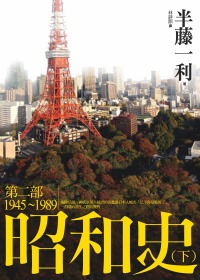
昭和史第二部(下)(半藤一利/林錚顗)

In this very last instalment of Showa Shi, the author focused on the 'after post-war' period of Japan. The forty years between 1950 and 1990 in Japan was characterised in different decades by different political climates, these are all narrated by the author from his personal perspective and experience.

1950s in Japan was constantly caught in political turmoil with different cabinets trying to achieve different ends. Add on to this, Japan, then under American occupation also had to have its political development swayed and sometimes imparted by the geopolitical developments, particularly the US's position in the Cold War vis-a-vis the USSR and China. As a result, the 'clean up' of militarism was incomplete and confusion in the interpretation of Article 9 in the new constitution became a permanent feature of Japan's politics. But once the people started getting tired of all the political upheavals and protests, they decided that they should "find a job" (示威结束,找份工作吧) (pg. 131). This is the author's very interesting way of describing how the Japanese decided that they should start to put emphasis on the economy, turning away from politics. The results are stupendous, at least until the bubble burst in 1990.

From this point, the author's description of the improvement in the standard of living among the Japanese takes an interesting turn. Instead of adopting an academic tone, he started to use many anecdotal examples to give readers an idea of the actual situation among ordinary Japanese. This included the amount of electrical equipment that a household owned (pg. 148), the popular movie (pg. 156), and my personal favourite, the popularity of Ultraman (pg. 185). As I have mentioned in an earlier review, this author did not claim to be an academic and so did not aspire to write a scholarly book. He was therefore not bound by the academic writing style to only cite other academic work. Besides using anecdotal examples, there were even occasions when he speculated outright (the section on the conversation between General MacArthur and the Emperor). The reader is cautioned about interpretation of events and facts.

Besides his obvious love and respect for Emperor Hirohito, the author was unbiased towards all other parties, be they right-wing or Communists, the US, Class A war criminals, or politicians from any party. He reserved his criticism only for the media industry, despite (or because) he himself having worked all his life as an journalist and editor. To him, the industry lacked spine and so was easily swayed, frequently changing their position, and always intimidated. This criticism is not uncommon, also described in another book, and depicted in a movie.

Of the four books in this series, I enjoyed the first one most. This is a personal preference because of my own area of interest. This fourth one is to me the least enjoyable, particularly in the middle when the author talked about the political in-fighting. It was not the writing, just personal interest (or lack of). But all things considered, this series is a very good one for those of us who want to understand the Showa period in Japan, that sixty fateful years.


(Find this book at Goodreads)

29 November 2015

昭和史第二部(上)(半藤一利/林錚顗)

This is the first volume of the second set of Showa Shi by Kazutoshi Handō. The first set dealt with Japan's decent into the Second World War, this set, particularly the first volume, deals with the few years after Japan's surrender and occupation by the USA. The major threads in this book are the life of the Japanese in the immediate aftermath, the drafting of Japan's new constitution, the Tokyo Tribunal, and the Korean War and its effects on Japan.

It is important to stress that the author was there when it happened, he was a thirteen year old boy who was too young to be enlisted when the war was going on, and so he was instead made to work in an ordnance factory. Being  old enough to experience the life after Japan's defeat, his story has the element of realism to it, not to mention that the author is also a persuasive one. Although what he said represented his own feelings, it gives the reader a sense of how others might have felt as well. The immediate end of the war brought tears (pg 12), which came from a mix of relief, regret, and just uncertainty. After years of war, some, especially the those in the army, would not accept that this was the end (pg 16). Civilians, on the other hand, had wanted it to be over for a long time. Yet when it came, the uncertainty that surrounds the cessation of the war threw many of them into despair.

But there were also those who were quick to switch their tone. Shortly before the war, the army was still encouraging everyone to sacrifice for the Emperor. Immediately after the surrender, the establishment was dissolved almost without incident (pg 19), it makes one wonder what was really in the mind of  Japanese Army brass and the common soldiers near the end. The biggest irony was how, in order to protect the women from the American occupying force, the police actually persuaded some to become prostitutes (pg 20). They expected the worst from the occupying force, that, can be taken as a reflection of themselves as an occupying force in other countries. But the general condition of the people was tough, and after many years of oppression, even the weather forecast on the radio was greeted with welcome, it was a small step towards normality (pg 22).

With that described, the author then moved on to a few important themes that were important to the aftermath of the war. The first of these is the meeting between General MacAurthur and the Emperor Hirohito.

From the Japanese perspective the Emperor certainly admitted his guilt to MacAurthur, and small actions, prevalent in a society as nuanced as Japan, can reflect this position. For example, Hirohito did not drink the coffee offered to him, that's a show of accepting his submissive position as a loser of the war (pg 41). Beyond this meeting, there were many occasions when the author tried to show that the Emperor was ready to face the consequences of surrender but many other Japanese were terrified of what the occupying force would do to him. They were almost obsessive about trying to ensure that he would not be tried by the allies. In fact, it appears that MacAurthur never intended to put the Emperor on trial, and the earlier worries were all unfounded.

The second theme was on the drafting of a new Japanese Constitution. In the first place, the Japanese were not even able to interpret the word as the Americans meant. To them, Constitution meant the make-up, or an organisation (pg 110), not as understood by the Americans. This confusion would extend to even the tone used in the recording of minutes (pg 170) and how seemingly unrelated events were interpreted by the Japanese. There were times when in the middle of discussions, B25s would fly overhead, the Japanese would take it to be a warning (pg 173) to relent to the Americans' position or be bombed again. And then there would be times when the Americans' would joke about using atomic energy to get some warmth and this, obviously insensitive even to me, was naturally taken to refer to the atomic bombs, a reminder again to the Japanese that the Americans held absolute power over them.

The exercise to redraft a new constitution was fraught with difficulties. Two groups of people were trying to draft the new constitution, one was appointed, one was self-appointed (pg 115). There were also people who thought that they should just do what the Americans wanted them to and then after the Americans leave, they could re-draft the whole constitution (pg 119). There were other difficulties, no one wanted to touch the issue of the position of the Emperor and so they procrastinated and delayed (pg 128). MacAurthur eventually lost patience and thought that the Americans should do the job (pg 160) but they did not tell the Japanese, leading to huge consternation among the Japanese.

While the constitution was being drafted, there was already a huge re-education exercise going on. The belief then was that Japanese education has indoctrinated everyone with militarism, leading them to fanatically fight a devastating war and so the whole curriculum must be revamped. Unfortunately with all wholesale obliteration exercises, the good are removed with the bad. There were actually good things about the original curriculum in moral education, but since the idea was to remove all the vestiges of the old, those that had thought good values were also removed (pg 135, 138).

This also extends to the position of the Emperor who hitherto had been like a God to the populace. After the Emperor abdicated from this position, people were wondering what to do, how to position their Emperor. Could they now just write to him and ask him to solve the problem of their hunger? Where would they write to, the palace? There are also social impacts. The democratisation of gender and age, giving all the same rights fundamentally changed the Japanese society. The older ones who would have been given more rights suddenly found themselves left with nothing much (pg 199). When it came to the removal of people linked to the war from their jobs, most of the head of organisations were removed. Although many were to later re-emerge as important people in the cabinet or in business, for a while most organisations were left with second-tier people and many, in order to escape persecution, turned other people in (pg 141).

One more humourous incident related by the author was on the textbooks used by the students. While all curriculum was to be revised, in the meantime the government was not able to pay for the printing of new textbooks, so the students had to continue using the old textbooks. But it is the policy that certain words relating to militarism must not appear. So these were painted over in black. But since there were so many of them in the textbooks, after the exercise, the whole textbook has become black (pg 62).

The part of the book that was most informative was on the Tokyo Tribunal. I have not read another book on this topic but have always assumed it to be a very serious affair and while the author did not try to trivialised it, one could not help noticing somehow that there were some rather dumbfounding moments. Most people would know that there were 28 accused in the tribunal, but few knew that  the Russians wanted to add another 2, and since there were only 28 chairs, two of the 28 in the original list were removed (pg 28).

The author gave his views of the purpose of the tribunal, first by stating his understanding of the its purpose. 1. To judge Japan's modern history, 2. As a ceremony for revenge, 3. As a part of re-education of the Japanese. The irony was the prosecution wanted to pronounce the defendants guilty, but the defendants themselves wanted to protect the emperor and were not averse to admitting guilt and so the motivations were aligned. Notwithstanding that, the author was particularly unhappy about the first charge - "As leaders, organisers, instigators, or accomplices in the formulation or execution of a common plan or conspiracy to wage wars of aggression, and war or wars in violation of international law". To him, unlike Germany, Japan's cabinet changed numerous times during the war, it was therefore difficult to accept that there was a conspiracy. This charge was fine for the Nuremburg Trial, but it was used forcefully in the Tokyo Tribunal because it was a precedence and a convenient one to sentence the accused to death. Since the Japanese did not agree to this charge, they honour the 8 convicted defendants in the Yakusuni Shrine (靖国神社).

Two other interesting points were raised by the author. Firstly, he speculated about what would happen if the cases were judged by the Japanese. Given the general aversion to war and the military then, more could have been sentenced to death. Secondly, and more tragically, the north-south divide in Korea and Vietnam all came about because of the need to let the Japanese surrender to the allies. In both cases, it was decided that the Japanese on the north of a certain latitude would surrender to the Russians, and those on the south would surrender to either the Americans or the British. None would be able to foresee the tragic consequences.

How did the Japanese view their guilt? The concept of 一億总忏悔, one hundred million people feeling guilty together, lulled the rest of the world into thinking that the Japanese really took a serious view of their war guilt. But since 'one hundred million' shared the collective guilt, everyone felt less guilty (pg 27). In addition, while the re-education of the Japanese made many wonder - did we really do this? (pg 93), it also gave them a chance to think, like the Germans, that they themselves were not so bad, It was the army that was bad (pg 94).  And really, to wonder about one's war guilt when he is hungry to the point of starvation is just unthinkable, most are more interested in filling their stomachs (pg 96).

This is an educational book written by an author who is not afraid to call to task his own people for perpetrating much suffering to victims of their atrocities. Yet where he felt that history has misunderstood the Japanese people, he would not hold back from correcting these views. His most valuable contribution comes from explaining the views of the Japanese people, their feelings, and bring to light their subtlety in everyday interactions and how this shaped how Japan became in the aftermath of the war.

(Find this book at Goodreads)

23 February 2014

昭和史第一部(下)(半藤一利/林錚顗)

In this second volume, the author concentrated on the early part of 1940 and all the way to 1945 when Japan surrendered after the dropping of the atomic bombs. The style of the author has been discussed in my earlier entry reviewing the first first volume of the work and has remained largely similar. In this volume, whether he meant to do it or not, the central theme is the behaviours of the policy makers and the military personnel in Japan in those years.

Starting from the late 1930s Japan has rearmed, having withdrawn from the League of Nations. They were then caught in something of a quagmire in China and while events in Europe have been increasingly dangerous, the Sino-Japanese War have been left largely as a side-event in the minds of the West. However, one can't help feeling that events in Asia have taken a life of its own. Japan increasingly felt isolated and was under pressure from the US whom exported most of the oil that Japan needed. Japan wanted to avoid conflict with the US and at the same time wanted to find a way to end the war in China for it was already beginning to take its toil domestically. Finding no support from the US, the UK and their other allies, Japan gravitated towards the Axis and finally entered into the Tripartite Pact with Germany and Italy. Japan's reason for entering the Pact (suggested by Germany) was not clear nor compelling, indeed there were those in Japan that had not supported Japan's entry into the Pact. But it appeared that those who supported it all did it for their own selfish reasons. Take this entry from Kazushige Ugaki's diary (pg 25) whom the author accused of supporting the Tripartite Pact in order to get more resources for the army. But whatever their personal motivations, one does not get the impression that something this important was seriously considered before the final decision was made.

Another example was how they were ready to enter into an alliance with the Soviet Union. One can argue that Japan's involvement in Manchuria was partly due to the need to check the Soviet Union. This got them into a stalemate in China which soured their relationships with much of the rest of the world, and yet later in having to continue the war in China they wanted an alliance with the Soviet Union (after Nomomhan to boot). It is a little hard to square the logic in all these.

Worse was their decision to bomb Pearl Harbor. There was almost a consensus that Japan could not have a prolonged war with the US, including the Admiral Yamamoto who planned the operation. Yet it was almost as if everyone allow one event to lead to another and just went along with it without voicing objections until it was a done deal. The worst of this behaviour would come when Japan wanted to end the war. The way they went about talking about how to go about it and never quite getting down to it was tragically comical. But the author did us a favour by discussing one relatively small event, quoting from two commanders' diaries he showed us why a coming to a decision was hard, even between (or especially between) Japanese.

Referring to the Battle of Kohima when Japan suffered a huge defeat, it appeared that the two commanders Renya Mutaguchi and Masakazu Kawabe knew they stood no chance to winning and their forces were about to be annihilated. Yet both of them would not order a retreat. Post war, this was what they wrote in their respective diaries:
  • Renya Mutaguchi: Although I wanted to say that it's already time to quit the fight in Imphal, when these words reached my mouth, I just couldn't get them out. I could only hope that someone would be able to tell from my expression.
  • Masakazu Kawabe: I got the impression from Mutaguchi's expression that there was something he wanted to say but just could not bring himself to. I didn't probe, and the meeting ended that way.
Personally I found this to be what was so valuable about the book. It is hard sometimes for us to understand how a nation tactically so superior to many of its adversaries could be so strategically blundering. However when it comes from a Japanese, who incidentally was a young lad during the war and could even remember his job in one of the torpedo factories, one gained this special insight and know, especially for an Asian, that it could very well be us.

(Find this book at Goodreads)

25 November 2013

昭和史第一部(上)(半藤一利/林錚顗)

Showa Shi (昭和史), roughly translated to The History of the Showa Period was written by Kazutoshi Handō (半藤一利). This work comes in two parts in a total of four volumes, covering the period between 1926 and 1989. This review is only on the first volume in the first part, spanning 1926 to Japan’s attack on Pearl Harbor in 1941. The edition I read was Chinese translation by 林錚顗, a history graduate from the Department of History in the National Taiwan University and the Tokyo University.

The trouble with reading a translated book, besides having things lost (or gained) in translation, is that it is unclear how authentic the book is in its translated form. When one finds an impressively written sentence or phrase, he cannot tell if this was written by the original writer or was just well translated because the language that it has been translated into happened to have more appropriate words or idioms that can be used conveniently. In this review I shall assume that everything was translated as the original author intended.

This volume focusing on the period between 1926 and 1941 tries to address this question – what led to Japan’s involvement in the Second World War? The author started his narrative with the incident in 1928 where the Japanese Kwantung Army murdered Zhang Zuolin (張作霖) by placing a bomb on the train track on which Zhang’s carriage was travelling. Starting his narrative with this event is not just chronologically sensible, it is also the harbinger of a central theme in the book: the Japanese military is rouge and the civilian government is not able to control it. This, together with other factors, eventually led Japan into the tragedy of the Second World War ending in its defeat and destruction.

The circumstances that landed Japan in its final state in 1945 can be understood through the interplay between the external environment and the emerging political philosophies that was eventually embraced by the country. The author carefully described the external environment and situations of that time, the most important of which included the Russo-Japanese War, the Great Depression, and Japan’s desire to be elevated to the status of a major international power. Against this backdrop, the author developed his arguments amid the complexities and intrigues that existed among the various power players, the army, the navy, the civilian parliament, and the advisors to the Emperor. Not only were the relationships among these players complex, within each there were also different factions subscribing to different philosophies, doctrines, and perspectives. Slowly however one of the factions within the army gained the upper hand sometimes through assassinations, other times through coercion. Eventually no one appeared to be able to control the army's field commanders, a situation epitomised by the graphic description of the Marco Polo Incident (pg 188). In the end a certain momentum was gathered and things gained a life of their own.

The style of the author is not one that I’m familiar with. Not having read enough, I don’t know if this is generally how Japanese historical accounts are written or it is just this author. But the prose is a mix of academic, personal, and poetic. For example, his account and analysis of the Nanjing incident is fair and well considered, admitting to the occurrence of the atrocities committed by Japanese soldiers, even apologising over it, but arguing with facts why the number 300,000 estimated at the International Military Tribunal for the Far East is a gross over-estimation (I do not intend to get into an argument over the accuracy of these numbers here.) Yet he would pepper his book with “Isn’t it so?” as if speaking directly to the readers. In addition, he could get into trivialities like why a certain politician has a particular nickname (pg 77). At other times he would include conversations between the actors as if he was quoting them verbatim. And then there would be flashes of brilliance, the most impressive of which is the way he described the end of the Young Officers’ Revolt (226 Incident).
可是,计划就在大高少尉与中侨中尉拔枪相向、四目相对之时结束了。。。(pg 164 - 二二六事件)
But the plan ended the moment Second Lieutenant Otaka and Infantry Lieutenant Nakahashi pointed their guns at each other, staring into each other’s eyes…
There is one issue that I have so far avoided, the author’s attitude towards the role of Emperor Hirohito. In this there is no doubt, the author went out of his way to absolve the Emperor of any responsibilities. The Emperor is either not informed of what had happened, misled by the military, or had his hands tied. This was clear from the start of the book when the author explained how the early events determined the limits of the Emperor’s power. The author made extensive reference to the Emperor's own biographical account 《昭和天王独白录》to gain insights into the Emperor’s thoughts. I wonder why I cannot find a translation of such an important record whether in Chinese or English.

If nothing, this book is important for its contribution to our understanding of what went on on the Japanese side throughout the years leading to the Second World War. It is more than just a chronicle of events which is available in many English accounts; it provided many details about how individuals thought, the dynamics between different individuals and groups, and the general psyche of the populace caught in those turbulent times. The author even had access to some of the important players for example Renya Mutaguchi, an important commander in the Marco Polo Bridge Incident (pg 189). Not having read enough on this subject, I cannot recommend an alternative to this book, but I feel that most of us will benefit from this book if we are not trying to do scholarly research in this area.

(Find this book at Goodreads)