This book carries great promise, if not responsibilities. Alas, it did not deliver on either. It was not that the author did a bad job, it was a project that failed because the object of the book, Young Marshal Zhang Xueliang (张学良) did not understand the nature of oral history and was therefore uncooperative. In the end, the author published the verbatim interview scripts, responsibly allowing future scholars access to the raw data for their own analysis and hopefully be able to come to an informed conclusion about Zhang, his life and times.
Zhang was an important person. His life was a colourful one, not only was he intimately involved in the many important events in the modern history of China (for example the Manchurian Incident), he was the co-mastermind of the Xi'an Incident (the other was Yang Hucheng 杨虎城). Much controversy still surrounds the event, with China (mainland) and Taiwan having different narratives about the incident and interpretations of the man's motivation and therefore his attitudes.What better way then to hear from the man himself?
It was with this expectation that I started the book. But what I read in the preface dampened my enthusiasm considerably. This book that was supposed to answer questions would not. If you watch the video of the interview, you would understand why. Zhang, in his old age, was no unlike many others; he has the tendency to boast about his achievements and his extra-marital affairs, he suffers from lapses in memory, and at times kept repeating the same thing over and over again. What I find most amusing are the occasions when he would say "I can't tell you who this person is", and almost as sure as the sun will rise, he would follow his next sentence with the name of the person whom he could not tell.
Yet despite its failure to live up to its expectations, the book is not without value. He did help to clarify a few things if only through one's own analysis. For example, when he told the author that there were people who asked him why he bothered to come to Wang's help after a failed attempt at Wang's life (pg. 236), the reader could immediately tell that many preferred Wang dead. He was also the best person to give insights into the workings of the Northeastern Army (奉军) and also some of the personalities (pg. 362). But personally, I think the most valuable part of the book is the epilogue provided by the author. This is a good piece of analytical work that is persuasively argued and engagingly written. This book would have been worth the read just for that part.
Like the author, my impression of the Young Marshal was deeply discounted after reading the book and watching the video mentioned above. He had a colourful life that is only available to people who were born in his times. He was involved in some of the most defining events of modern Chinese history. Yet as an old man, he was like many others, and his failure to maintain respectability during these interviews washes off the mystic that has accompanied him throughout his life, even and especially in detention. Perhaps like what the author said, if not for the Xi'an Incident, Zhang Xueliang is nothing.
PS. The book came with a few pictures of Zhang and also his calligraphy. I wonder why he wrote his own name in simplified Chinese. I cannot explain that.
Showing posts with label Japan. Show all posts
10 September 2017
24 August 2017
The Forgotten Highlander (Alistair Urquhart)
This is the first time I read a first-hand account of a POW involved in the Malayan Campaign. I am greatly affected by it, despite being brought up on a diet of Japanese atrocities in Asia in World War 2. Much is said about the killing, maiming, raping and torture, but a reader is usually left to imagine the magnitude of these atrocities through the statistics; this book describes in graphic details the actual behaviours of the Japanese and their equally brutal Korean subjects and the horrible conditions the POWs were subjected to.
The author escaped the fighting in Malaya and Singapore as he was assigned to administrative work in the Battle Box in Fort Canning but was taken prisoner after the surrender and hence went on to suffer more than three years in various ordeals including building the notorious Death Railway in Thailand and Burma, being torpedoed in 'hellships' and then almost being close enough when the atomic bomb was dropped on Nagasaki. He survived to tell the story and the story was all the more stirring precisely because it was not told with heroics in mind. He told an honest story of how he survived and how he tried to go on, he also told a story of how he eventually became almost immune to the death and suffering that was happening around him. But while this book can be read as a superficial description of one man's experience, there are hints of bigger issues that worth exploring. One of these is the author's attitudes towards the Japanese.
It is no surprise that the author loathed his enemies, especially the camp guards who tortured them no end, yet there was one interesting episode that he mentioned briefly near the end of the book that could have given the readers much to think about - he and Dr Mathieson attended to a sick Japanese girl towards whom he felt no animosity. How does a POW, having gone through such systematic inhumane treatment, feel towards another of 'the other'? This complex attitude of the POWs, even if just that of the author, would have added much to the richness of the book.
Another one is the Koreans who were conscripted to serve in South-East Asia. The Koreans today generally still harbour great dislike of the Japanese owing to the bad legacy Japan left as their colonial master. Yet, in the treatment of the POWs and the populace of South-East Asia, Koreans are known to be no less harsh than the Japanese. In fact, the author even alluded to the Japanese being more measured when it came to beating the POWs (pg. 219). The Koreans today paint themselves as the victims of the Japanese imperialism and in the current K-pop wave, most Asians other than the Japanese, are eager to agree. But were they? This is one subject that is worth exploring (together with the attitudes of the Taiwanese who were also conscripted and served in South-East Asia).
The final one is the parallel that I could not help drawing between the author's experience in signing the agreement with the Japanese in the Selarang Incident and with the British government when he returned to Britain. He described himself signing a name that would not identify him, only in this case if he were to be like his comrades who signed 'Mickey Mouse' in Selarang, he would surely blow his own cover. That bitterness in how he was treated upon his return would stay with him. This is not the first time I came across this theme, it was how General Percival was treated upon his release.
This book resonates a lot with me, mainly because it describes the experience of a soldier who was in Singapore in the days before I was born. His description of the sights and sounds of Singapore then gives me much to imagine. The bumpy road he rode along from 'Singapore' (known as 'town' today) to Changi has long since been replaced by an expressway (our term for 'highway') but it was still there when I was young, so is Selarang camp, which I drive past on occasions just to see the white buildings since its so near home. Now I know it was once home to the Gordon Highlanders as well.
(Find this book at Goodreads)
The author escaped the fighting in Malaya and Singapore as he was assigned to administrative work in the Battle Box in Fort Canning but was taken prisoner after the surrender and hence went on to suffer more than three years in various ordeals including building the notorious Death Railway in Thailand and Burma, being torpedoed in 'hellships' and then almost being close enough when the atomic bomb was dropped on Nagasaki. He survived to tell the story and the story was all the more stirring precisely because it was not told with heroics in mind. He told an honest story of how he survived and how he tried to go on, he also told a story of how he eventually became almost immune to the death and suffering that was happening around him. But while this book can be read as a superficial description of one man's experience, there are hints of bigger issues that worth exploring. One of these is the author's attitudes towards the Japanese.
It is no surprise that the author loathed his enemies, especially the camp guards who tortured them no end, yet there was one interesting episode that he mentioned briefly near the end of the book that could have given the readers much to think about - he and Dr Mathieson attended to a sick Japanese girl towards whom he felt no animosity. How does a POW, having gone through such systematic inhumane treatment, feel towards another of 'the other'? This complex attitude of the POWs, even if just that of the author, would have added much to the richness of the book.
Another one is the Koreans who were conscripted to serve in South-East Asia. The Koreans today generally still harbour great dislike of the Japanese owing to the bad legacy Japan left as their colonial master. Yet, in the treatment of the POWs and the populace of South-East Asia, Koreans are known to be no less harsh than the Japanese. In fact, the author even alluded to the Japanese being more measured when it came to beating the POWs (pg. 219). The Koreans today paint themselves as the victims of the Japanese imperialism and in the current K-pop wave, most Asians other than the Japanese, are eager to agree. But were they? This is one subject that is worth exploring (together with the attitudes of the Taiwanese who were also conscripted and served in South-East Asia).
The final one is the parallel that I could not help drawing between the author's experience in signing the agreement with the Japanese in the Selarang Incident and with the British government when he returned to Britain. He described himself signing a name that would not identify him, only in this case if he were to be like his comrades who signed 'Mickey Mouse' in Selarang, he would surely blow his own cover. That bitterness in how he was treated upon his return would stay with him. This is not the first time I came across this theme, it was how General Percival was treated upon his release.
This book resonates a lot with me, mainly because it describes the experience of a soldier who was in Singapore in the days before I was born. His description of the sights and sounds of Singapore then gives me much to imagine. The bumpy road he rode along from 'Singapore' (known as 'town' today) to Changi has long since been replaced by an expressway (our term for 'highway') but it was still there when I was young, so is Selarang camp, which I drive past on occasions just to see the white buildings since its so near home. Now I know it was once home to the Gordon Highlanders as well.
(Find this book at Goodreads)
20 August 2017
Singapore And After: a study of the Pacific Campaign (Joseph Montague Kenworthy and Lord Strabolgi)
This book was published in 1942, immediately after South-East Asia fell to the Japanese and when India and Australia were threatened. What it means is that much was still not known when it was written. Not only was the final outcome of the Second World War a few years away, most of the documents related to the Campaign were still not released. The reader therefore cannot expect a book that is filled with facts substantiated with data nor one that critically analyses the Campaign. The author did not claim this book to be one, and from the length as well as the tone of the book, I get the impression that this book was written to inform the people in the United Kingdom of what had just happened to the colonies in the Far East, not just Malaya and Singapore, for the book includes a survey of Burma, the Philippines and the Dutch Indies.
This book was written in a hurry because on my copy, inside the front cover, an earlier owner had dedicated the book to her son/daughter with the date 2nd April 1942 written on it. The rush to get the book published resulted in inaccuracies in many places. Some of these are error of facts, for example the number of artillery batteries in Singapore (definitely more than two) (pg. 88) and Chiang Tso-lin dying in 1918 (it was in 1928). There are others relating to names of places; many of these I reserve my judgement because they could be spelt differently from how they are now due to the Romanization of the names for example Tjilatjap instead of Chilachap as spelt today. But there is one I find unacceptable - Tengate (Tengah) Aerodrome in Singapore (pg. 93). It took me a while to conclude that he was referring to Tengah.
Other faults include the rather random pictures that appear in random places throughout the book, for instance, why would a picture of Georgetown, Penang appear in the chapter on the Philippines and a Japanese submarine in the middle of the Appendix? Even more perplexing is Appendix I - A short chronology of Chinese History. Yet there is something that I must commend about the editing - mis-spelt names of places may be a result of ignorance of the Far East (it was 1942 after all), but beyond these, I did not come across any other editorial mistakes such as a spelling error. Why do I think this is amazing? Some of the printing is of such quality that reminds me of a facsimile typed on an old typewriter that did not have a clean set of strike bars. That reminded me that those were the days without spell-checkers. In 1942 under such dire conditions, someone (not the author, I think) has done a really good job.
The author's position was quite consistent in this book: no matter which theatre he was referring to, he would lament the lack of conscription in the years before the war to prepare the locals to fight the enemies. He did not blame the lack of foresight, he felt it was a misguided policy that deliberately excluded the locals. Another area where he was consistent was in his scathing attack of the British politicians' handling of the war and conversely his praise of both the Dutch and the Americans.
If the book suffers from the faults mentioned above, there are a few things that make me think well of the author. First of all, some of his reading of the Japanese's intentions were quite accurate. His conclusion that the Japanese did not intervene in Russia despite Operation Barbarossa was due to their experience in Nomonhan (which he got the year wrong, it was 1939, not 1938) bore out in a well-argued book on the subject written decades later. Secondly, I like his sense of optimism and courage that never falter throughout the book. Remember, this author was not talking with hindsight, he wrote the book immediately after the Far East fell like dominoes, yet he totally believed that Japan would lose. He wrongly predicted that the loss would result from a combination of the pincer on the Japanese coming from Australia in the south and China in the north but he never wavered in his belief that Japan would lose. He was a courageous man, I have never come across another soul who would take Churchill's famous exhortation of his countrymen to fight the enemies 'in the streets, on the beaches and in the hills' to be a reflection of defeatism. He asked instead why they should not fight in the enemy's streets, beaches and hills.
I am going to keep this book. Not because it is a resource that I think I would return to but for the historic value of the copy I own and as a source of optimism and courage whenever I need them. We don't just read for knowledge do we?
(Find this book at Goodreads.)
This book was written in a hurry because on my copy, inside the front cover, an earlier owner had dedicated the book to her son/daughter with the date 2nd April 1942 written on it. The rush to get the book published resulted in inaccuracies in many places. Some of these are error of facts, for example the number of artillery batteries in Singapore (definitely more than two) (pg. 88) and Chiang Tso-lin dying in 1918 (it was in 1928). There are others relating to names of places; many of these I reserve my judgement because they could be spelt differently from how they are now due to the Romanization of the names for example Tjilatjap instead of Chilachap as spelt today. But there is one I find unacceptable - Tengate (Tengah) Aerodrome in Singapore (pg. 93). It took me a while to conclude that he was referring to Tengah.
Other faults include the rather random pictures that appear in random places throughout the book, for instance, why would a picture of Georgetown, Penang appear in the chapter on the Philippines and a Japanese submarine in the middle of the Appendix? Even more perplexing is Appendix I - A short chronology of Chinese History. Yet there is something that I must commend about the editing - mis-spelt names of places may be a result of ignorance of the Far East (it was 1942 after all), but beyond these, I did not come across any other editorial mistakes such as a spelling error. Why do I think this is amazing? Some of the printing is of such quality that reminds me of a facsimile typed on an old typewriter that did not have a clean set of strike bars. That reminded me that those were the days without spell-checkers. In 1942 under such dire conditions, someone (not the author, I think) has done a really good job.
The author's position was quite consistent in this book: no matter which theatre he was referring to, he would lament the lack of conscription in the years before the war to prepare the locals to fight the enemies. He did not blame the lack of foresight, he felt it was a misguided policy that deliberately excluded the locals. Another area where he was consistent was in his scathing attack of the British politicians' handling of the war and conversely his praise of both the Dutch and the Americans.
If the book suffers from the faults mentioned above, there are a few things that make me think well of the author. First of all, some of his reading of the Japanese's intentions were quite accurate. His conclusion that the Japanese did not intervene in Russia despite Operation Barbarossa was due to their experience in Nomonhan (which he got the year wrong, it was 1939, not 1938) bore out in a well-argued book on the subject written decades later. Secondly, I like his sense of optimism and courage that never falter throughout the book. Remember, this author was not talking with hindsight, he wrote the book immediately after the Far East fell like dominoes, yet he totally believed that Japan would lose. He wrongly predicted that the loss would result from a combination of the pincer on the Japanese coming from Australia in the south and China in the north but he never wavered in his belief that Japan would lose. He was a courageous man, I have never come across another soul who would take Churchill's famous exhortation of his countrymen to fight the enemies 'in the streets, on the beaches and in the hills' to be a reflection of defeatism. He asked instead why they should not fight in the enemy's streets, beaches and hills.
I am going to keep this book. Not because it is a resource that I think I would return to but for the historic value of the copy I own and as a source of optimism and courage whenever I need them. We don't just read for knowledge do we?
(Find this book at Goodreads.)
Labels:
Japan,
Malaya,
Singapore,
World War 2
09 August 2017
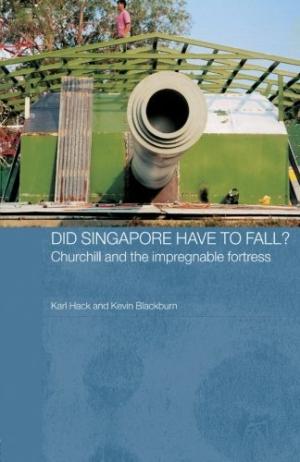
Did Singapore Have to Fall?: Churchill and the Impregnable Fortress (Karl Hack and Kevin Blackburn)
How does one answer the question - Did Singapore have to fall? Was the final outcome a result of a breakdown in discipline in the Commonwealth troops in the final days of the campaign? Was it because of poorer generalship? Was it because geopolitical events overtook the original considerations despite there being political will? Or was materiel committed yet wrongly deployed? Or perhaps Singapore was doomed from the start, going back to when it was wrongly conceived as a naval base and then wrongly perceived as an impregnable fortress? This book written by a pair of academics then teaching in the Nanyang Technological University in Singapore looks at the outcome from these angles and came up with a highly readable and persuasively argued book that took recently-available documents and literature into consideration.
The book spends a chapter looking at each of the questions asked above but in the reversed order. That the world was hit hard by the Great Depression in the 1920s was well-known. That delayed the construction and eventually down-sized the Singapore naval base. It also paved the way for the Washington Naval Treaty of 1922. Some have argued that Britain's financial situation and ratification of the treaty prevented her from building a large enough navy to counter the Japanese when it mattered and so one can say that Malaya was doomed from that moment. The authors studied this in depth and concluded that this might not be so. In addition they also addressed other issues such as the diversion of a few hundred fighter planes from the thousands going to Russia to Malaya and the commitment of tanks to the defence of Malaya and Singapore. In each case, they concluded that not only was it hard for Whitehall to justify their moving materiel to Malaya, particularly when the Russians were fighting and losing in Europe, the earlier neglect of Malaya would make these too little too late.
Much was also made of Operation Matador, the plan to move troops into Songkhla and Pattani in Thailand to counter a Japanese landing. Whether it would have made a difference, we would not know but Map 4.1 on page 59 of the book shows the options that the Japanese had which would have rendered Matador ineffective even if it had been put into action. If all these were not able to make a crucial difference, it would be down to the defence preparations, the handling of the campaign and the quality of the troops to win the battle.
Even when I was in school, we were told that the guns that were deployed along the southern coast of Singapore were 'pointing the wrong way', implying first of all that the British were not expecting the Japanese to invade from the north, and that the guns were not able to traverse. This, through meticulous research, the authors were able to debunk (right down to the number of degrees the guns were able to traverse and which ones actually fired at the enemy). I wonder how this 'pointing the wrong way' myth can still stand after this book. Unfortunately these guns were actually built for the purpose of coastal defence and were given the wrong type of rounds (armour piercing rather than high explosives). Their contributions were therefore limited.
If the static defences were ineffective, it would be down to the troops to win the war. Alas, it is known that many of the troops were not properly trained nor equipped. Yet there exist plenty of examples of those who performed admirably well. Still that was not enough to make the fortress, if Singapore ever was one, impregnable. However, as a Singaporean reader, my sympathy is with the soldiers who fought, suffered and even died, whatever the objective judgement of them. Even if there exist plenty of evidence of untrained, indiscipline and incompetent soldiers, they died trying to defend this island. Those who did not would suffer years in the POW camps or worse, building the Death Railway.
I live very near Changi, no more than 3 miles away from the Johor Battery and the Changi and Selarang POW camps featured prominently in this book. Most of all, my son is now doing his national service in Changi Airbase, right where much happened. The Singapore Armed Forces has helped to preserve much of 'old' Singapore and I can still ask him about the places in his camp that were referred to in the book. This makes the experience of reading this book a lot more real. Plenty of Australians still visit the Changi Museum and the surroundings when they are in Singapore, I believe many of them have relatives who served in Singapore during the campaign. I cannot bring myself to criticise the men whatever other sources claim, I do not claim to be objective.
This book is well worth reading, particularly for those who are interested in understanding the campaign and the issues related to it more broadly. It is well-researched, logically argued, and clearly presented. This book does not focus on the tactical aspects of the campaign, for that, readers can refer to Colin Smith's Singapore Burning or Masanobu Tsuji's Japan's Greatest Victory/Britain's Greatest Defeat, books that are no less enjoyable.
(Find this book at Goodreads.)
The book spends a chapter looking at each of the questions asked above but in the reversed order. That the world was hit hard by the Great Depression in the 1920s was well-known. That delayed the construction and eventually down-sized the Singapore naval base. It also paved the way for the Washington Naval Treaty of 1922. Some have argued that Britain's financial situation and ratification of the treaty prevented her from building a large enough navy to counter the Japanese when it mattered and so one can say that Malaya was doomed from that moment. The authors studied this in depth and concluded that this might not be so. In addition they also addressed other issues such as the diversion of a few hundred fighter planes from the thousands going to Russia to Malaya and the commitment of tanks to the defence of Malaya and Singapore. In each case, they concluded that not only was it hard for Whitehall to justify their moving materiel to Malaya, particularly when the Russians were fighting and losing in Europe, the earlier neglect of Malaya would make these too little too late.
Much was also made of Operation Matador, the plan to move troops into Songkhla and Pattani in Thailand to counter a Japanese landing. Whether it would have made a difference, we would not know but Map 4.1 on page 59 of the book shows the options that the Japanese had which would have rendered Matador ineffective even if it had been put into action. If all these were not able to make a crucial difference, it would be down to the defence preparations, the handling of the campaign and the quality of the troops to win the battle.
Even when I was in school, we were told that the guns that were deployed along the southern coast of Singapore were 'pointing the wrong way', implying first of all that the British were not expecting the Japanese to invade from the north, and that the guns were not able to traverse. This, through meticulous research, the authors were able to debunk (right down to the number of degrees the guns were able to traverse and which ones actually fired at the enemy). I wonder how this 'pointing the wrong way' myth can still stand after this book. Unfortunately these guns were actually built for the purpose of coastal defence and were given the wrong type of rounds (armour piercing rather than high explosives). Their contributions were therefore limited.
If the static defences were ineffective, it would be down to the troops to win the war. Alas, it is known that many of the troops were not properly trained nor equipped. Yet there exist plenty of examples of those who performed admirably well. Still that was not enough to make the fortress, if Singapore ever was one, impregnable. However, as a Singaporean reader, my sympathy is with the soldiers who fought, suffered and even died, whatever the objective judgement of them. Even if there exist plenty of evidence of untrained, indiscipline and incompetent soldiers, they died trying to defend this island. Those who did not would suffer years in the POW camps or worse, building the Death Railway.
I live very near Changi, no more than 3 miles away from the Johor Battery and the Changi and Selarang POW camps featured prominently in this book. Most of all, my son is now doing his national service in Changi Airbase, right where much happened. The Singapore Armed Forces has helped to preserve much of 'old' Singapore and I can still ask him about the places in his camp that were referred to in the book. This makes the experience of reading this book a lot more real. Plenty of Australians still visit the Changi Museum and the surroundings when they are in Singapore, I believe many of them have relatives who served in Singapore during the campaign. I cannot bring myself to criticise the men whatever other sources claim, I do not claim to be objective.
This book is well worth reading, particularly for those who are interested in understanding the campaign and the issues related to it more broadly. It is well-researched, logically argued, and clearly presented. This book does not focus on the tactical aspects of the campaign, for that, readers can refer to Colin Smith's Singapore Burning or Masanobu Tsuji's Japan's Greatest Victory/Britain's Greatest Defeat, books that are no less enjoyable.
(Find this book at Goodreads.)
Labels:
Japan,
Malaya,
Singapore,
World War 2
14 May 2017
The Garden of Evening Mists (Tan Twan Eng)
This is an award winning book which was shortlisted for the Man Booker Prize in 2013. Written by Malaysian author Tan Twan Eng, the story is set in the Cameroon Highlands in Malaysia and is about the main protagonist, Teoh Yun Ling's effort to discover the truth behind the people she met and her own experience as a prisoner in a Japanese camp during the Second World War.
Many good reviews are available on Goodreads and I encourage you to read those. I intend to write my own reflection after reading the book, not a review.
The last time I went to the Cameroon Highlands must have been 40 years ago, I haven't been back since. But reading this book certainly brings back a lot of memories and for once, I was able to visualise the place described by the author, fictitious maybe, but real enough for me. I must confess that I am not an avid reader of local Singaporean literature and this is the first time I venture into Malaysian literature. The experience of trying to imagine the place as described is an interesting one, familiar, yet not being able to call my own. It is not only the places, the language also has that same effect on me. The author made liberal use of Bahasa Malaysia, a language which I cannot claim to be fluent at but still knowing enough to make out what was being said. Others, like Cold Storage is also comfortingly familiar though could pose a problem to readers unfamiliar with the supermarket chain that has been around for more than a hundred years.
I came to know of this book after sitting through two back-to-back paper presentations in a conference that focused on this book. I read it because one of them referred to this book as 'fiction augmenting history', in particular WW2 history. A huge part of the book focuses on the time a few years after the war, when Yun Ling took up an apprenticeship with Aritomo. This was augmented with significant parts of contemporary times, and completing it were small sections on Yun Ling's experience in the internment camp. Among the few thread that ran through the book, the evolution of Yun Ling's attitude towards her captors struck me most. How she must have first hated the Japanese because of their treatment of her and her sister, to slowly embracing the culture (gardening and archery amongst them) and finally as she reached her own retirement age, being more interested in finding the truth than settling scores.
This is how people in Southeast Asia have changed over the 7 decades after the war, except that, most of us have moved on to another phase - consigning the whole national experience to history whether we know the truth or not. Just like the two goddesses mentioned in the book, Mnemosyne, the goddess of Memory and her twin sister, the goddess of Forgetting, whose name we cannot remember anymore, some things we choose to remember, others we choose to forget.
Many good reviews are available on Goodreads and I encourage you to read those. I intend to write my own reflection after reading the book, not a review.
The last time I went to the Cameroon Highlands must have been 40 years ago, I haven't been back since. But reading this book certainly brings back a lot of memories and for once, I was able to visualise the place described by the author, fictitious maybe, but real enough for me. I must confess that I am not an avid reader of local Singaporean literature and this is the first time I venture into Malaysian literature. The experience of trying to imagine the place as described is an interesting one, familiar, yet not being able to call my own. It is not only the places, the language also has that same effect on me. The author made liberal use of Bahasa Malaysia, a language which I cannot claim to be fluent at but still knowing enough to make out what was being said. Others, like Cold Storage is also comfortingly familiar though could pose a problem to readers unfamiliar with the supermarket chain that has been around for more than a hundred years.
I came to know of this book after sitting through two back-to-back paper presentations in a conference that focused on this book. I read it because one of them referred to this book as 'fiction augmenting history', in particular WW2 history. A huge part of the book focuses on the time a few years after the war, when Yun Ling took up an apprenticeship with Aritomo. This was augmented with significant parts of contemporary times, and completing it were small sections on Yun Ling's experience in the internment camp. Among the few thread that ran through the book, the evolution of Yun Ling's attitude towards her captors struck me most. How she must have first hated the Japanese because of their treatment of her and her sister, to slowly embracing the culture (gardening and archery amongst them) and finally as she reached her own retirement age, being more interested in finding the truth than settling scores.
This is how people in Southeast Asia have changed over the 7 decades after the war, except that, most of us have moved on to another phase - consigning the whole national experience to history whether we know the truth or not. Just like the two goddesses mentioned in the book, Mnemosyne, the goddess of Memory and her twin sister, the goddess of Forgetting, whose name we cannot remember anymore, some things we choose to remember, others we choose to forget.
09 April 2017
Japan Prepares for Total War: The Search for Economic Security, 1919–1941 (Michael A. Barnhart)
This is a book that explores why Japan went to war in China in the 1930s and got herself entangled in a war with the British, Dutch, and most of all, the Americans, guaranteeing their own eventual destruction. The story takes the reader back to the end of the First World War when the the military learned two lessons from Germany's defeat:
1. The army should avoid politics so that politics would not interfere with the army.
2. Japan needs to find a way to keep herself economically self-sufficient or risk an inevitably decline given the rapid grow in her population.
Ironically, the former, instead of keeping politics out of the army, the army came to dominate politics so much so that the political system in Japan almost ceased to exist by the late 1930s. And in the case of the latter, the quest to avoid decline would eventually lead to her near-annihilation.
Japan's story in the 1920s and 30s is quite an amazing one. Today, depending on how they see that period of their history, people are still arguing whether Japan waged a war or aggression or self-preservation. Japan was facing a population explosion at that time, they needed land to emigrate their people to and they needed resources which Japan scarcely had. Couple this with her recent victory over both China (1894/5) and Russia (1905), not only did the opportunity presented itself in the shape of Manchuria, it also gave the army the confidence to pursue what they deemed the politicians were not capable of. When the early policies of bribery and working with the regional warlord (in this case Zhang Zhuolin) did not work out, the Japanese murdered him, driving his son to eventually align the Northeastern provinces with the central government of Chiang Kaishek. That developed into the Manchurian Incident giving the Japanese the opportunity to occupy the provinces which later unexpectedly led to the Marco Polo Bridge Incident. One thing led to another, and in no time the Americans were openly showing displeasure with the Japanese.
This book looks at the events from both the Japanese and American perspectives. It was like a movie jumping from scene to scene, alternating between what the Japanese were contemplating and how the Americans were responding. If one wants to know how politicians in the US engage in discussions, arguments and decision-making, this book has it all. Many people are familiar with the doctrine of "graduated escalation" McNamara introduced in the lead up to the Vietnam War. It is not that different in the Second World War; the Americans would respond to a Japanese escalation, who in turn would take some measures in the belief that the Americans were go to suffocate them. The Americans, on seeing the Japanese not backing down, would consider them belligerent and take more severe measures, in the end, Pearl Habor was quite inevitable, and so would the Japanese's surrender.
This very detailed book is full of important information and would be of immense interest to the enthusiast who wants to know the longer story of Japan's step-by-step journey to war with the Americans. In a sense this is more complete than an earlier book that I read, Japan 1941: Countdown to Infamy by Eri Hotta. However, this one is much harder to reader compared to Hotta's book which was written in a more story-telling style. Still, a reader who makes it through the book will be rewarded with a good understanding of the unfortunate circumstances that drew both the Japanese and Americans into the final showdown.
(Find this book at Goodreads)
1. The army should avoid politics so that politics would not interfere with the army.
2. Japan needs to find a way to keep herself economically self-sufficient or risk an inevitably decline given the rapid grow in her population.
Ironically, the former, instead of keeping politics out of the army, the army came to dominate politics so much so that the political system in Japan almost ceased to exist by the late 1930s. And in the case of the latter, the quest to avoid decline would eventually lead to her near-annihilation.
Japan's story in the 1920s and 30s is quite an amazing one. Today, depending on how they see that period of their history, people are still arguing whether Japan waged a war or aggression or self-preservation. Japan was facing a population explosion at that time, they needed land to emigrate their people to and they needed resources which Japan scarcely had. Couple this with her recent victory over both China (1894/5) and Russia (1905), not only did the opportunity presented itself in the shape of Manchuria, it also gave the army the confidence to pursue what they deemed the politicians were not capable of. When the early policies of bribery and working with the regional warlord (in this case Zhang Zhuolin) did not work out, the Japanese murdered him, driving his son to eventually align the Northeastern provinces with the central government of Chiang Kaishek. That developed into the Manchurian Incident giving the Japanese the opportunity to occupy the provinces which later unexpectedly led to the Marco Polo Bridge Incident. One thing led to another, and in no time the Americans were openly showing displeasure with the Japanese.
This book looks at the events from both the Japanese and American perspectives. It was like a movie jumping from scene to scene, alternating between what the Japanese were contemplating and how the Americans were responding. If one wants to know how politicians in the US engage in discussions, arguments and decision-making, this book has it all. Many people are familiar with the doctrine of "graduated escalation" McNamara introduced in the lead up to the Vietnam War. It is not that different in the Second World War; the Americans would respond to a Japanese escalation, who in turn would take some measures in the belief that the Americans were go to suffocate them. The Americans, on seeing the Japanese not backing down, would consider them belligerent and take more severe measures, in the end, Pearl Habor was quite inevitable, and so would the Japanese's surrender.
This very detailed book is full of important information and would be of immense interest to the enthusiast who wants to know the longer story of Japan's step-by-step journey to war with the Americans. In a sense this is more complete than an earlier book that I read, Japan 1941: Countdown to Infamy by Eri Hotta. However, this one is much harder to reader compared to Hotta's book which was written in a more story-telling style. Still, a reader who makes it through the book will be rewarded with a good understanding of the unfortunate circumstances that drew both the Japanese and Americans into the final showdown.
(Find this book at Goodreads)
Labels:
China,
Japan,
Manchuria,
World War 2
06 February 2017
昭和史第二部(下)(半藤一利/林錚顗)
In this very last instalment of Showa Shi, the author focused on the 'after post-war' period of Japan. The forty years between 1950 and 1990 in Japan was characterised in different decades by different political climates, these are all narrated by the author from his personal perspective and experience.
1950s in Japan was constantly caught in political turmoil with different cabinets trying to achieve different ends. Add on to this, Japan, then under American occupation also had to have its political development swayed and sometimes imparted by the geopolitical developments, particularly the US's position in the Cold War vis-a-vis the USSR and China. As a result, the 'clean up' of militarism was incomplete and confusion in the interpretation of Article 9 in the new constitution became a permanent feature of Japan's politics. But once the people started getting tired of all the political upheavals and protests, they decided that they should "find a job" (示威结束,找份工作吧) (pg. 131). This is the author's very interesting way of describing how the Japanese decided that they should start to put emphasis on the economy, turning away from politics. The results are stupendous, at least until the bubble burst in 1990.
From this point, the author's description of the improvement in the standard of living among the Japanese takes an interesting turn. Instead of adopting an academic tone, he started to use many anecdotal examples to give readers an idea of the actual situation among ordinary Japanese. This included the amount of electrical equipment that a household owned (pg. 148), the popular movie (pg. 156), and my personal favourite, the popularity of Ultraman (pg. 185). As I have mentioned in an earlier review, this author did not claim to be an academic and so did not aspire to write a scholarly book. He was therefore not bound by the academic writing style to only cite other academic work. Besides using anecdotal examples, there were even occasions when he speculated outright (the section on the conversation between General MacArthur and the Emperor). The reader is cautioned about interpretation of events and facts.
Besides his obvious love and respect for Emperor Hirohito, the author was unbiased towards all other parties, be they right-wing or Communists, the US, Class A war criminals, or politicians from any party. He reserved his criticism only for the media industry, despite (or because) he himself having worked all his life as an journalist and editor. To him, the industry lacked spine and so was easily swayed, frequently changing their position, and always intimidated. This criticism is not uncommon, also described in another book, and depicted in a movie.
Of the four books in this series, I enjoyed the first one most. This is a personal preference because of my own area of interest. This fourth one is to me the least enjoyable, particularly in the middle when the author talked about the political in-fighting. It was not the writing, just personal interest (or lack of). But all things considered, this series is a very good one for those of us who want to understand the Showa period in Japan, that sixty fateful years.
(Find this book at Goodreads)
1950s in Japan was constantly caught in political turmoil with different cabinets trying to achieve different ends. Add on to this, Japan, then under American occupation also had to have its political development swayed and sometimes imparted by the geopolitical developments, particularly the US's position in the Cold War vis-a-vis the USSR and China. As a result, the 'clean up' of militarism was incomplete and confusion in the interpretation of Article 9 in the new constitution became a permanent feature of Japan's politics. But once the people started getting tired of all the political upheavals and protests, they decided that they should "find a job" (示威结束,找份工作吧) (pg. 131). This is the author's very interesting way of describing how the Japanese decided that they should start to put emphasis on the economy, turning away from politics. The results are stupendous, at least until the bubble burst in 1990.
From this point, the author's description of the improvement in the standard of living among the Japanese takes an interesting turn. Instead of adopting an academic tone, he started to use many anecdotal examples to give readers an idea of the actual situation among ordinary Japanese. This included the amount of electrical equipment that a household owned (pg. 148), the popular movie (pg. 156), and my personal favourite, the popularity of Ultraman (pg. 185). As I have mentioned in an earlier review, this author did not claim to be an academic and so did not aspire to write a scholarly book. He was therefore not bound by the academic writing style to only cite other academic work. Besides using anecdotal examples, there were even occasions when he speculated outright (the section on the conversation between General MacArthur and the Emperor). The reader is cautioned about interpretation of events and facts.
Besides his obvious love and respect for Emperor Hirohito, the author was unbiased towards all other parties, be they right-wing or Communists, the US, Class A war criminals, or politicians from any party. He reserved his criticism only for the media industry, despite (or because) he himself having worked all his life as an journalist and editor. To him, the industry lacked spine and so was easily swayed, frequently changing their position, and always intimidated. This criticism is not uncommon, also described in another book, and depicted in a movie.
Of the four books in this series, I enjoyed the first one most. This is a personal preference because of my own area of interest. This fourth one is to me the least enjoyable, particularly in the middle when the author talked about the political in-fighting. It was not the writing, just personal interest (or lack of). But all things considered, this series is a very good one for those of us who want to understand the Showa period in Japan, that sixty fateful years.
(Find this book at Goodreads)
Labels:
Chinese Books,
Japan,
Showa Shi
23 January 2017
永远的零 (百田尚樹/王蘊潔)
I had earlier introduced readers to the movie based on this book. I finally got down to reading the Chinese translation of the book and it did not disappoint. Unsurprisingly, the book surpasses the movie in terms sensitivity and nuance. Readers, unlike movie audience, have the opportunity to pause and reflect. And reflect they must for not only is this book balanced and thought-provoking, it also challenges the common image of the Kamikaze pilots, one of youths brain-washed and while absolutely courageous, were never able to consider the futility of their mission.
The story is simple. A pair of siblings found out from their mother that she was the step daughter of their grandfather and the real grandfather died in the Second World War as a Kamikaze pilot. She wanted to learn more about him and asked her children to see if they could find any about him. They tried and in the process managed to interview a few of their grandfather's old comrades who encountered him at different theatres and had diverse views of him. While they all agreed that he was an exceptionally skillful pilot, they were less consistent when talking about his courage.
The story is written following a rough chronological order with the siblings coincidentally first meeting people who came across their grandfather in the early stage of the Pacific War and then progressively finding people who knew him in the later stage of the war. Parallel to this is the narrative which started with accusations of him being a coward ending up with him looking more like a good husband and father who refused to die, only because he wanted to go back to his family. Yet he volunteered himself as a Kamikaze pilot, a vocation without hope of survival, and died just days before Japan surrendered. Why did he do this? His reason would be used by the author to try and draw the readers into the wider motivations of the people who became Kamikaze pilots.
While it is easy for people to fall under the spell of some 'isms', the Kamikaze concept takes things into the extreme. You are given a mission that guarantees death with or without success. It is impossible for any sensible person to imagine agreeing to such a mission, yet they did, so for a long time after the war, when historians consider the state of mind of these pilots, they could only conclude that they have been brain-washed and therefore volunteered for such a fanatical vocation. This book did not try to dispute that, but takes the reader through the experience of those who volunteered and the mental and emotional struggle they had to go through especially if their names appeared on the charts in the morning.
Almost everyone in the book, whether relating their own experiences or the experiences of others said that they would not volunteer for such a stupid vocation. But in many instances, they had to make the choice openly at the parade square when everyone else was there. Few would dare to say no for fear of immediate reprisals. Intriguingly, many of those who were given the chance to indicate their choices in a close ballot said yes. There appears to be a climate of fear that nothing was secret, their superiors would know their choice and the reprisals would be unendurable. However, it is certain death we are talking about, what could be worse?
This is where we gain some insights into the psyche of the pilots - volunteering does not imply certain call-up. Volunteering puts you in the 'eligible' list, if you were lucky, you might not be called up. Not-volunteering volunteers you for certain transfer to the most hopeless theatres as an infantry soldier where conditions were the worst, which was equivalent to certain death plus a period of suffering before the end comes. And so they took their chances. Those who did not find their names in the list in the morning heaved a sigh of relief and lived for one more day. Those who did tried to psyche themselves up by convincing themselves that their sacrifice would not be in vain, mostly without success. The pilots interviewed talked about to the letters written by the pilots before their missions (now kept in the Chiran Peace Museum) which convey a sense of loss, helplessness, frustration, and love for their families. This helps to humanise the Kamikaze pilots who would then go on to the most inhuman missions. There is always a contradiction in considering the plight of these pilots. In this book they appeared to understand the hopelessness of their cause and the uselessness of their death, yet many would have been documented to fanatically throw their lives away for their emperor. How should one reconcile the two contradictory sides of the Kamikazes?
I always think that the Japanese culture is a very nuanced and multi-layered one. It is easy to misinterpret them (although sometimes I suspect misrepresenting them serves some political purpose) and so as a nation they look really unrepentant, with the constant visits to pay their respects to Class A war criminals in the Yasukune Shrine and their irresponsible textbooks. Perhaps in trying to read their history, one should suspend our judgement for a while and then try and see if there are more shades than we know before we pass an overly simplistic judgement. The author himself displays some of this nuance in this book. As a one being called a right-winger, I was surprised that in the book he wrote (through one of the characters) that "A country that sends good people to their death like this might as well be destroyed."
This book serves the reader at different levels. One can take it as a simple historical fiction book, or a book that induces some reflection and contemplation, or even a book on the Pacific War from the Japanese perspective. Personally, I think the value of the latter should not be under-rated just because it is fiction. I believe that the author did his work in researching and interviewing when writing this book. I wish that it would be translated into English soon so that more readers can read it and make their own judgement.
(Find this book at Goodreads)
The story is simple. A pair of siblings found out from their mother that she was the step daughter of their grandfather and the real grandfather died in the Second World War as a Kamikaze pilot. She wanted to learn more about him and asked her children to see if they could find any about him. They tried and in the process managed to interview a few of their grandfather's old comrades who encountered him at different theatres and had diverse views of him. While they all agreed that he was an exceptionally skillful pilot, they were less consistent when talking about his courage.
The story is written following a rough chronological order with the siblings coincidentally first meeting people who came across their grandfather in the early stage of the Pacific War and then progressively finding people who knew him in the later stage of the war. Parallel to this is the narrative which started with accusations of him being a coward ending up with him looking more like a good husband and father who refused to die, only because he wanted to go back to his family. Yet he volunteered himself as a Kamikaze pilot, a vocation without hope of survival, and died just days before Japan surrendered. Why did he do this? His reason would be used by the author to try and draw the readers into the wider motivations of the people who became Kamikaze pilots.
While it is easy for people to fall under the spell of some 'isms', the Kamikaze concept takes things into the extreme. You are given a mission that guarantees death with or without success. It is impossible for any sensible person to imagine agreeing to such a mission, yet they did, so for a long time after the war, when historians consider the state of mind of these pilots, they could only conclude that they have been brain-washed and therefore volunteered for such a fanatical vocation. This book did not try to dispute that, but takes the reader through the experience of those who volunteered and the mental and emotional struggle they had to go through especially if their names appeared on the charts in the morning.
Almost everyone in the book, whether relating their own experiences or the experiences of others said that they would not volunteer for such a stupid vocation. But in many instances, they had to make the choice openly at the parade square when everyone else was there. Few would dare to say no for fear of immediate reprisals. Intriguingly, many of those who were given the chance to indicate their choices in a close ballot said yes. There appears to be a climate of fear that nothing was secret, their superiors would know their choice and the reprisals would be unendurable. However, it is certain death we are talking about, what could be worse?
This is where we gain some insights into the psyche of the pilots - volunteering does not imply certain call-up. Volunteering puts you in the 'eligible' list, if you were lucky, you might not be called up. Not-volunteering volunteers you for certain transfer to the most hopeless theatres as an infantry soldier where conditions were the worst, which was equivalent to certain death plus a period of suffering before the end comes. And so they took their chances. Those who did not find their names in the list in the morning heaved a sigh of relief and lived for one more day. Those who did tried to psyche themselves up by convincing themselves that their sacrifice would not be in vain, mostly without success. The pilots interviewed talked about to the letters written by the pilots before their missions (now kept in the Chiran Peace Museum) which convey a sense of loss, helplessness, frustration, and love for their families. This helps to humanise the Kamikaze pilots who would then go on to the most inhuman missions. There is always a contradiction in considering the plight of these pilots. In this book they appeared to understand the hopelessness of their cause and the uselessness of their death, yet many would have been documented to fanatically throw their lives away for their emperor. How should one reconcile the two contradictory sides of the Kamikazes?
I always think that the Japanese culture is a very nuanced and multi-layered one. It is easy to misinterpret them (although sometimes I suspect misrepresenting them serves some political purpose) and so as a nation they look really unrepentant, with the constant visits to pay their respects to Class A war criminals in the Yasukune Shrine and their irresponsible textbooks. Perhaps in trying to read their history, one should suspend our judgement for a while and then try and see if there are more shades than we know before we pass an overly simplistic judgement. The author himself displays some of this nuance in this book. As a one being called a right-winger, I was surprised that in the book he wrote (through one of the characters) that "A country that sends good people to their death like this might as well be destroyed."
This book serves the reader at different levels. One can take it as a simple historical fiction book, or a book that induces some reflection and contemplation, or even a book on the Pacific War from the Japanese perspective. Personally, I think the value of the latter should not be under-rated just because it is fiction. I believe that the author did his work in researching and interviewing when writing this book. I wish that it would be translated into English soon so that more readers can read it and make their own judgement.
(Find this book at Goodreads)
Labels:
Chinese Books,
Japan,
World War 2
11 December 2016
Main Fleet to Singapore (Russell Grenfell)
This relatively short book has an interesting title: Main Fleet to Singapore which gives one the impression that it is about the naval decisions concerning British dispositions in the Far East. This is largely correct if one were to look at the proportion of the book dedicated to the events and decisions leading up to the sinking of the Prince of Wales and the Repulse. But it has a sub-title: An Account of Naval Actions of the Last War. This suggests that the book is more ambitious and it indeed covers the Dutch Indies which fell after Singapore, going all the way to the Battle of Midway. A book that is a little more than 200 pages might not be able to give adequate cover to the naval aspect of the Malayan Campaign, let alone the naval campaigns leading up and including the Battle of Midway. Readers should therefore not expect too much if it is the strategic and tactical details they are looking for. But what make this book invaluable are critical analyses and therefore persuasive arugments and great writing.
The first few chapters of the book detailing the situation in the Far East including the rise of Japan and the Singapore Base is largely a historical account. From Chapter 9 Inquest on the Disaster (the sinking of the Prince of Wales and the Repulse) onwards however, the author's incisive analysis starts to come through and he was able to persuade the reader as to why the situation was rather precarious for the British after the loss of Southeast Asia to the Japanese - the Japanese would be able to move into the Indian Ocean against a weak British naval force and do untold damage to the Indian subcontinent and would potentially be able to link up with the Germans in the Middle East. Indeed the Japanese had attacked Ceylon from sea and was simultaneously moving to India through Burma overland; this theory is not far-fetched.
From this point on, the author concluded subsequent chapters with equally thoughtful analyses. In the final chapter he presented his views on how British naval domination for centuries were handed over to the Americans. He traced how it happened to the British sentiment at the turn of the century when it became increasingly pacifist, even rejoicing at the outcomes of the Washington Conferences where the naval treaties were signed. That would not be the only reason for the subsequent difficulties that Britain found herself in when defending her interests in the Far East but I would leave readers to get the rest from the book.
What I particularly enjoy about the book is the writing. That the writer has a great command of the language is beyond doubt. His combination of adjectives, verbs and other elements of the English language is greatly appreciated if not educational. I shall share three examples:
All in all, a very readable book that is informative and engrossing if a little dated. Yet, if the reader is going for a critical perspective rather than the history, he will not be disappointed with this enjoyable book.
(Find this book at Goodreads)
The first few chapters of the book detailing the situation in the Far East including the rise of Japan and the Singapore Base is largely a historical account. From Chapter 9 Inquest on the Disaster (the sinking of the Prince of Wales and the Repulse) onwards however, the author's incisive analysis starts to come through and he was able to persuade the reader as to why the situation was rather precarious for the British after the loss of Southeast Asia to the Japanese - the Japanese would be able to move into the Indian Ocean against a weak British naval force and do untold damage to the Indian subcontinent and would potentially be able to link up with the Germans in the Middle East. Indeed the Japanese had attacked Ceylon from sea and was simultaneously moving to India through Burma overland; this theory is not far-fetched.
From this point on, the author concluded subsequent chapters with equally thoughtful analyses. In the final chapter he presented his views on how British naval domination for centuries were handed over to the Americans. He traced how it happened to the British sentiment at the turn of the century when it became increasingly pacifist, even rejoicing at the outcomes of the Washington Conferences where the naval treaties were signed. That would not be the only reason for the subsequent difficulties that Britain found herself in when defending her interests in the Far East but I would leave readers to get the rest from the book.
What I particularly enjoy about the book is the writing. That the writer has a great command of the language is beyond doubt. His combination of adjectives, verbs and other elements of the English language is greatly appreciated if not educational. I shall share three examples:
"If fortune was against the Japanese that day, they had invited its disfavour." (pg. 173)Referring to how military people tend to look at defensive tactics with disfavour:
"And a system that leads to the destruction of the highest proportion of enemy warships cannot have much wrong with it, whatever it is called." (pg. 206)My personal favourite is this. Referring to Admiral Spruance's realisation that he might be able to catch the Japanese carriers unready at the Battle of Midway:
"... a chance had opened out to catch the enemy carriers when they were embarrassed with the recovery of the Midway force." (pg. 198)I could not help imagining the carriers with their pants down.
All in all, a very readable book that is informative and engrossing if a little dated. Yet, if the reader is going for a critical perspective rather than the history, he will not be disappointed with this enjoyable book.
(Find this book at Goodreads)
Labels:
Japan,
Malaya,
Singapore,
World War 2
22 November 2016
Percival and the Tragedy of Singapore (Sir John Smyth, V.C.)
The title of this book accurately describes the foci of the book: General Percival and the fall of Singapore. However, the objective of tying the man and the campaign together can only be achieved if the narrative is weaved carefully and in this, there were points when the book risked achieving neither.
The book started off fine enough, concentrating on General Percival's early military career, detailing his time in Northern Ireland, his time in staff college and his first stint in Singapore where he made some good calls about what the defence of Singapore would entail should the Japanese ever attack south. All went well until the middle section of the book on the Malayan Campaign. Here it became less clear if the book was about the General Officer Commanding (GOC) or if it was about the campaign. Of course, as the GOC, he was intricately tied to the campaign, but the author focused overwhelmingly on the Japanese's tactics and the British's countermeasures and only gave the GOC passing mentions. Part of the reason could be the author's attempt to show the hopelessness of the situation right from the start and so to absolve the GOC of responsibilities for the inevitable outcome.
But once the campaign was over, the focus went back to the General and on his years in captivity and the post-war life, closing on a bitter-sweet note on his passing on January 1966. Again, if the book is on the General, the post-war section should receive as much attention as the pre-war part which is unfortunately not the case. I found this part well worth reading for it allows me to know a little more about his life after the war. Equally interesting is the author's description of his work with the general in the Far East Prisoners of War Association which was set up to support the POWs taken in Malaya/Singapore and Burma.
Since the publication of this book (1971), a lot more information has become available, scholars have published many articles on the subject, and other books have also been written on the Campaign. If it is the Malayan Campaign that a reader is interested in, this is one that can be considered: Singapore Burning by Colin Smith. For one written from the Japanese perspective, readers can consider Japan's Greatest Victory/ Britain's Greatest Defeat by Masanobu Tsuji. There is a more recent (1993) book that takes on a similar thread Scapegoat: General Percival Of Singapore by Clifford Kinvig that readers may want to consider as well.
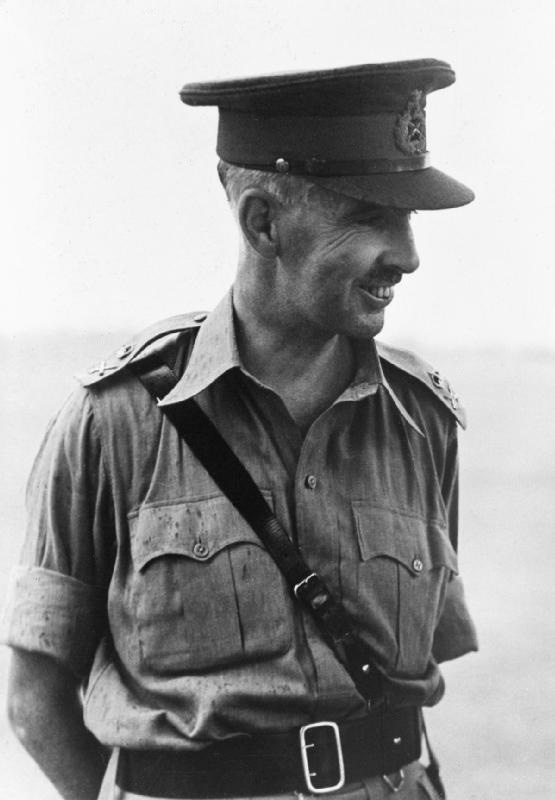
(I could not find a picture of the cover of this book, so I used the most dignified picture of General Percival available.)
The book started off fine enough, concentrating on General Percival's early military career, detailing his time in Northern Ireland, his time in staff college and his first stint in Singapore where he made some good calls about what the defence of Singapore would entail should the Japanese ever attack south. All went well until the middle section of the book on the Malayan Campaign. Here it became less clear if the book was about the General Officer Commanding (GOC) or if it was about the campaign. Of course, as the GOC, he was intricately tied to the campaign, but the author focused overwhelmingly on the Japanese's tactics and the British's countermeasures and only gave the GOC passing mentions. Part of the reason could be the author's attempt to show the hopelessness of the situation right from the start and so to absolve the GOC of responsibilities for the inevitable outcome.
But once the campaign was over, the focus went back to the General and on his years in captivity and the post-war life, closing on a bitter-sweet note on his passing on January 1966. Again, if the book is on the General, the post-war section should receive as much attention as the pre-war part which is unfortunately not the case. I found this part well worth reading for it allows me to know a little more about his life after the war. Equally interesting is the author's description of his work with the general in the Far East Prisoners of War Association which was set up to support the POWs taken in Malaya/Singapore and Burma.
Since the publication of this book (1971), a lot more information has become available, scholars have published many articles on the subject, and other books have also been written on the Campaign. If it is the Malayan Campaign that a reader is interested in, this is one that can be considered: Singapore Burning by Colin Smith. For one written from the Japanese perspective, readers can consider Japan's Greatest Victory/ Britain's Greatest Defeat by Masanobu Tsuji. There is a more recent (1993) book that takes on a similar thread Scapegoat: General Percival Of Singapore by Clifford Kinvig that readers may want to consider as well.
(I could not find a picture of the cover of this book, so I used the most dignified picture of General Percival available.)
Labels:
Japan,
Malaya,
Singapore,
World War 2
05 October 2016
Yamashita's Ghost (Allan A. Ryan)
This book is about the trial of General Tomoyuki Yamashita in the Philippines at the end of the Second World War. It is not a simple narrative of the events that took place during the trial. The author argued that the trial was a show done to satisfy the vanity of General Douglas MacArthur. As a result, the first trial of its kind, saddled with the destiny to set a precedence, was relegated into a theatre that contravenes all manner of good legal process (pg. 88).
The book started with the concept of a military tribunal, stressing that it is a challenging one. While it is grounded in legal practice, the process is often carried out by people not trained in the legal profession. More importantly, the idea of laws governing behaviours in wars is a tenuous one. Therefore it is easy for a tribunal to end up miscarrying the justice it is supposed to uphold. This appears to be the case with the tribunal trying Yamashita.
Yamashita was charged with failing in his duty as commander of Japanese forces in the Philippines to prevent them from committing atrocities in the dying days of the war leading to what is called the Rape of Manila. The author raised two questions to this charge: the first is whether Yamashita indeed knew about what was going on, and if he did, whether he could do anything about it. The answers to both questions appear to be a resounding ‘no’. Yamashita did not know about the rampage of that was going on in Manila because he had ordered all troops to vacate the city and was not informed of any atrocities that took place later. Secondly, even if he had known, by then the American forces had so effectively cut off his communication lines that there was no way he could stop the troops even if he had wanted to.
In the end Yamashita was found guilty and sentenced to death, a verdict the author felt was unjust, conceived through a ‘legal’ process flawed in so many ways. Most of his dissatisfaction however, is directed at the presiding judge, Maj. Gen. R. B. Reynolds. To him, General Reynolds was unfit to preside over the tribunal and was portrayed as incompetent (pg. 121, 161, 244) and unfair. On numerous occasions, he allowed the prosecution the latitude that would not have been in a proper trial. He admitted ‘hearsay’ and even double or triple hearsay to be admitted as evidence and when asked to make a judgement on the legality of the prosecution’s methods, could only say “sustained”. Yet, this might not have been the case had it not been for General MacArthur’s haste in wanting the tribunal to conclude quickly, therefore the sub-title “MacArthur's Justice”.
This is a book that requires careful reading and reflection; the author can easily be accused of being a revisionist arguing that a high-ranking Japanese officer was not responsible for the suffering of prisoners-of-war and civilians. To the author, war crimes tribunals is a self-contradictory concept. Wars are started for different reasons but killing of soldiers and civilians are implicit, to put it within the framework of law is oxymoronic. However, we intuitively think that people who perpetuate atrocities must be brought to justice, the question is whether it can be done properly. Despite the difficulties there is value to a war crimes tribunal (which the author argued in the last chapter of the book) and when it is convened, it has to be done properly, and given the self-contradictory nature, carefully. This was obviously not the case in the Yamashita tribunal. I do not think that the author is sympathetic to the Japanese, but he recognised that a tribunal that is not carried out properly would allow those sympathetic to the defendants to claim that it was “victors’ justice” (as argued by Maurice Bardèche in his book, Nuremberg or the Promised Land).
At the end of the book, I asked myself what would have been the right thing to do. While I agree with the author’s argument, I found it impossible to imagine that Yamashita would be acquitted in that climate where everyone who suffered under the Japanese occupation wanted to see something done to members of the Japanese military. The author did not deny the Rape of Manila, he in fact showed data and described the atrocities without any attempt at whitewashing. To him the one that was responsible was Iwabuchi who openly ignored Yamashita’s order to vacate Manila. But Iwabuchi was killed in Manila with almost all his troops. As such, there should not be a tribunal. Yet I cannot imagine this whole issue to不了了之 (a Chinese phrase to describe a situation where something is left unclosed and eventually forgotten). I can, being born a generation later, buy into the author’s argument, but I cannot imagine my grandparents or even parents accepting it. In the immediate aftermath of the war, it was politically untenable. Yamashita would have to be executed, even if purely out of vindication, whatever the consequences. This was acted out in the Chinese movie The Tokyo Tribunal where China’s representative on the prosecution, Mei Ju-ao, wondered to himself at the end of the movie – “I cannot imagine what would happen had we not gathered enough votes to put the accused to death.” This scene is probably made-up, but it reflected the sentiments at the time. The judges could judge according to the logic and spirit of the law, the people wanted their own form of justice.
I came across a book on the Tokyo Military Tribunal – Beyond Victor’s Justice where in the foreword, Sir Gerard Brennan who was involved in the trial of General Nishimura in Australia claimed that it was the first time he came across the passing of the death sentence and it was appalling to him. This was despite Nishimura being quite clearly implicated in the massacre of wounded Australia troops left behind in Parit Sulong, Malaya. This is a contrast to the emotions that civilians who suffered under the Japanese experienced then. We see therefore on one side, a defence that would not convict an accused over slightest doubt in the interpretation of an order but on the other, the people who had suffered untold atrocities who would not care who had to pay for it.
This is a very thought-provoking book. The last few chapters of the book are short and are not on Yamashita’s trial. They are there to show the legacy of that trial and the impact it would have right up to modern times. The last chapter is where the author shared his thoughts on the concept of war crimes. If the rest of the book are well-worth reading, this last chapter is invaluable. Readers like me who are not familiar with this tribunal or the concept of war crimes will find this a very good introduction and will be richly rewarded for reading it.
(Find this book at Goodreads)
The book started with the concept of a military tribunal, stressing that it is a challenging one. While it is grounded in legal practice, the process is often carried out by people not trained in the legal profession. More importantly, the idea of laws governing behaviours in wars is a tenuous one. Therefore it is easy for a tribunal to end up miscarrying the justice it is supposed to uphold. This appears to be the case with the tribunal trying Yamashita.
Yamashita was charged with failing in his duty as commander of Japanese forces in the Philippines to prevent them from committing atrocities in the dying days of the war leading to what is called the Rape of Manila. The author raised two questions to this charge: the first is whether Yamashita indeed knew about what was going on, and if he did, whether he could do anything about it. The answers to both questions appear to be a resounding ‘no’. Yamashita did not know about the rampage of that was going on in Manila because he had ordered all troops to vacate the city and was not informed of any atrocities that took place later. Secondly, even if he had known, by then the American forces had so effectively cut off his communication lines that there was no way he could stop the troops even if he had wanted to.
In the end Yamashita was found guilty and sentenced to death, a verdict the author felt was unjust, conceived through a ‘legal’ process flawed in so many ways. Most of his dissatisfaction however, is directed at the presiding judge, Maj. Gen. R. B. Reynolds. To him, General Reynolds was unfit to preside over the tribunal and was portrayed as incompetent (pg. 121, 161, 244) and unfair. On numerous occasions, he allowed the prosecution the latitude that would not have been in a proper trial. He admitted ‘hearsay’ and even double or triple hearsay to be admitted as evidence and when asked to make a judgement on the legality of the prosecution’s methods, could only say “sustained”. Yet, this might not have been the case had it not been for General MacArthur’s haste in wanting the tribunal to conclude quickly, therefore the sub-title “MacArthur's Justice”.
This is a book that requires careful reading and reflection; the author can easily be accused of being a revisionist arguing that a high-ranking Japanese officer was not responsible for the suffering of prisoners-of-war and civilians. To the author, war crimes tribunals is a self-contradictory concept. Wars are started for different reasons but killing of soldiers and civilians are implicit, to put it within the framework of law is oxymoronic. However, we intuitively think that people who perpetuate atrocities must be brought to justice, the question is whether it can be done properly. Despite the difficulties there is value to a war crimes tribunal (which the author argued in the last chapter of the book) and when it is convened, it has to be done properly, and given the self-contradictory nature, carefully. This was obviously not the case in the Yamashita tribunal. I do not think that the author is sympathetic to the Japanese, but he recognised that a tribunal that is not carried out properly would allow those sympathetic to the defendants to claim that it was “victors’ justice” (as argued by Maurice Bardèche in his book, Nuremberg or the Promised Land).
At the end of the book, I asked myself what would have been the right thing to do. While I agree with the author’s argument, I found it impossible to imagine that Yamashita would be acquitted in that climate where everyone who suffered under the Japanese occupation wanted to see something done to members of the Japanese military. The author did not deny the Rape of Manila, he in fact showed data and described the atrocities without any attempt at whitewashing. To him the one that was responsible was Iwabuchi who openly ignored Yamashita’s order to vacate Manila. But Iwabuchi was killed in Manila with almost all his troops. As such, there should not be a tribunal. Yet I cannot imagine this whole issue to不了了之 (a Chinese phrase to describe a situation where something is left unclosed and eventually forgotten). I can, being born a generation later, buy into the author’s argument, but I cannot imagine my grandparents or even parents accepting it. In the immediate aftermath of the war, it was politically untenable. Yamashita would have to be executed, even if purely out of vindication, whatever the consequences. This was acted out in the Chinese movie The Tokyo Tribunal where China’s representative on the prosecution, Mei Ju-ao, wondered to himself at the end of the movie – “I cannot imagine what would happen had we not gathered enough votes to put the accused to death.” This scene is probably made-up, but it reflected the sentiments at the time. The judges could judge according to the logic and spirit of the law, the people wanted their own form of justice.
I came across a book on the Tokyo Military Tribunal – Beyond Victor’s Justice where in the foreword, Sir Gerard Brennan who was involved in the trial of General Nishimura in Australia claimed that it was the first time he came across the passing of the death sentence and it was appalling to him. This was despite Nishimura being quite clearly implicated in the massacre of wounded Australia troops left behind in Parit Sulong, Malaya. This is a contrast to the emotions that civilians who suffered under the Japanese experienced then. We see therefore on one side, a defence that would not convict an accused over slightest doubt in the interpretation of an order but on the other, the people who had suffered untold atrocities who would not care who had to pay for it.
This is a very thought-provoking book. The last few chapters of the book are short and are not on Yamashita’s trial. They are there to show the legacy of that trial and the impact it would have right up to modern times. The last chapter is where the author shared his thoughts on the concept of war crimes. If the rest of the book are well-worth reading, this last chapter is invaluable. Readers like me who are not familiar with this tribunal or the concept of war crimes will find this a very good introduction and will be richly rewarded for reading it.
(Find this book at Goodreads)
Labels:
Japan,
Tribunal,
World War 2
25 August 2016
东京审判:被忘却的纽伦堡 (Etienne Jaudel/杨亚平/程兆奇)
This book on the International Military Tribunal for the Far East is translated from French, originally titled Le procès de Tokyo: Un Nuremberg oublié by Etienne Jaudel. It is a small volume and reads more like a dissertation than a book. Short as it is, this book has its value; for those who have not read much about the Tribunal, this book gives a very good overview of the various aspects of the tribunal, such as the prosecutors, the accused, the judicial proceedings and the criticism of the various aspects of the Tribunal since. More than that, the author actually has a thesis – the Tribunal, as flawed as it was, was important in giving closure to the victims and the families who suffered terribly in the hands of the Japanese in the Second World War.
Many political scientists and legal experts who study the Tribunal questioned the legality of the proceedings. This became especially so after Richard H. Minear published Victors' Justice: Tokyo War Crimes Trial which got many to start looking at the convicted as victims of miscarried justice. Jaudel gave a good account of the difficulties and disagreements in the literature. These include the sparing of the Japanese Emperor Hirohito (pg. 5, 32); the concept of Crime Against Peace having no precedence (pg. 67); the procedural issues (pg. 12, 52) and the suitability of the general prosecutor, Joseph Keenan (pg. 13).
His perspective is different however. To him, a crime so great deserves punishment for those accountable and while the proceedings were not without flaws, the defendants were given due representation including the provision of fifteen defence lawyers (pg. 35). And although the type of evidence admitted was not like those in a usual criminal trial, the circumstances and the deliberate destruction of documents by the Japanese at the end of the war made it necessary for personal diaries and evidence not produced under oath (pg. 52) to be admitted. Furthermore, the author asked, could one expect that the accused be only convicted after there was no longer any doubt in any part of the proceedings? He reminded readers that the accused had all the legal rights accorded by the prosecution and more importantly, the prosecution had the moral grounds to prosecute because they represent countries that did not commit the same crimes (pg. 148).
Admittedly this Tribunal was different from the Nuremburg Trials because the political structure in Japan and Germany were different. In the case of Germany, it was much easier to identify the culprits because they reigned supreme during the war. Japan on the other hand, had ten prime ministers in that time. With power seemingly diffused among the Emperor, the cabinet and the military, it is hard to establish who should take overall responsibilities for the war and the atrocities resulting from it. From the start, the Tribunal was besieged with the problem of whether it was individual crimes or collective crimes the accused were prosecuted for (pg. 39) and with such a confusing administrative structure, the author felt that it was just to convict the accused so long as the prosecution could prove that the accused have direct or indirect involvement in the policy-making process involving the war.
Two judges in the panel of 12 needs special mention here. The first is Judge Radhabinod Pal who was dissenting and would later write a book to explain his position (Pal, 1953). He was accused by a Japanese author, Saburo Ienaga, of being partial to the accused because Pal was anti-communist and China was slowly drifting towards Communism during the trial (Saburo Ienaga, pg. 201). This is hard to prove especially when Ienaga himself was accused of being a communist. However, the credibility of the Judge took a bit of a hit when it was revealed here that he missed 109 days out of 423 during the trials, making him the biggest absentee (pg. 47).
The second judge is Judge Bert Röling who was also dissenting. He was among the people who believed that it was right not to put Emperor Hirohito on trial because he was just a figure-head and did not really have a say (pg. 143). This is ironic because it was precisely because of this that many felt that the Tribunal was a farce (pg. 145). This case is instructive for it highlights the fact that while people many agree that the Tribunal was less than impeccable, they were of the opinion for different reasons. This lack of agreement among the critics of the Tribunal may actually strengthen its legitimacy.
This book is marred by lapses, some of which are minor like the exact dates when Yamashita left for the Philippines which had no material impact on this book (pg. 33, 78, 80, 137, 151) but others are major (pg. 37, 49, 60, 62) such as the date that Japan withdrew its membership of the League of Nations (pg. 78). Fortunately, the translator, 程兆奇 did a good job checking the facts and correcting them in the footnotes. What I personally like about the author was his willingness to consider non-scholastic work which he qualified (pg. 20). I think pure scholarly work done in the scholastic tradition is important because it is on this that future knowledge is built. Unfortunately this always leaves the output dry and the physical scenes incomplete. I found myself constantly forming images informed by pictures from books or even scenes from the television programmes especially when reading works on China in that era. I hope more scholars would consider non-scholastic works but of course with qualifications and proper citations.
Finally, two points made by the author is worth repeating here. First of all, he, in response to Minear’s term ‘Victors’ Justice’, proposed that the Tribunal could also be called ‘Losers’ Justice’ because the judges in the Tribunal were all from countries that have suffered under the Japanese, they therefore represent their civilians who have suffered when they were losers (pg. 65). Secondly, a position not widely considered, is the fact that the outcome of the Tribunal ironically relieved the Japanese of their war guilt, for now they can say that it was the responsibility of those convicted (pg. 150) that perpetuated the atrocities and cruelty throughout Asia and brought Japan to the brink of destruction.
Reference
Ienaga, S. (1979). The Pacific War, 1931-1945 : A Critical Perspective on Japan's Role in World War II. NY:The Pantheon Asia Library.
Pal, R. (1953). International Military Tribunal for the Far East: Dissentient Judgement. Kolkata:Sanyal & Co.
(Find this book at Goodread)
Many political scientists and legal experts who study the Tribunal questioned the legality of the proceedings. This became especially so after Richard H. Minear published Victors' Justice: Tokyo War Crimes Trial which got many to start looking at the convicted as victims of miscarried justice. Jaudel gave a good account of the difficulties and disagreements in the literature. These include the sparing of the Japanese Emperor Hirohito (pg. 5, 32); the concept of Crime Against Peace having no precedence (pg. 67); the procedural issues (pg. 12, 52) and the suitability of the general prosecutor, Joseph Keenan (pg. 13).
His perspective is different however. To him, a crime so great deserves punishment for those accountable and while the proceedings were not without flaws, the defendants were given due representation including the provision of fifteen defence lawyers (pg. 35). And although the type of evidence admitted was not like those in a usual criminal trial, the circumstances and the deliberate destruction of documents by the Japanese at the end of the war made it necessary for personal diaries and evidence not produced under oath (pg. 52) to be admitted. Furthermore, the author asked, could one expect that the accused be only convicted after there was no longer any doubt in any part of the proceedings? He reminded readers that the accused had all the legal rights accorded by the prosecution and more importantly, the prosecution had the moral grounds to prosecute because they represent countries that did not commit the same crimes (pg. 148).
Admittedly this Tribunal was different from the Nuremburg Trials because the political structure in Japan and Germany were different. In the case of Germany, it was much easier to identify the culprits because they reigned supreme during the war. Japan on the other hand, had ten prime ministers in that time. With power seemingly diffused among the Emperor, the cabinet and the military, it is hard to establish who should take overall responsibilities for the war and the atrocities resulting from it. From the start, the Tribunal was besieged with the problem of whether it was individual crimes or collective crimes the accused were prosecuted for (pg. 39) and with such a confusing administrative structure, the author felt that it was just to convict the accused so long as the prosecution could prove that the accused have direct or indirect involvement in the policy-making process involving the war.
Two judges in the panel of 12 needs special mention here. The first is Judge Radhabinod Pal who was dissenting and would later write a book to explain his position (Pal, 1953). He was accused by a Japanese author, Saburo Ienaga, of being partial to the accused because Pal was anti-communist and China was slowly drifting towards Communism during the trial (Saburo Ienaga, pg. 201). This is hard to prove especially when Ienaga himself was accused of being a communist. However, the credibility of the Judge took a bit of a hit when it was revealed here that he missed 109 days out of 423 during the trials, making him the biggest absentee (pg. 47).
The second judge is Judge Bert Röling who was also dissenting. He was among the people who believed that it was right not to put Emperor Hirohito on trial because he was just a figure-head and did not really have a say (pg. 143). This is ironic because it was precisely because of this that many felt that the Tribunal was a farce (pg. 145). This case is instructive for it highlights the fact that while people many agree that the Tribunal was less than impeccable, they were of the opinion for different reasons. This lack of agreement among the critics of the Tribunal may actually strengthen its legitimacy.
This book is marred by lapses, some of which are minor like the exact dates when Yamashita left for the Philippines which had no material impact on this book (pg. 33, 78, 80, 137, 151) but others are major (pg. 37, 49, 60, 62) such as the date that Japan withdrew its membership of the League of Nations (pg. 78). Fortunately, the translator, 程兆奇 did a good job checking the facts and correcting them in the footnotes. What I personally like about the author was his willingness to consider non-scholastic work which he qualified (pg. 20). I think pure scholarly work done in the scholastic tradition is important because it is on this that future knowledge is built. Unfortunately this always leaves the output dry and the physical scenes incomplete. I found myself constantly forming images informed by pictures from books or even scenes from the television programmes especially when reading works on China in that era. I hope more scholars would consider non-scholastic works but of course with qualifications and proper citations.
Finally, two points made by the author is worth repeating here. First of all, he, in response to Minear’s term ‘Victors’ Justice’, proposed that the Tribunal could also be called ‘Losers’ Justice’ because the judges in the Tribunal were all from countries that have suffered under the Japanese, they therefore represent their civilians who have suffered when they were losers (pg. 65). Secondly, a position not widely considered, is the fact that the outcome of the Tribunal ironically relieved the Japanese of their war guilt, for now they can say that it was the responsibility of those convicted (pg. 150) that perpetuated the atrocities and cruelty throughout Asia and brought Japan to the brink of destruction.
Reference
Ienaga, S. (1979). The Pacific War, 1931-1945 : A Critical Perspective on Japan's Role in World War II. NY:The Pantheon Asia Library.
Pal, R. (1953). International Military Tribunal for the Far East: Dissentient Judgement. Kolkata:Sanyal & Co.
(Find this book at Goodread)
Labels:
China,
Chinese Books,
Japan,
Tribunal,
World War 2
01 August 2016
太平洋戰爭 (家永三郎/何欣泰 ) The Pacific War 1931-1945 (Saburo Ienaga)
To many, the Pacific War is geographically limited to the eastern side of the Pacific Ocean, extending furthest south to the Coral Sea and west to the Philippines. It is also chronologically limited to the period between 8th December 1941 and 2nd September 1945. To the Japanese and Chinese however, the Pacific War extends to China and Southeast Asia and started on 18th September 1931, when the Kwantung Army invaded Manchuria. This distinction is important: to many Americans, Pearl Harbor was a sneak attack, requiring a full retaliatory response. To the Japanese, it was the outcome of the sanctions that the USA placed upon them, and having no way out, they had to attack the USA in the hope they would sue for peace. These sanctions were put in place in step with the escalation of Japan's conquest in China, leading to the most drastic embargo of oil as Japan invaded Indochina, which could be traced back to Japan's actions in China. To the Japanese, the Pacific War is a 15-year war and their ultimate near-devastation is to be traced to 1931, which is why the characters that appear in Japanese and Chinese literature on the war is a lot more colourful and well-developed than the fleeting mention that they get in Western literature.
This book by Saburo Ienaga is a survey of the events leading to Japan's ultimate defeat and the conditions in Japan throughout that period. The author's motivation is to educate the post-war generation about Japan's recent past, and more importantly, to counter the resurgent right-wing narrative in Japan. In doing so, not only did he discuss the military and cabinet decisions, he also provided a view into the controls the military put place to ensure that the populace remained docile and abiding and would not raise any objections to the military's adventures.
In the 1920s and throughout the 1930s, militarism was pervasive and this started to make inroads into schools through systematic perversion of the school curriculum as well as the increase in imperialistic-mindedness of the teachers. There were those who tried to resists, but by 1940, there was largely no more open dissent (pg. 117) and even the "intellectual community not only caved in under pressure but accommodated with alacrity to the new order" (pg. 121). This being the case, and with the constant bombardment of news of the Imperial Japanese Army and Navy scoring victories after victories over any adversaries, it became impossible for the Japanese civilian to know the truth.
The author's main concern was that there never seemed to be a time when the post-war Japanese society evaluated Japan's history in the early part of the 20th century. War memories started to fade and there are even signs that the war apologists were beginning to make a come back. Indeed, there were even people who advocated the reassessment the war because excessive emphasis on war responsibility "would produce a guilt-ridden nation," (pg. 253). And as if to prove his point, Inenaga published a draft of a Japanese history textbook for high school based on his New Japanese History. The draft was rejected by the Ministry of Education in 1952 because they did not like the way he depicted certain events, this resulted in him bringing a lawsuit to the ministry.
I cannot claim to be a scholar in Japanese literature on the War, but I observed a few interesting perspectives of Emperor Hirohito from the few works I have read. The right-wing perspective is that the Emperor might have a role in starting the war, but it was a just war and he did the right thing. Among those who disagree with the war and admitted to the atrocities of the Imperial Japanese Army are two different views. One is that the Emperor had no choice and was not really in control of events. Respected academic and author, Kazutoshi Handō is of this opinion. The other perspective, to which this author subscribed, is that the Emperor should bear the responsibilities and at the end of the war, with everyone suffering the most difficult conditions, and the myth of the Emperor shattered, people were ready to indict him had the Allies so decided. Finally, there are those who chose to side-step the role of the Emperor. This is an interesting issue for further exploration and I hope that the book I'm currently reading would help to shed some light.
As a small volume, it is impossible for the author to go into enough details of any events or any aspect of the lives of the Japanese. I started reading the Chinese translation of the book and found it hard, mainly because of the style that I'm not used to. The English translation is much easier to read but seem to lack a certain depth. However, those who are interested in getting one Japanese perspective (a left-leaning one) of the Pacific War will find this book useful.
(Find this book at Goodreads)
This book by Saburo Ienaga is a survey of the events leading to Japan's ultimate defeat and the conditions in Japan throughout that period. The author's motivation is to educate the post-war generation about Japan's recent past, and more importantly, to counter the resurgent right-wing narrative in Japan. In doing so, not only did he discuss the military and cabinet decisions, he also provided a view into the controls the military put place to ensure that the populace remained docile and abiding and would not raise any objections to the military's adventures.
In the 1920s and throughout the 1930s, militarism was pervasive and this started to make inroads into schools through systematic perversion of the school curriculum as well as the increase in imperialistic-mindedness of the teachers. There were those who tried to resists, but by 1940, there was largely no more open dissent (pg. 117) and even the "intellectual community not only caved in under pressure but accommodated with alacrity to the new order" (pg. 121). This being the case, and with the constant bombardment of news of the Imperial Japanese Army and Navy scoring victories after victories over any adversaries, it became impossible for the Japanese civilian to know the truth.
The author's main concern was that there never seemed to be a time when the post-war Japanese society evaluated Japan's history in the early part of the 20th century. War memories started to fade and there are even signs that the war apologists were beginning to make a come back. Indeed, there were even people who advocated the reassessment the war because excessive emphasis on war responsibility "would produce a guilt-ridden nation," (pg. 253). And as if to prove his point, Inenaga published a draft of a Japanese history textbook for high school based on his New Japanese History. The draft was rejected by the Ministry of Education in 1952 because they did not like the way he depicted certain events, this resulted in him bringing a lawsuit to the ministry.
I cannot claim to be a scholar in Japanese literature on the War, but I observed a few interesting perspectives of Emperor Hirohito from the few works I have read. The right-wing perspective is that the Emperor might have a role in starting the war, but it was a just war and he did the right thing. Among those who disagree with the war and admitted to the atrocities of the Imperial Japanese Army are two different views. One is that the Emperor had no choice and was not really in control of events. Respected academic and author, Kazutoshi Handō is of this opinion. The other perspective, to which this author subscribed, is that the Emperor should bear the responsibilities and at the end of the war, with everyone suffering the most difficult conditions, and the myth of the Emperor shattered, people were ready to indict him had the Allies so decided. Finally, there are those who chose to side-step the role of the Emperor. This is an interesting issue for further exploration and I hope that the book I'm currently reading would help to shed some light.
As a small volume, it is impossible for the author to go into enough details of any events or any aspect of the lives of the Japanese. I started reading the Chinese translation of the book and found it hard, mainly because of the style that I'm not used to. The English translation is much easier to read but seem to lack a certain depth. However, those who are interested in getting one Japanese perspective (a left-leaning one) of the Pacific War will find this book useful.
(Find this book at Goodreads)
Labels:
China,
Japan,
World War 2
09 July 2016
Defeat into Victory (William Slim)
This book is about the Burma/India Theatre in the Second World War where the British arguably scored their first victory against the Japanese. While this theatre did not receive as much attention as the Malayan Campaign, the fighting was not less brutal and conditions possibly harder. Resources were scarce, understandable given the secondary status this
theatre was accorded (pg. 24). Food was pathetic (pg. 178) and even
uniform was not enough at first (pg. 42). Add to this the difficulty of sewing together combatants from different nationalities: British, Indian, Burmese, Nepalese (Gurkhas), American (airmen) and Chinese, the challenge of stopping the Japanese advance into India was formidable. On top of that, some people could be fighting for either side (especially the Indians who served in the Indian National Army) and with a foe that exhibited systematic cruelty and brutality in any theatre (pg. 51, 238), it was no wonder that many felt demoralised and were conditioned to think that there was no way to stop the Japanese.
The central theme of this book is how the Commonwealth soldiers, with the help of the Americans airmen, eventually re-grouped, trained and through small victories scored in patrols, turned their beliefs around and came to recognise that the Japanese were not invincible. The Japanese could be defeated by a side who trained better and planned better, a side that was determined not to be forced into retreat again. The story of how they overcame the lack of resources, broken promises of higher command due to exigencies in other theatres, and maintained and improved their morale makes for a good lesson in leadership and practical intelligence.
The writing is another reason I enjoyed the book. The writer was able to give very vivid descriptions of events (pg. 28), scenes and people (pg. 31) all written in a style uncommon in military history and rare today as we push for the use of Business English. There are a few occasions when I even felt the writing poetic. For that, one should see the author's description of Northern Burma (pg. 246), the opening of Chapter 12, and about the great Irrawaddy (pg. 416), written with such respect. He also had a great sense of humour such that the book is peppered throughout with funny anecdotes (see pg. 44, 61, 141, 330). His reflections on the loss of Burma (pg. 120 onwards) also contain invaluable insights.
Some may accuse the author of being a borderline racist in his writing (pg. 281) based on today's politically correct rhetoric but I personally did not detect disrespect. If he disapproved of his Asian allies or was disappointed by them, he did not link any of this to their race, but to the lack of training or the conditions under which they had to operate. In fact he had high praises for the Indian units fighting for him and maintained the highest respect for the Gurkhas.
The one question that kept coming back to me as I read the book was why this theatre receive so little attention, especially given that it resulted in a convincing victory for the the British. Was it one that really mattered so little in the bigger scheme of things? Wouldn't it be disastrous had Burma/India ended up like Singapore? An earlier book I read had indeed speculated that the outcome of the war might be different had the British been defeated in Burma and India, and India, while geographically huge, might not be difficult to sway towards the Japanese, given the independence movement led by the Congress Party.
But like all speculations, it is hard to predict what really would happen. All we know is that the Japanese were defeated by the British and her allies for the first time and this is part of the general pattern of the war for the Japanese from then on. Interestingly, Japanese sources, both left and right-wing (Handō, 2009; Ienaga 2010; Yakuta & Watanabe, 2013), pay more attention to the defeat they tasted in Imphal, putting the blame squarely on Lieutenant General Renya Mutaguchi's lack of leadership, capabilities, and decisiveness.
Even if the victory here did not serve the overall cause strategically, there are reasons for one to learn about this theatre if just to know how an army, so lacking in resources could turn defeat into victory against an enemy that seemed so invicincible. And there is no one better to learn from than the one who was instrumental in the victory.
(This review is based on the edition published by The Reprint Society, Ltd.)
(Find this book at Goodreads)
References
Handō, K. (2009), Showa Shi 1926-1945 Volume 2, Heibonsha Limited, Tokyo: Japan.
Ienaga, S. (2010), The Pacific War 1931-1945, Pantheon Asia Library, NY.
Hyakuta, N and Watanabe, S. (2013), Zerosen To Nihontou, Maple House Cultural Publishing, Taipei: Taiwan.
The central theme of this book is how the Commonwealth soldiers, with the help of the Americans airmen, eventually re-grouped, trained and through small victories scored in patrols, turned their beliefs around and came to recognise that the Japanese were not invincible. The Japanese could be defeated by a side who trained better and planned better, a side that was determined not to be forced into retreat again. The story of how they overcame the lack of resources, broken promises of higher command due to exigencies in other theatres, and maintained and improved their morale makes for a good lesson in leadership and practical intelligence.
The writing is another reason I enjoyed the book. The writer was able to give very vivid descriptions of events (pg. 28), scenes and people (pg. 31) all written in a style uncommon in military history and rare today as we push for the use of Business English. There are a few occasions when I even felt the writing poetic. For that, one should see the author's description of Northern Burma (pg. 246), the opening of Chapter 12, and about the great Irrawaddy (pg. 416), written with such respect. He also had a great sense of humour such that the book is peppered throughout with funny anecdotes (see pg. 44, 61, 141, 330). His reflections on the loss of Burma (pg. 120 onwards) also contain invaluable insights.
Some may accuse the author of being a borderline racist in his writing (pg. 281) based on today's politically correct rhetoric but I personally did not detect disrespect. If he disapproved of his Asian allies or was disappointed by them, he did not link any of this to their race, but to the lack of training or the conditions under which they had to operate. In fact he had high praises for the Indian units fighting for him and maintained the highest respect for the Gurkhas.
The one question that kept coming back to me as I read the book was why this theatre receive so little attention, especially given that it resulted in a convincing victory for the the British. Was it one that really mattered so little in the bigger scheme of things? Wouldn't it be disastrous had Burma/India ended up like Singapore? An earlier book I read had indeed speculated that the outcome of the war might be different had the British been defeated in Burma and India, and India, while geographically huge, might not be difficult to sway towards the Japanese, given the independence movement led by the Congress Party.
But like all speculations, it is hard to predict what really would happen. All we know is that the Japanese were defeated by the British and her allies for the first time and this is part of the general pattern of the war for the Japanese from then on. Interestingly, Japanese sources, both left and right-wing (Handō, 2009; Ienaga 2010; Yakuta & Watanabe, 2013), pay more attention to the defeat they tasted in Imphal, putting the blame squarely on Lieutenant General Renya Mutaguchi's lack of leadership, capabilities, and decisiveness.
Even if the victory here did not serve the overall cause strategically, there are reasons for one to learn about this theatre if just to know how an army, so lacking in resources could turn defeat into victory against an enemy that seemed so invicincible. And there is no one better to learn from than the one who was instrumental in the victory.
(This review is based on the edition published by The Reprint Society, Ltd.)
(Find this book at Goodreads)
References
Handō, K. (2009), Showa Shi 1926-1945 Volume 2, Heibonsha Limited, Tokyo: Japan.
Ienaga, S. (2010), The Pacific War 1931-1945, Pantheon Asia Library, NY.
Hyakuta, N and Watanabe, S. (2013), Zerosen To Nihontou, Maple House Cultural Publishing, Taipei: Taiwan.
23 May 2016
零戰與日本刀 (百田尚樹, 渡部昇一/ 張詠翔)
The title of this book (Zero Fighter and the Samurai Sword) is misleading in that only about a third of the book is about the Zero Fighter. But the rest of the book is eye-opening for me for I have never read anything written by a right-wing commentator in Japan. Let me first start with the first part of the book that compares the Zero Fighter to the samurai sword.
Why did the authors compare the Zero Fighter to the samurai sword? Much of it has to do with fact that they are built in the same spirit. Samurai swords are beautiful, deadly, yet very brittle, like the Zero Fighter. This Japanese fighter was once the most advanced aircraft in the Second World War. It was fast and maneuverable, but was known to be highly vulnerable. Even a single round from an enemy's aircraft could destroy it. This is unlike the American fighters which were generally robust but were either less agile or less quick. The authors argued that this is exactly aligned to the Japanese psyche: Japan doesn't have the concept of a shield, they only have the concept of a spear (pg. 13), this is almost unique in the world. As a result, they could sacrifice protection for their pilots in order to improve the speed and maneuverability of their planes.That is as far as the discussion on the Zero Fighter went. The rest of the book uncovers the attitudes of the authors towards Japan's participation in the Second World War.
The authors were critical of the Japanese military in the Second World War - not because they perpetuated a war that was unjust, but because they were incompetent, lacked efficiency and strategic vision thereby leaving Japan to the ultimate defeat (pg. 138). Their basic assumption is that Japan's invasion of grabbing of others' resources is totally within reason and they presented four arguments to support that position.
Japan had no choice
The nature of the Pacific War (in Southeast Asia) is to gain resources denied to Japan by the USA (pg. 47). Japan had to find a way to accommodate their growing population, they needed space and resources and China looked like the natural place to get it, especially when there was a total breakdown of governance. So their entry into China was not unlawful and seriously, it was no different from the pseudo-colonisation imposed on China by the West. But the Americans would not play ball, and started tightening the economic noose around Japan. What else could Japan do? So they had to strikes first in Southeast Asia to ensure that the West could not deny them of the resources (pg. 111) and they had to strike at Pearl Harbor in order to get the Pacific Fleet out of the way so that the Japanese Navy could secure the oil resources in the East Indies failing which, the Japanese Navy would not be able to move their ships, it's now or never (pg. 123).
It's other people's fault
Of course Japan would not have come to this had it not been for China's refusal to just accept Japan's annexation of Manchuria. This eventually led to the Marco Polo Bridge Incident, an escalation that Japan was determined to avoid (pg. 170). The Chinese's refusal to back down meant that Japan had to try and destroy the Chinese army which in turn caused international opinion to turn against them.
The locals in Southeast Asia welcomed the Japanese anyway
Although the current history textbooks in Japan said that Japan invaded the Southeast Asian countries, but seriously, Japan was not fighting the indigenous people of these countries, they were fighting their colonial masters, like the Dutch, French, Americans, and the British. These were the real invaders (pg. 201). To support this, the authors cited the example of the Indonesians who were asked by their colonial masters, the Dutch, to destroy the refinery facilities. But they hated the Dutch who had exploited them for more than 300 years and so had this notion that a 'yellow-face' God would come and save them. So when the Japanese paratroopers (were there?) came, the Indonesians thought that the God had come. As a result, none of them obeyed the Dutch and so the Japanese came as liberators instead of invaders (pg. 53).
Japan was the victim
Either way in the end, isn't Japan still the only country to suffer the atomic bomb - twice? And once Japan was defeated, the allies put together a show called the Tokyo Tribunal, which was actually just a farce. Beyond the documents at the tribunal, there were no other documents criticising the Japanese. Even McArthur said that Japan fought a defensive war(?) (pg. 180).
The authors even went as far as to consider the counter-factual of Japan prevailing in the Pacific against the Americans, or invading Russia during Operation Barbarossa which could result in the Americans suing for peace. The outcome would have been very different.
I personally found the arguments unpersuasive but I cannot say that they are totally without merits. However, I need to first state my position. I do not think that any country who faced a lack of resource has the right to build an army and go and grab the resources of another country. My own country has zero natural resources and is equally starved of land, that does not give us an excuse to eye other people's resources. So Japan's basic assumption that they could just go across to China and make demands is not acceptable to me.
Unfortunately, China was easy meat then. Fat with resources but in the era of the warlords, was devoid of a central government. Japan, like the other 8 nations, could easily walk all over China with impunity. Japan almost got a way with it, if one were to look at the annexation of Manchuria and the Chinese's response to it (I have reviewed books on this, see here and here).
As to the locals welcoming the Japanese as liberators, there were actually examples of this. A good number in India had looked upon Japan as the Asian country to liberate them from the British. Some of the indigenous people in Southeast Asia felt the same, except the Chinese immigrants to Southeast Asia who were the target of vengeance of the Japanese. But once the Japanese revealed themselves to be even more brutal than the western colonial masters, their attitudes changed.
This is a short and easy book to read. It being the first book I come across as told from the right-wing perspective is educational and interesting. But I also happen to know that the authors are Nanking Massacre deniers. This has severely coloured my perception of the book, for it is one thing to disagree on the interpretation of facts, it is another thing to deny facts. Those who are looking for a book on the Zero Fighter would be disappointed, but if the reader is willing to entertain a different perspective of the Second World War, this book is an interesting one.
(Find this book at Goodreads)
Why did the authors compare the Zero Fighter to the samurai sword? Much of it has to do with fact that they are built in the same spirit. Samurai swords are beautiful, deadly, yet very brittle, like the Zero Fighter. This Japanese fighter was once the most advanced aircraft in the Second World War. It was fast and maneuverable, but was known to be highly vulnerable. Even a single round from an enemy's aircraft could destroy it. This is unlike the American fighters which were generally robust but were either less agile or less quick. The authors argued that this is exactly aligned to the Japanese psyche: Japan doesn't have the concept of a shield, they only have the concept of a spear (pg. 13), this is almost unique in the world. As a result, they could sacrifice protection for their pilots in order to improve the speed and maneuverability of their planes.That is as far as the discussion on the Zero Fighter went. The rest of the book uncovers the attitudes of the authors towards Japan's participation in the Second World War.
The authors were critical of the Japanese military in the Second World War - not because they perpetuated a war that was unjust, but because they were incompetent, lacked efficiency and strategic vision thereby leaving Japan to the ultimate defeat (pg. 138). Their basic assumption is that Japan's invasion of grabbing of others' resources is totally within reason and they presented four arguments to support that position.
Japan had no choice
The nature of the Pacific War (in Southeast Asia) is to gain resources denied to Japan by the USA (pg. 47). Japan had to find a way to accommodate their growing population, they needed space and resources and China looked like the natural place to get it, especially when there was a total breakdown of governance. So their entry into China was not unlawful and seriously, it was no different from the pseudo-colonisation imposed on China by the West. But the Americans would not play ball, and started tightening the economic noose around Japan. What else could Japan do? So they had to strikes first in Southeast Asia to ensure that the West could not deny them of the resources (pg. 111) and they had to strike at Pearl Harbor in order to get the Pacific Fleet out of the way so that the Japanese Navy could secure the oil resources in the East Indies failing which, the Japanese Navy would not be able to move their ships, it's now or never (pg. 123).
It's other people's fault
Of course Japan would not have come to this had it not been for China's refusal to just accept Japan's annexation of Manchuria. This eventually led to the Marco Polo Bridge Incident, an escalation that Japan was determined to avoid (pg. 170). The Chinese's refusal to back down meant that Japan had to try and destroy the Chinese army which in turn caused international opinion to turn against them.
The locals in Southeast Asia welcomed the Japanese anyway
Although the current history textbooks in Japan said that Japan invaded the Southeast Asian countries, but seriously, Japan was not fighting the indigenous people of these countries, they were fighting their colonial masters, like the Dutch, French, Americans, and the British. These were the real invaders (pg. 201). To support this, the authors cited the example of the Indonesians who were asked by their colonial masters, the Dutch, to destroy the refinery facilities. But they hated the Dutch who had exploited them for more than 300 years and so had this notion that a 'yellow-face' God would come and save them. So when the Japanese paratroopers (were there?) came, the Indonesians thought that the God had come. As a result, none of them obeyed the Dutch and so the Japanese came as liberators instead of invaders (pg. 53).
Japan was the victim
Either way in the end, isn't Japan still the only country to suffer the atomic bomb - twice? And once Japan was defeated, the allies put together a show called the Tokyo Tribunal, which was actually just a farce. Beyond the documents at the tribunal, there were no other documents criticising the Japanese. Even McArthur said that Japan fought a defensive war(?) (pg. 180).
The authors even went as far as to consider the counter-factual of Japan prevailing in the Pacific against the Americans, or invading Russia during Operation Barbarossa which could result in the Americans suing for peace. The outcome would have been very different.
I personally found the arguments unpersuasive but I cannot say that they are totally without merits. However, I need to first state my position. I do not think that any country who faced a lack of resource has the right to build an army and go and grab the resources of another country. My own country has zero natural resources and is equally starved of land, that does not give us an excuse to eye other people's resources. So Japan's basic assumption that they could just go across to China and make demands is not acceptable to me.
Unfortunately, China was easy meat then. Fat with resources but in the era of the warlords, was devoid of a central government. Japan, like the other 8 nations, could easily walk all over China with impunity. Japan almost got a way with it, if one were to look at the annexation of Manchuria and the Chinese's response to it (I have reviewed books on this, see here and here).
As to the locals welcoming the Japanese as liberators, there were actually examples of this. A good number in India had looked upon Japan as the Asian country to liberate them from the British. Some of the indigenous people in Southeast Asia felt the same, except the Chinese immigrants to Southeast Asia who were the target of vengeance of the Japanese. But once the Japanese revealed themselves to be even more brutal than the western colonial masters, their attitudes changed.
This is a short and easy book to read. It being the first book I come across as told from the right-wing perspective is educational and interesting. But I also happen to know that the authors are Nanking Massacre deniers. This has severely coloured my perception of the book, for it is one thing to disagree on the interpretation of facts, it is another thing to deny facts. Those who are looking for a book on the Zero Fighter would be disappointed, but if the reader is willing to entertain a different perspective of the Second World War, this book is an interesting one.
(Find this book at Goodreads)
Labels:
Japan,
World War 2
17 April 2016
The Manchurian Myth (Rana Mitter)
A little after 10.30 pm on September 18, 1931, a bomb went off at a section of the railway line belonging to the Southern Manchuria Railway. Although located in Manchuria, the railway was the property of the Japanese, having secured it from the Russians after the Russo-Japanese War. The event was the brainchild of two army officers from the Kwantung Army, Ishiwara Kanji (石原莞尔) and Itagaki Seishiro (板垣征四郎). Their intention was to create an excuse for the Kwantung army to send their troops into Mukden (now Shenyang) as part of their plan to occupy Manchuria. This is today known as the Mukden Incident or Manchurian Incident (9-1-8 Incident as known to the Chinese, 九一八事变). This incident would launch the 15-Year War with China, as it is known in Japan.
Manchuria was made up of the Three Eastern Provinces of China (东三省) and was the power-base of Zhang Xueliang (张学良), popularly known as the 'Young Marshal' (少帅). Zhang had a good-size army, but was told not to resist the Japanese. Zhang himself was not in Fengtian, the capital of Shenyang when the incident took place and neither were his deputies. In a short time, the Kwantung Army occupied Fengtian and in a few months, the rest of the three provinces.The Incident would precipitate a long list of discussion topics and scholarly research including the effectiveness of the League of Nations, the motivation of Chiang Kaishek, then leader of China, the stain on Zhang's reputation hence, and so on. Few, however, ventured into the lives of the Chinese caught in the unexpected turmoil, fewer have explored their attitudes towards the occupation.
In this book, Professor Rana Mitter attempted just that. But more, he wanted to explore why many in the occupied provinces even collaborated with instead of resisting the Japanese. This is dangerous grounds to tread. No Chinese today today would admit to not resisting or at least hating the Japanese during the occupation. As such, the author could only look to official documents, newspapers, records and also known events to reconstruct the climate in Manchukuo, as the three occupied provinces were known after they were made a puppet state by the Japanese. Prof Mitter's research question was this: how was the Kwantung Army, with relatively few troops in the area, able to control an area over 350,000 square miles with a population of 30 million with it own strength alone? Did they enlist the help of the local population since help was unlikely to come from Japan given the Japanese government's extreme disapproval of the incident?
Indeed the Kwantung Army was able to enlist widespread collaboration of many Chinese including the elites (pg. 6), local leaders (pg. 72), local warlords like Ma Zhanshan, and one might even argue, Chiang himself, for his assent to the Tanggu Truce was tacit agreement to the Japanese occupation. The commoners were however, largely indifferent; this applies to those from either side of the border separating intramural China (关内) from the three eastern provinces. The elites and students in intramural China were indignant to the occupation but the commoners were not really concerned.
This is a complex problem. Although in contemporary China, everyone considers the three eastern provinces as integral to China, this was not always the case. While the Qing Dynasty was by then no more, the Manchus, who originated from the three eastern provinces, after differentiating themselves deliberately from the Han Chinese, made it difficult for the Han Chinese in the 1920s and 30s to see the three provinces as part of China proper. The occupation of the provinces did not appear to many Chinese as a violation of their own country (pg. 187). Even among those living in the occupied provinces, who by then were overwhelmingly Han Chinese (pg. 23), there was little evidence of active resistance. This might be down to two principal reasons. Firstly, the fear of reprisal. The Japanese were ready to take extremely brutal measures against those suspected of engaging in subversive activities (pg. 112-113). Secondly, non-resistance could mean that life went on as usual and in some cases, life even got better than under Zhang (pg. 56, 119, 122, 124). Adding to this was the fact that only a small portion of the locals had enough knowledge to understand what was going on (pg. 99), it therefore comes as no surprise that Manchukuo was more or less peaceful in its years. This state of affairs was similarly depicted by Cordes (2013) in his travelogue where he described the indifference he witnessed among the Chinese in Manchukuo, painfully living their cheap lives which could be taken away from them at any moment. This was also more or less how Chi (2004) depicted the lives of the Chinese in her novel. Some were resentful of the Japanese, but they largely went on living their lives by avoiding the Japanese where possible.
Which goes counter to the contemporary narrative from China about the determined resistance and even uprising against the Japanese. And if there was indeed resistance, it was mainly through propaganda efforts made by the elites and students in intramural China, far away from Manchukuo. Armed resistance was carried out by bandits who were ever ready to plunder the commoners when necessary and at times they would think nothing of switching sides (pg. 175). Organised armed resistance was dominated by people with nothing to lose, the bankrupt peasants and bandits (pg. 197).
But lest one thinks that Chinese were generally unpatriotic and would gladly identify with the Japanese, it must be stressed that they were never in doubt of their identity. Against the reality of the non-resistance policy of Chiang, what could a commoner do? Help was not forthcoming from the own government (KMT) nor from their most recent ruler (Zhang) and even less likely from an noncommittal League of Nations (see the findings of the Lytton Commission). Life had to go on, so most went about it pragmatically, fully aware of the Japanese presense and brutality but finding a way to cope.
Prof Mitter can be an engaging writer. This is evident from his other book, Forgotten Ally: China's World War II, 1937-1941 (Mitter 2013). But the book under review is adapted from this PhD thesis and I must say that theses are seldom written to engage. While I'm sure this book has been edited for readability, the thesis undertone is still widely felt. Having said that, one must recognise the value of the work. If nothing, it presents the complexity of nationalism in China then. In contrast to what is popularly brandished about today, Chinese in all strata of the society were able to adjust and accommodate the reality of Japanese occupation. We are not talking about a few black sheeps, we are talking about a whole society. This is unlikely to be palatable to the Chinese government of today. They have conscientiously sought to portray that part of history as one of Japanese brutality and Chinese resistance. Some strategies they have used include blaming Chiang for his policy of non-resistance (correctly in my view) and instead using his army to pursue the Communists, and fervently referring to Manchukuo as 伪满洲国 (fictitious Manchukuo) to stress its illegitimacy (compare the title of Chi's novel in the Chinese and the Taiwanese editions). The truth, at least at the commoners' level, is more of ambivalence on one side of the border and trying to maintain life as usual on the other.
(Find this book at Goodreads)
Chi, Z. J. (迟子建) (2004). 伪满洲国. Beijing, China, 人民文学出版社.
Cordes, E. (柯德士) (2013). 沉睡的与惊醒的“满洲国”. Liaoning, China, 辽宁人民出版社.
Mitter, R. (2013). Forgotten Ally: China's World War II, 1937-1945. NY, Houghton Mifflin Harcourt.
Manchuria was made up of the Three Eastern Provinces of China (东三省) and was the power-base of Zhang Xueliang (张学良), popularly known as the 'Young Marshal' (少帅). Zhang had a good-size army, but was told not to resist the Japanese. Zhang himself was not in Fengtian, the capital of Shenyang when the incident took place and neither were his deputies. In a short time, the Kwantung Army occupied Fengtian and in a few months, the rest of the three provinces.The Incident would precipitate a long list of discussion topics and scholarly research including the effectiveness of the League of Nations, the motivation of Chiang Kaishek, then leader of China, the stain on Zhang's reputation hence, and so on. Few, however, ventured into the lives of the Chinese caught in the unexpected turmoil, fewer have explored their attitudes towards the occupation.
In this book, Professor Rana Mitter attempted just that. But more, he wanted to explore why many in the occupied provinces even collaborated with instead of resisting the Japanese. This is dangerous grounds to tread. No Chinese today today would admit to not resisting or at least hating the Japanese during the occupation. As such, the author could only look to official documents, newspapers, records and also known events to reconstruct the climate in Manchukuo, as the three occupied provinces were known after they were made a puppet state by the Japanese. Prof Mitter's research question was this: how was the Kwantung Army, with relatively few troops in the area, able to control an area over 350,000 square miles with a population of 30 million with it own strength alone? Did they enlist the help of the local population since help was unlikely to come from Japan given the Japanese government's extreme disapproval of the incident?
Indeed the Kwantung Army was able to enlist widespread collaboration of many Chinese including the elites (pg. 6), local leaders (pg. 72), local warlords like Ma Zhanshan, and one might even argue, Chiang himself, for his assent to the Tanggu Truce was tacit agreement to the Japanese occupation. The commoners were however, largely indifferent; this applies to those from either side of the border separating intramural China (关内) from the three eastern provinces. The elites and students in intramural China were indignant to the occupation but the commoners were not really concerned.
This is a complex problem. Although in contemporary China, everyone considers the three eastern provinces as integral to China, this was not always the case. While the Qing Dynasty was by then no more, the Manchus, who originated from the three eastern provinces, after differentiating themselves deliberately from the Han Chinese, made it difficult for the Han Chinese in the 1920s and 30s to see the three provinces as part of China proper. The occupation of the provinces did not appear to many Chinese as a violation of their own country (pg. 187). Even among those living in the occupied provinces, who by then were overwhelmingly Han Chinese (pg. 23), there was little evidence of active resistance. This might be down to two principal reasons. Firstly, the fear of reprisal. The Japanese were ready to take extremely brutal measures against those suspected of engaging in subversive activities (pg. 112-113). Secondly, non-resistance could mean that life went on as usual and in some cases, life even got better than under Zhang (pg. 56, 119, 122, 124). Adding to this was the fact that only a small portion of the locals had enough knowledge to understand what was going on (pg. 99), it therefore comes as no surprise that Manchukuo was more or less peaceful in its years. This state of affairs was similarly depicted by Cordes (2013) in his travelogue where he described the indifference he witnessed among the Chinese in Manchukuo, painfully living their cheap lives which could be taken away from them at any moment. This was also more or less how Chi (2004) depicted the lives of the Chinese in her novel. Some were resentful of the Japanese, but they largely went on living their lives by avoiding the Japanese where possible.
Which goes counter to the contemporary narrative from China about the determined resistance and even uprising against the Japanese. And if there was indeed resistance, it was mainly through propaganda efforts made by the elites and students in intramural China, far away from Manchukuo. Armed resistance was carried out by bandits who were ever ready to plunder the commoners when necessary and at times they would think nothing of switching sides (pg. 175). Organised armed resistance was dominated by people with nothing to lose, the bankrupt peasants and bandits (pg. 197).
But lest one thinks that Chinese were generally unpatriotic and would gladly identify with the Japanese, it must be stressed that they were never in doubt of their identity. Against the reality of the non-resistance policy of Chiang, what could a commoner do? Help was not forthcoming from the own government (KMT) nor from their most recent ruler (Zhang) and even less likely from an noncommittal League of Nations (see the findings of the Lytton Commission). Life had to go on, so most went about it pragmatically, fully aware of the Japanese presense and brutality but finding a way to cope.
Prof Mitter can be an engaging writer. This is evident from his other book, Forgotten Ally: China's World War II, 1937-1941 (Mitter 2013). But the book under review is adapted from this PhD thesis and I must say that theses are seldom written to engage. While I'm sure this book has been edited for readability, the thesis undertone is still widely felt. Having said that, one must recognise the value of the work. If nothing, it presents the complexity of nationalism in China then. In contrast to what is popularly brandished about today, Chinese in all strata of the society were able to adjust and accommodate the reality of Japanese occupation. We are not talking about a few black sheeps, we are talking about a whole society. This is unlikely to be palatable to the Chinese government of today. They have conscientiously sought to portray that part of history as one of Japanese brutality and Chinese resistance. Some strategies they have used include blaming Chiang for his policy of non-resistance (correctly in my view) and instead using his army to pursue the Communists, and fervently referring to Manchukuo as 伪满洲国 (fictitious Manchukuo) to stress its illegitimacy (compare the title of Chi's novel in the Chinese and the Taiwanese editions). The truth, at least at the commoners' level, is more of ambivalence on one side of the border and trying to maintain life as usual on the other.
(Find this book at Goodreads)
Chi, Z. J. (迟子建) (2004). 伪满洲国. Beijing, China, 人民文学出版社.
Cordes, E. (柯德士) (2013). 沉睡的与惊醒的“满洲国”. Liaoning, China, 辽宁人民出版社.
Mitter, R. (2013). Forgotten Ally: China's World War II, 1937-1945. NY, Houghton Mifflin Harcourt.
27 February 2016
民國史抗戰篇:烽火八年 (唐德剛)
This book is a selection of Professor Tong Te Kong's works. Some are papers published in journals, others are his papers presented at conferences and a few were his editorials in the newspapers; there are even a couple of letters he wrote in reply to people who wrote in with comments about his works.
Professor Tong was born in China in 1920 and was in his teens in the tumultuous years when China was resisting Japan. He attained his PhD in Columbia University and stayed on in the US, becoming a naturalised citizen. This background is important because being an American citizen, he had the freedom to write without having to take sides, Chinese or Taiwanese. This is an important quality when one writes about China's modern history, for both sides (less the Taiwanese nowadays) try to narrate the story from their own perspectives, leaving one an incomplete if not biased picture of the history not made up by the narrative from the other side.
Although a collection of essays, Prof Tong's position is a consistent one and the chronoligcal arrangement of the essays makes following the events easy. To the author, once the Japanese were given a foothold on the Asian mainland, opportunities were abundant for all kinds of conflict with the Chinese armed forces, and the Japanese (especially the Kwantung Army) made use of it to the fullest (pg. 21), culminating in the Marco Polo Bridge Incident that kicked-off the Second Sino-Japanese War proper. However, the situation following the incident was not only a series of battles, there were also political intrigues and double-crossing. The most famous of these no doubt is Wang Jingwei's defection from the KMT setting up an alternative government in the fallen Nanjing. A good number of chapters dealt with this and since one of the players was Prof Tong's father-in-law, his account of the incident has added weight. The value of these few chapters is not just in the special insights he was able to give, but his good analysis of why Wang is today considered the traitor of the first order. And it is just as well that a significant part of this book is on this treachery for if there is a thread running through the book, it is that of duplicity.
Besides Wang's own betrayal, there was also Chiang himself dabbling in such some rather dubious episodes when the need arises. His own management of the situation with the Japanese is a case in point. On the one hand he whipped up the nationalistic fervour among the students but on the other he sent his agents to talk peace with the Japanese (pg. 30). A similar ploy was employed when he was dealing with the Americans. At that stage though he was deep in the war with the Japanese, when it suited him, he would intentionally give the Americans the impression that he might seek a separate peace with the Japanese (pg. 303) just so that he could continue to blackmail the Americans.
However, the most chilling instance of betrayal of all was how Stalin might have dealt with China. It is not generally known, but it was said in the book (pg 261) that Stalin contemplated a deal with Japan in which they would split China into two, much like how he and Hitler split Poland. This is not something beyond Stalin, and if it happened, the history of China and indeed, the Second World War would be different. In the end, the only ones that seem to be straight-dealing are the Germans. (There is a story about the Oskar Trautmann, ambassador of Germany to China that bears reading, pg. 170).
Having been brought up on a diet of Western scholastic journals, I was rather amused by the style of Prof Tong. The Chinese language, like English, has been increasingly 'simplified' to make it 'user-friendly'. Prof Tong however, continued to write in a more traditional way and while sacrificing
'user-friendliness', he has shown me how the Chinese language, when used correctly, can be economical but elegant. Yet at the same time, he used words that one would never see in Western scholastic work, such as the Chinese version of 'bullshit' (pg. 257).
Prof Tong gave a balanced in writing this book, being a scholar who must have intimate contact with colleagues from China, Taiwan and Japan, he has honed the skills required to carefully present his case while avoiding unnecessarily upsetting anyone. Despite that, when he thinks that his case is strong, he would not hesitate to say it for what it is. As an example, he was not afraid to give an unflattering description of the KMT soldiers (pg.13) or to smash the common CCP narrative of how much they contributed in resisting the Japanese (pg. 270). Yet at the same time, where credit is due, he would not be stingy about it (pg. 174). Similarly, while he obviously had great respect for the Young Marshal Zhang Xueliang (whom he had a chance to interview), he was quite ready to say that Zhang was naive (pg. 183) and even rash (pg. 353) in .
The author was obviously learned, just a clarification on whether the Marco Polo Bridge was supposed to be 《卢沟桥》 or 《芦沟桥》could be the subject of a paper that quoted very good examples. His own experience as a teenager in the war, his relations to people who were important players in those days, and his work as an oral historian all contributed to his huge base of knowledge. Add to this his very interesting and engaging style, I find his books well-worth reading and cannot wait to start on his other books in my collection.
(Find this book at Goodreads)
Professor Tong was born in China in 1920 and was in his teens in the tumultuous years when China was resisting Japan. He attained his PhD in Columbia University and stayed on in the US, becoming a naturalised citizen. This background is important because being an American citizen, he had the freedom to write without having to take sides, Chinese or Taiwanese. This is an important quality when one writes about China's modern history, for both sides (less the Taiwanese nowadays) try to narrate the story from their own perspectives, leaving one an incomplete if not biased picture of the history not made up by the narrative from the other side.
Although a collection of essays, Prof Tong's position is a consistent one and the chronoligcal arrangement of the essays makes following the events easy. To the author, once the Japanese were given a foothold on the Asian mainland, opportunities were abundant for all kinds of conflict with the Chinese armed forces, and the Japanese (especially the Kwantung Army) made use of it to the fullest (pg. 21), culminating in the Marco Polo Bridge Incident that kicked-off the Second Sino-Japanese War proper. However, the situation following the incident was not only a series of battles, there were also political intrigues and double-crossing. The most famous of these no doubt is Wang Jingwei's defection from the KMT setting up an alternative government in the fallen Nanjing. A good number of chapters dealt with this and since one of the players was Prof Tong's father-in-law, his account of the incident has added weight. The value of these few chapters is not just in the special insights he was able to give, but his good analysis of why Wang is today considered the traitor of the first order. And it is just as well that a significant part of this book is on this treachery for if there is a thread running through the book, it is that of duplicity.
Besides Wang's own betrayal, there was also Chiang himself dabbling in such some rather dubious episodes when the need arises. His own management of the situation with the Japanese is a case in point. On the one hand he whipped up the nationalistic fervour among the students but on the other he sent his agents to talk peace with the Japanese (pg. 30). A similar ploy was employed when he was dealing with the Americans. At that stage though he was deep in the war with the Japanese, when it suited him, he would intentionally give the Americans the impression that he might seek a separate peace with the Japanese (pg. 303) just so that he could continue to blackmail the Americans.
However, the most chilling instance of betrayal of all was how Stalin might have dealt with China. It is not generally known, but it was said in the book (pg 261) that Stalin contemplated a deal with Japan in which they would split China into two, much like how he and Hitler split Poland. This is not something beyond Stalin, and if it happened, the history of China and indeed, the Second World War would be different. In the end, the only ones that seem to be straight-dealing are the Germans. (There is a story about the Oskar Trautmann, ambassador of Germany to China that bears reading, pg. 170).
Having been brought up on a diet of Western scholastic journals, I was rather amused by the style of Prof Tong. The Chinese language, like English, has been increasingly 'simplified' to make it 'user-friendly'. Prof Tong however, continued to write in a more traditional way and while sacrificing
'user-friendliness', he has shown me how the Chinese language, when used correctly, can be economical but elegant. Yet at the same time, he used words that one would never see in Western scholastic work, such as the Chinese version of 'bullshit' (pg. 257).
Prof Tong gave a balanced in writing this book, being a scholar who must have intimate contact with colleagues from China, Taiwan and Japan, he has honed the skills required to carefully present his case while avoiding unnecessarily upsetting anyone. Despite that, when he thinks that his case is strong, he would not hesitate to say it for what it is. As an example, he was not afraid to give an unflattering description of the KMT soldiers (pg.13) or to smash the common CCP narrative of how much they contributed in resisting the Japanese (pg. 270). Yet at the same time, where credit is due, he would not be stingy about it (pg. 174). Similarly, while he obviously had great respect for the Young Marshal Zhang Xueliang (whom he had a chance to interview), he was quite ready to say that Zhang was naive (pg. 183) and even rash (pg. 353) in .
The author was obviously learned, just a clarification on whether the Marco Polo Bridge was supposed to be 《卢沟桥》 or 《芦沟桥》could be the subject of a paper that quoted very good examples. His own experience as a teenager in the war, his relations to people who were important players in those days, and his work as an oral historian all contributed to his huge base of knowledge. Add to this his very interesting and engaging style, I find his books well-worth reading and cannot wait to start on his other books in my collection.
"The reporter knows nothing but probes persistently hoping to hit the sweet spot which will induce the interviewee to start talking. The researcher, on the other hand, starts with a hunch. He probes in the hope of hitting the sweet spot which will cause the interviewee to bottle up, and that's it, the hunch is confirmed."
- Prof Tong on the difference between a reporter and a researcher (pg. 105)
(Find this book at Goodreads)
Subscribe to:
Posts (Atom)