Showing posts with label Chinese Books. Show all posts

10 September 2017

张学良口述历史 (唐德刚)

This book carries great promise, if not responsibilities. Alas, it did not deliver on either. It was not that the author did a bad job, it was a project that failed because the object of the book, Young Marshal Zhang Xueliang (张学良) did not understand the nature of oral history and was therefore uncooperative. In the end, the author published the verbatim interview scripts, responsibly allowing future scholars access to the raw data for their own analysis and hopefully be able to come to an informed conclusion about Zhang, his life and times.

Zhang was an important person. His life was a colourful one, not only was he intimately involved in the many important events in the modern history of China (for example the Manchurian Incident), he was the co-mastermind of the Xi'an Incident (the other was Yang Hucheng 杨虎城). Much controversy still surrounds the event, with China (mainland) and Taiwan having different narratives about the incident and interpretations of the man's motivation and therefore his attitudes.What better way then to hear from the man himself?

It was with this expectation that I started the book. But what I read in the preface dampened my enthusiasm considerably. This book that was supposed to answer questions would not. If you watch the video of the interview, you would understand why. Zhang, in his old age, was no unlike many others; he has the tendency to boast about his achievements and his extra-marital affairs, he suffers from lapses in memory, and at times kept repeating the same thing over and over again. What I find most amusing are the occasions when he would say "I can't tell you who this person is", and almost as sure as the sun will rise, he would follow his next sentence with the name of the person whom he could not tell.

Yet despite its failure to live up to its expectations, the book is not without value. He did help to clarify a few things if only through one's own analysis. For example, when he told the author that there were people who asked him why he bothered to come to Wang's help after a failed attempt at Wang's life (pg. 236), the reader could immediately tell that many preferred Wang dead. He was also the best person to give insights into the workings of the Northeastern Army (奉军) and also some of the personalities (pg. 362). But personally, I think the most valuable part of the book is the epilogue provided by the author. This is a good piece of analytical work that is persuasively argued and engagingly written. This book would have been worth the read just for that part.

Like the author, my impression of the Young Marshal was deeply discounted after reading the book and watching the video mentioned above. He had a colourful life that is only available to people who were born in his times. He was involved in some of the most defining events of modern Chinese history. Yet as an old man, he was like many others, and his failure to maintain respectability during these interviews washes off the mystic that has accompanied him throughout his life, even and especially in detention. Perhaps like what the author said, if not for the  Xi'an Incident, Zhang Xueliang is nothing.

PS. The book came with a few pictures of Zhang and also his calligraphy. I wonder why he wrote his own name in simplified Chinese. I cannot explain that.

17 June 2017

李宗仁回忆录(上) / (李宗仁/唐德刚)

Li Zongren (李宗仁) is an important person in the history of modern China. A member of the Kuomintang (KMT) government, he rose to the position of Vice-President of Taiwan, next only to Chiang Kai-shek. What made him even more interesting was his eventual return to mainland China in 1965 breaking ties with the KMT.

This is the first of his two-volume autobiography and covered events all the way from his childhood years (which he considerately limited to the first two chapters) to the end of the Northern Expedition, rounding off with a brief mention of his role in Zhang Xueliang's (张学良) submission to the central government in what is known as the 'Northeast changing of flags' (东北易帜).

This book is invaluable for the details that he provided about the various important events that he was involved in such as the unification of Guangxi and Guangdong and the string of battles in the Northern Expedition. I regret not having anticipate this level of details otherwise I would have brought a map with me to follow the advances.I would also prepare myself to take notes for future reference. Beyond the historical facts that he wrote about, the book was also decorated with plenty of insider information and his opinion of the people that are known to us. The most scathing of his criticism was reserved for Chiang who came across as petty, suspicious, and devious, but highly savvy politically. There are other events which I hope he had given more coverage, for example the Shanghai Massacre in which many Communists were tortured and murdered in the name of cleaning up the Kuomintang and 东北易帜 mentioned above. Li being one of the insiders would have been able to throw much light on these events instead of the superficial treatment which he gave to them.

The reader would not fail to notice and surely lament on the condition that China was in at that time. Warlords, big and small, ran amok throughout the land. Some provided some semblance of governance, others were just exploiting the common men for what they were worth, every one of had to maintain a huge army, all of them hoping to exploit the weaknesses of the other to consolidate and expand their territories. The various regional armies were constantly going through 新编 (formation or constitution), 收编 (absorption by another army), or 重编 (re-consitution); that tells the reader how volatile and unreliable the warlord governments were. And almost exactly like how it was like in the Romance of the Three Kingdoms, alliances of convenience were easily formed and just as easily betrayed. Former enemies could one day sit down and reminiscent about the 'good old times' when they fought battles on opposite sides while seemingly paying no attention to the thousands who had died in those years, Han Chinese against Han Chinese. It is no wonder modern Chinese governments are most paranoid about not letting China descend into factions again. One wonder how the Sino-Japanese War would pan out had it not been for the wasteful civil wars fought in the decades prior to 1937.

The writing style is not easy for the modern reader. Although the style is not classified as traditional Chinese (文原文), it is by no means the modern Chinese that is used today. This makes reading difficult at first until I started getting used to it, and in fact started to appreciate the beauty of it.Readers must also be ready for the image that Li has portrayed himself in this book. He has made himself looked like an idealistic follower of Sun Yat San's revolution and had no interest in politics and power. Too many times, he also gave himself the roles of the wise seer who was able to counselled the right moves at critical junctures. Although I do not know enough to dispute these, I find too many of such incidents mentioned to make this book somewhat self-serving. But if you look beyond these, this hugely rewarding book is a must-read for all students of the modern history of China.

06 February 2017

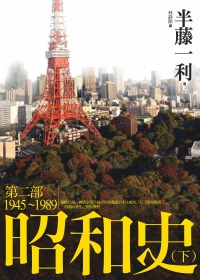
昭和史第二部(下)(半藤一利/林錚顗)

In this very last instalment of Showa Shi, the author focused on the 'after post-war' period of Japan. The forty years between 1950 and 1990 in Japan was characterised in different decades by different political climates, these are all narrated by the author from his personal perspective and experience.

1950s in Japan was constantly caught in political turmoil with different cabinets trying to achieve different ends. Add on to this, Japan, then under American occupation also had to have its political development swayed and sometimes imparted by the geopolitical developments, particularly the US's position in the Cold War vis-a-vis the USSR and China. As a result, the 'clean up' of militarism was incomplete and confusion in the interpretation of Article 9 in the new constitution became a permanent feature of Japan's politics. But once the people started getting tired of all the political upheavals and protests, they decided that they should "find a job" (示威结束,找份工作吧) (pg. 131). This is the author's very interesting way of describing how the Japanese decided that they should start to put emphasis on the economy, turning away from politics. The results are stupendous, at least until the bubble burst in 1990.

From this point, the author's description of the improvement in the standard of living among the Japanese takes an interesting turn. Instead of adopting an academic tone, he started to use many anecdotal examples to give readers an idea of the actual situation among ordinary Japanese. This included the amount of electrical equipment that a household owned (pg. 148), the popular movie (pg. 156), and my personal favourite, the popularity of Ultraman (pg. 185). As I have mentioned in an earlier review, this author did not claim to be an academic and so did not aspire to write a scholarly book. He was therefore not bound by the academic writing style to only cite other academic work. Besides using anecdotal examples, there were even occasions when he speculated outright (the section on the conversation between General MacArthur and the Emperor). The reader is cautioned about interpretation of events and facts.

Besides his obvious love and respect for Emperor Hirohito, the author was unbiased towards all other parties, be they right-wing or Communists, the US, Class A war criminals, or politicians from any party. He reserved his criticism only for the media industry, despite (or because) he himself having worked all his life as an journalist and editor. To him, the industry lacked spine and so was easily swayed, frequently changing their position, and always intimidated. This criticism is not uncommon, also described in another book, and depicted in a movie.

Of the four books in this series, I enjoyed the first one most. This is a personal preference because of my own area of interest. This fourth one is to me the least enjoyable, particularly in the middle when the author talked about the political in-fighting. It was not the writing, just personal interest (or lack of). But all things considered, this series is a very good one for those of us who want to understand the Showa period in Japan, that sixty fateful years.


(Find this book at Goodreads)

23 January 2017

永远的零 (百田尚樹/王蘊潔)

I had earlier introduced readers to the movie based on this book. I finally got down to reading the Chinese translation of the book and it did not disappoint. Unsurprisingly, the book surpasses the movie in terms sensitivity and nuance. Readers, unlike movie audience, have the opportunity to pause and reflect. And reflect they must for not only is this book balanced and thought-provoking, it also challenges the common image of the Kamikaze pilots, one of youths brain-washed and while absolutely courageous, were never able to consider the futility of their mission.

The story is simple. A pair of siblings found out from their mother that she was the step daughter of their grandfather and the real grandfather died in the Second World War as a Kamikaze pilot. She wanted to learn more about him and asked her children to see if they could find any about him. They tried and in the process managed to interview a few of their grandfather's old comrades who encountered him at different theatres and had diverse views of him. While they all agreed that he was an exceptionally skillful pilot, they were less consistent when talking about his courage.

The story is written following a rough chronological order with the siblings coincidentally first meeting people who came across their grandfather in the early stage of the Pacific War and then progressively finding people who knew him in the later stage of the war. Parallel to this is the narrative which started with accusations of him being a coward ending up with him looking more like a good husband and father who refused to die, only because he wanted to go back to his family. Yet he volunteered himself as a Kamikaze pilot, a vocation without hope of survival, and died just days before Japan surrendered. Why did he do this? His reason would be used by the author to try and draw the readers into the wider motivations of the people who became Kamikaze pilots.

While it is easy for people to fall under the spell of some 'isms', the Kamikaze concept takes things into the extreme. You are given a mission that guarantees death with or without success. It is impossible for any sensible person to imagine agreeing to such a mission, yet they did, so for a long time after the war, when historians consider the state of mind of these pilots, they could only conclude that they have been brain-washed and therefore volunteered for such a fanatical vocation. This book did not try to dispute that, but takes the reader through the experience of those who volunteered and the mental and emotional struggle they had to go through especially if their names appeared on the charts in the morning.

Almost everyone in the book, whether relating their own experiences or the experiences of others said that they would not volunteer for such a stupid vocation. But in many instances, they had to make the choice openly at the parade square when everyone else was there. Few would dare to say no for fear of immediate reprisals. Intriguingly, many of those who were given the chance to indicate their choices in a close ballot said yes. There appears to be a climate of fear that nothing was secret, their superiors would know their choice and the reprisals would be unendurable. However, it is certain death we are talking about, what could be worse?

This is where we gain some insights into the psyche of the pilots - volunteering does not imply certain call-up. Volunteering puts you in the 'eligible' list, if you were lucky, you might not be called up. Not-volunteering volunteers you for certain transfer to the most hopeless theatres as an infantry soldier where conditions were the worst, which was equivalent to certain death plus a period of suffering before the end comes. And so they took their chances. Those who did not find their names in the list in the morning heaved a sigh of relief and lived for one more day. Those who did tried to psyche themselves up by convincing themselves that their sacrifice would not be in vain, mostly without success. The pilots interviewed talked about to the letters written by the pilots before their missions (now kept in the Chiran Peace Museum) which convey a sense of loss, helplessness, frustration, and love for their families. This helps to humanise the Kamikaze pilots who would then go on to the most inhuman missions. There is always a contradiction in considering the plight of these pilots. In this book they appeared to understand the hopelessness of their cause and the uselessness of their death, yet many would have been documented to fanatically throw their lives away for their emperor. How should one reconcile the two contradictory sides of the Kamikazes?

I always think that the Japanese culture is a very nuanced and multi-layered one. It is easy to misinterpret them (although sometimes I suspect misrepresenting them serves some political purpose) and so as a nation they look really unrepentant, with the constant visits to pay their respects to Class A war criminals in the Yasukune Shrine and their irresponsible textbooks. Perhaps in trying to read their history, one should suspend our judgement for a while and then try and see if there are more shades than we know before we pass an overly simplistic judgement. The author himself displays some of this nuance in this book. As a one being called a right-winger, I was surprised that in the book he wrote (through one of the characters) that "A country that sends good people to their death like this might as well be destroyed."

This book serves the reader at different levels. One can take it as a simple historical fiction book, or a book that induces some reflection and contemplation, or even a book on the Pacific War from the Japanese perspective. Personally, I think the value of the latter should not be under-rated just because it is fiction. I believe that the author did his work in researching and interviewing when writing this book. I wish that it would be translated into English soon so that more readers can read it and make their own judgement.

(Find this book at Goodreads)

25 August 2016

东京审判:被忘却的纽伦堡 (Etienne Jaudel/杨亚平/程兆奇)

This book on the International Military Tribunal for the Far East is translated from French, originally titled Le procès de Tokyo: Un Nuremberg oublié by Etienne Jaudel. It is a small volume and reads more like a dissertation than a book. Short as it is, this book has its value; for those who have not read much about the Tribunal, this book gives a very good overview of the various aspects of the tribunal, such as the prosecutors, the accused, the judicial proceedings and the criticism of the various aspects of the Tribunal since. More than that, the author actually has a thesis – the Tribunal, as flawed as it was, was important in giving closure to the victims and the families who suffered terribly in the hands of the Japanese in the Second World War.

Many political scientists and legal experts who study the Tribunal questioned the legality of the proceedings. This became especially so after Richard H. Minear published Victors' Justice: Tokyo War Crimes Trial which got many to start looking at the convicted as victims of miscarried justice. Jaudel gave a good account of the difficulties and disagreements in the literature. These include the sparing of the Japanese Emperor Hirohito (pg. 5, 32); the concept of Crime Against Peace having no precedence (pg. 67); the procedural issues (pg. 12, 52) and the suitability of the general prosecutor, Joseph Keenan (pg. 13).

His perspective is different however. To him, a crime so great deserves punishment for those accountable and while the proceedings were not without flaws, the defendants were given due representation including the provision of fifteen defence lawyers (pg. 35). And although the type of evidence admitted was not like those in a usual criminal trial, the circumstances and the deliberate destruction of documents by the Japanese at the end of the war made it necessary for personal diaries and evidence not produced under oath (pg. 52) to be admitted. Furthermore, the author asked, could one expect that the accused be only convicted after there was no longer any doubt in any part of the proceedings? He reminded readers that the accused had all the legal rights accorded by the prosecution and more importantly, the prosecution had the moral grounds to prosecute because they represent countries that did not commit the same crimes (pg. 148).

Admittedly this Tribunal was different from the Nuremburg Trials because the political structure in Japan and Germany were different. In the case of Germany, it was much easier to identify the culprits because they reigned supreme during the war. Japan on the other hand, had ten prime ministers in that time. With power seemingly diffused among the Emperor, the cabinet and the military, it is hard to establish who should take overall responsibilities for the war and the atrocities resulting from it. From the start, the Tribunal was besieged with the problem of whether it was individual crimes or collective crimes the accused were prosecuted for (pg. 39) and with such a confusing administrative structure, the author felt that it was just to convict the accused so long as the prosecution could prove that the accused have direct or indirect involvement in the policy-making process involving the war.

Two judges in the panel of 12 needs special mention here. The first is Judge Radhabinod Pal who was dissenting and would later write a book to explain his position (Pal, 1953). He was accused by a Japanese author, Saburo Ienaga, of being partial to the accused because Pal was anti-communist and China was slowly drifting towards Communism during the trial (Saburo Ienaga, pg. 201). This is hard to prove especially when Ienaga himself was accused of being a communist. However, the credibility of the Judge took a bit of a hit when it was revealed here that he missed 109 days out of 423 during the trials, making him the biggest absentee (pg. 47).

The second judge is Judge Bert Röling who was also dissenting. He was among the people who believed that it was right not to put Emperor Hirohito on trial because he was just a figure-head and did not really have a say (pg. 143). This is ironic because it was precisely because of this that many felt that the Tribunal was a farce (pg. 145). This case is instructive for it highlights the fact that while people many agree that the Tribunal was less than impeccable, they were of the opinion for different reasons. This lack of agreement among the critics of the Tribunal may actually strengthen its legitimacy.

This book is marred by lapses, some of which are minor like the exact dates when Yamashita left for the Philippines which had no material impact on this book (pg. 33, 78, 80, 137, 151) but others  are major  (pg. 37, 49, 60, 62) such as the date that Japan withdrew its membership of the League of Nations (pg. 78). Fortunately, the translator, 程兆奇 did a good job checking the facts and correcting them in the footnotes. What I personally like about the author was his willingness to consider non-scholastic work which he qualified (pg. 20). I think pure scholarly work done in the scholastic tradition is important because it is on this that future knowledge is built. Unfortunately this always leaves the output dry and the physical scenes incomplete. I found myself constantly forming images informed by pictures from books or even scenes from the television programmes especially when reading works on China in that era. I hope more scholars would consider non-scholastic works but of course with qualifications and proper citations.

Finally, two points made by the author is worth repeating here. First of all, he, in response to Minear’s term ‘Victors’ Justice’, proposed that the Tribunal could also be called ‘Losers’ Justice’ because the judges in the Tribunal were all from countries that have suffered under the Japanese, they therefore represent their civilians who have suffered when they were losers (pg. 65). Secondly, a position not widely considered, is the fact that the outcome of the Tribunal ironically relieved the Japanese of their war guilt, for now they can say that it was the responsibility of those convicted (pg. 150) that perpetuated the atrocities and cruelty throughout Asia and brought Japan to the brink of destruction.

Reference
Ienaga, S. (1979). The Pacific War, 1931-1945 : A Critical Perspective on Japan's Role in World War II. NY:The Pantheon Asia Library.

Pal, R. (1953). International Military Tribunal for the Far East: Dissentient Judgement. Kolkata:Sanyal & Co.

(Find this book at Goodread)

08 April 2016

父亲与我 (尤今)

You Jin (尤今) is a prolific Singaporean author whose genre spans short stories, fiction, travelogues and autobiography, among others. She is not a historian and did not claim to write this book as a piece of scholarly historical work. This is a book that is divided into two parts, the first about her father and his days as a member of Force 136, and the second on the life of her parents.

The first part is her arrangement of her father's (Tham) diaries and documents left from his days in Force 136, a branch under the Special Operations Executive (SOE) that operated in Malaya behind the enemy lines during the Second World War. Tham was an important member of Force 136 that was given training in special operations in China and India before returning to Malaya with fellow operatives in 1943.

The purpose of Tham's return to Malaysia was to set up a communications channel with the British Command, then in India in preparation for an eventual British landing in Malaya. But it was not the intent of this book to explore this issue in depth, rather, Tham's diaries provide readers with a very good peek into occupied Malaya between 1943 and 1945 particularly how the anti-Japanese militias with which Force 136 co-existed, lived and evaded capture. Ironically, this group of comrades would become the Malayan Communists Party after the war and would be pursue with deadly force by the British.

Personally, I feel that the most interesting parts of the books were on the few interactions Tham and members of Force 136 had with the populous. First of all, there was this divide between the Chinese and the other races. The Malays more or less went about life as usual and in fact viewed the Chinese with suspicion (pg. 60). Whether it was because of natural enmity or for fear that the Chinese would bring trouble to them because the Japanese tended to treat Chinese more cruelty is unclear. However, one experience with the Indians is instructive. On one occasion, in order not to arouse suspicion, Tham and his colleagues had to pretend that they were Japanese, shouting unintelligible Japanese, cowing the local Indians into silence (pg. 57). The enmity might therefore have also sprouted from the fact that the Malays and Indians could not tell Chinese and Japanese apart. Secondly, among the Chinese there also seemed to be people who were able to get on with life rather undisturbed by the Japanese, this is contrary to the more common narrative of popular Chinese resistance.

In fact knowing now that the British did not make any serious attempt to retake Malaya, one has to wonder about the agency of Force 136. What exactly did they achieve as operatives in Malaya? The current historical narratives surely make quite a big deal of them. There is no doubt their life was hard and fraught with danger and on many occasions they had to suffer deprivation and pain. But in the end did they matter? This would be an interesting area to explore in future.

Leading the team of operatives was John Davis, CBE, DSO. This Englishman, who could speak Cantonese, not only struck up a good relationship with the members of Force 136, on many occasions he provided strong leadership to the group. Whether it is going off to look for water in hostile territory (pg. 16) or getting everyone out of a the jungle when the local guides were lost (pg. 60), one can see that it was he who the rest of the team looked up to. His story is told in Margaret Sheenan's (2008) book Our Man in Malaya.

The story of Force 136 has been recounted in several books (see for example Chen & Tan, 1995; Taylor, 1989; Trenowden, 1983) and this one adds in a small way to that body of literature. But its contribution is more of a first-hand account of the operatives' life in Malaya. Although it was a bit too brief for me, this serves as a good introduction to a topic that a reader may want to delve deeper into in future.

(Find this book at Goodreads) 

Chen, C. and Tan, C. T. (1995). Force 136: Story of a WWII Resistance Fighter. Singapore, Asiapac Books Pte, Ltd.

Shennan, M. (2008). Our Man in Malaya: John Davis, CBE, DSO, Force 136 SOE and Post-War Counter-Insurgency. UK, The History Press.

Taylor, C. G. (1989). The Forgotten Ones of South East Asia Command & Force 136. NY, Hyperion Books.

Trenowden, I. (1983). Malayan Operations Most Secret Force 136. UK, Heinemann.

27 February 2016

民國史抗戰篇:烽火八年 (唐德剛)

This book is a selection of Professor Tong Te Kong's works. Some are papers published in journals, others are his papers presented at conferences and a few were his editorials in the newspapers; there are even a couple of letters he wrote in reply to people who wrote in with comments about his works.

Professor Tong was born in China in 1920 and was in his teens in the tumultuous years when China was resisting Japan. He attained his PhD in Columbia University and stayed on in the US, becoming a naturalised citizen. This background is important because being an American citizen, he had the freedom to write without having to take sides, Chinese or Taiwanese. This is an important quality when one writes about China's modern history, for both sides (less the Taiwanese nowadays) try to narrate the story from their own perspectives, leaving one an incomplete if not biased picture of the history not made up by the narrative from the other side. 

Although a collection of essays, Prof Tong's position is a consistent one and the chronoligcal arrangement of the essays makes following the events easy. To the author, once the Japanese were given a foothold on the Asian mainland, opportunities were abundant for all kinds of conflict with the Chinese armed forces, and the Japanese (especially the Kwantung Army) made use of it to the fullest (pg. 21), culminating in the Marco Polo Bridge Incident that kicked-off the Second Sino-Japanese War proper. However, the situation following the incident was not only a series of battles, there were also political intrigues and double-crossing. The most famous of these no doubt is Wang Jingwei's defection from the KMT setting up an alternative government in the fallen Nanjing. A good number of chapters dealt with this and since one of the players was Prof Tong's father-in-law, his account of the incident has added weight. The value of these few chapters is not just in the special insights he was able to give, but his good analysis of why Wang is today considered the traitor of the first order. And it is just as well that a significant part of this book is on this treachery for if there is a thread running through the book, it is that of duplicity.

Besides Wang's own betrayal, there was also Chiang himself dabbling in such some rather dubious episodes when the need arises. His own management of the situation with the Japanese is a case in point. On the one hand he whipped up the nationalistic fervour among the students but on the other he sent his agents to talk peace with the Japanese (pg. 30). A similar ploy was employed when he was dealing with the Americans. At that stage though he was deep in the war with the Japanese, when it suited him, he would intentionally give the Americans the impression that he might seek a separate peace with the Japanese (pg. 303) just so that he could continue to blackmail the Americans.

However, the most chilling instance of betrayal of all was how Stalin might have dealt with China. It is not generally known, but it was said in the book (pg 261) that Stalin contemplated a deal with Japan in which they would split China into two, much like how he and Hitler split Poland. This is not something beyond Stalin, and if it happened, the history of China and indeed, the Second World War would be different. In the end, the only ones that seem to be straight-dealing are the Germans. (There is a story about the Oskar Trautmann, ambassador of Germany to China that bears reading, pg. 170).

Having been brought up on a diet of Western scholastic journals, I was rather amused by the style of Prof Tong. The Chinese language, like English, has been increasingly 'simplified' to make it 'user-friendly'. Prof Tong however, continued to write in a more traditional way and while sacrificing
'user-friendliness', he has shown me how the Chinese language, when used correctly, can be  economical but elegant. Yet at the same time, he used words that one would never see in Western scholastic work, such as the Chinese version of 'bullshit' (pg. 257).

Prof Tong gave a balanced in writing this book, being a scholar who must have intimate contact with colleagues from China, Taiwan and Japan, he has honed the skills required to carefully present his case while avoiding unnecessarily upsetting anyone. Despite that, when he thinks that his case is strong, he would not hesitate to say it for what it is. As an example, he was not afraid to give an unflattering description of the KMT soldiers (pg.13) or to smash the common CCP narrative of how much they contributed in resisting the Japanese (pg. 270). Yet at the same time, where credit is due, he would not be stingy about it (pg. 174). Similarly, while he obviously had great respect for the Young Marshal Zhang Xueliang (whom he had a chance to interview), he was quite ready to say that Zhang was naive (pg. 183) and even rash (pg. 353) in .

The author was obviously learned, just a clarification on whether the Marco Polo Bridge was supposed to be 《卢沟桥》 or 《芦沟桥》could be the subject of a paper that quoted very good examples. His own experience as a teenager in the war, his relations to people who were important players in those days, and his work as an oral historian all contributed to his huge base of knowledge. Add to this his very interesting and engaging style, I find his books well-worth reading and cannot wait to start on his other books in my collection.

"The reporter knows nothing but probes persistently hoping to hit the sweet spot which will induce the interviewee to start talking. The researcher, on the other hand, starts with a hunch. He probes in the hope of hitting the sweet spot which will cause the interviewee to bottle up, and that's it, the hunch is confirmed."
- Prof Tong on the difference between a reporter and a researcher (pg. 105)

(Find this book at Goodreads)

02 January 2016

百年家族-张学良 (李翠莲)

This is yet another book on the Young Marshal, Zhang Xueliang, this time written by a Chinese scholar (as compared to Taiwanese). Although most of the book is on the Young Marshal, the first quarter of it is on his father, Zhang Zhuolin. The inclusion of the elder Zhang is useful, for it gives the reader the background of the Young Marshals' life, his upbringing and in particular how his father has influenced the direction of his life.

Any book on Zhang Xueliang would not miss the Xi'an Incident, and to a lesser extent, the Manchurian Incident, this book is no exception. However, the author took a broader view of Zhang's life and so did not give a disproporationate amount of attention to just these two incidents. Instead, she focused on the various important events that took place throughout his life, including his more than half century of internment and more importantly, the different people that are important in his life: his father, his first wife Yu Fengzhi, his second wife Edith Zhao, his siblings and most all, Chiang.

Although there was no chapter dedicated to Chiang, he was mentioned throughout the book and invariably in a bad light. All decisions made cast him as a devious, selfish and crafty leader, unworthy of a loyal and somewhat naive Zhang. As a book published in China shortly after the Cultural Revolution, it is not surprising that the author took on such a position and tone. Unfortunately this makes the book come across as biased and may lead the reader to devalue it as a resource. Zhang made several decisions that could be interpreted in different ways, and he was vague about them in later life in various interviews. But while the author made him look patriotic and compassionate throughout, sometimes even naive against the indespicable Chiang, one must remember that Zhang is not incapable of duplicity. For example, how does one interpret his back-channel and eventually direct communications with the Communist while serving as the deputy to Chiang who had overall command of the KMT army? How does one look at Zhang's hedging of bets during the Central Plains War (中原大战) as he twiddled his thumbs and decalred that he would support Chiang if Chiang could take Jinan (济南) (pg 185)?

Having said that, this book is actually packed with good facts and information, especially with regards to the dates and events. This shows good research which unfortunately is weakened by an overly anti-Chiang interpretation on the author's part.

(Find this book at Goodreads)

29 November 2015

昭和史第二部(上)(半藤一利/林錚顗)

This is the first volume of the second set of Showa Shi by Kazutoshi Handō. The first set dealt with Japan's decent into the Second World War, this set, particularly the first volume, deals with the few years after Japan's surrender and occupation by the USA. The major threads in this book are the life of the Japanese in the immediate aftermath, the drafting of Japan's new constitution, the Tokyo Tribunal, and the Korean War and its effects on Japan.

It is important to stress that the author was there when it happened, he was a thirteen year old boy who was too young to be enlisted when the war was going on, and so he was instead made to work in an ordnance factory. Being  old enough to experience the life after Japan's defeat, his story has the element of realism to it, not to mention that the author is also a persuasive one. Although what he said represented his own feelings, it gives the reader a sense of how others might have felt as well. The immediate end of the war brought tears (pg 12), which came from a mix of relief, regret, and just uncertainty. After years of war, some, especially the those in the army, would not accept that this was the end (pg 16). Civilians, on the other hand, had wanted it to be over for a long time. Yet when it came, the uncertainty that surrounds the cessation of the war threw many of them into despair.

But there were also those who were quick to switch their tone. Shortly before the war, the army was still encouraging everyone to sacrifice for the Emperor. Immediately after the surrender, the establishment was dissolved almost without incident (pg 19), it makes one wonder what was really in the mind of  Japanese Army brass and the common soldiers near the end. The biggest irony was how, in order to protect the women from the American occupying force, the police actually persuaded some to become prostitutes (pg 20). They expected the worst from the occupying force, that, can be taken as a reflection of themselves as an occupying force in other countries. But the general condition of the people was tough, and after many years of oppression, even the weather forecast on the radio was greeted with welcome, it was a small step towards normality (pg 22).

With that described, the author then moved on to a few important themes that were important to the aftermath of the war. The first of these is the meeting between General MacAurthur and the Emperor Hirohito.

From the Japanese perspective the Emperor certainly admitted his guilt to MacAurthur, and small actions, prevalent in a society as nuanced as Japan, can reflect this position. For example, Hirohito did not drink the coffee offered to him, that's a show of accepting his submissive position as a loser of the war (pg 41). Beyond this meeting, there were many occasions when the author tried to show that the Emperor was ready to face the consequences of surrender but many other Japanese were terrified of what the occupying force would do to him. They were almost obsessive about trying to ensure that he would not be tried by the allies. In fact, it appears that MacAurthur never intended to put the Emperor on trial, and the earlier worries were all unfounded.

The second theme was on the drafting of a new Japanese Constitution. In the first place, the Japanese were not even able to interpret the word as the Americans meant. To them, Constitution meant the make-up, or an organisation (pg 110), not as understood by the Americans. This confusion would extend to even the tone used in the recording of minutes (pg 170) and how seemingly unrelated events were interpreted by the Japanese. There were times when in the middle of discussions, B25s would fly overhead, the Japanese would take it to be a warning (pg 173) to relent to the Americans' position or be bombed again. And then there would be times when the Americans' would joke about using atomic energy to get some warmth and this, obviously insensitive even to me, was naturally taken to refer to the atomic bombs, a reminder again to the Japanese that the Americans held absolute power over them.

The exercise to redraft a new constitution was fraught with difficulties. Two groups of people were trying to draft the new constitution, one was appointed, one was self-appointed (pg 115). There were also people who thought that they should just do what the Americans wanted them to and then after the Americans leave, they could re-draft the whole constitution (pg 119). There were other difficulties, no one wanted to touch the issue of the position of the Emperor and so they procrastinated and delayed (pg 128). MacAurthur eventually lost patience and thought that the Americans should do the job (pg 160) but they did not tell the Japanese, leading to huge consternation among the Japanese.

While the constitution was being drafted, there was already a huge re-education exercise going on. The belief then was that Japanese education has indoctrinated everyone with militarism, leading them to fanatically fight a devastating war and so the whole curriculum must be revamped. Unfortunately with all wholesale obliteration exercises, the good are removed with the bad. There were actually good things about the original curriculum in moral education, but since the idea was to remove all the vestiges of the old, those that had thought good values were also removed (pg 135, 138).

This also extends to the position of the Emperor who hitherto had been like a God to the populace. After the Emperor abdicated from this position, people were wondering what to do, how to position their Emperor. Could they now just write to him and ask him to solve the problem of their hunger? Where would they write to, the palace? There are also social impacts. The democratisation of gender and age, giving all the same rights fundamentally changed the Japanese society. The older ones who would have been given more rights suddenly found themselves left with nothing much (pg 199). When it came to the removal of people linked to the war from their jobs, most of the head of organisations were removed. Although many were to later re-emerge as important people in the cabinet or in business, for a while most organisations were left with second-tier people and many, in order to escape persecution, turned other people in (pg 141).

One more humourous incident related by the author was on the textbooks used by the students. While all curriculum was to be revised, in the meantime the government was not able to pay for the printing of new textbooks, so the students had to continue using the old textbooks. But it is the policy that certain words relating to militarism must not appear. So these were painted over in black. But since there were so many of them in the textbooks, after the exercise, the whole textbook has become black (pg 62).

The part of the book that was most informative was on the Tokyo Tribunal. I have not read another book on this topic but have always assumed it to be a very serious affair and while the author did not try to trivialised it, one could not help noticing somehow that there were some rather dumbfounding moments. Most people would know that there were 28 accused in the tribunal, but few knew that  the Russians wanted to add another 2, and since there were only 28 chairs, two of the 28 in the original list were removed (pg 28).

The author gave his views of the purpose of the tribunal, first by stating his understanding of the its purpose. 1. To judge Japan's modern history, 2. As a ceremony for revenge, 3. As a part of re-education of the Japanese. The irony was the prosecution wanted to pronounce the defendants guilty, but the defendants themselves wanted to protect the emperor and were not averse to admitting guilt and so the motivations were aligned. Notwithstanding that, the author was particularly unhappy about the first charge - "As leaders, organisers, instigators, or accomplices in the formulation or execution of a common plan or conspiracy to wage wars of aggression, and war or wars in violation of international law". To him, unlike Germany, Japan's cabinet changed numerous times during the war, it was therefore difficult to accept that there was a conspiracy. This charge was fine for the Nuremburg Trial, but it was used forcefully in the Tokyo Tribunal because it was a precedence and a convenient one to sentence the accused to death. Since the Japanese did not agree to this charge, they honour the 8 convicted defendants in the Yakusuni Shrine (靖国神社).

Two other interesting points were raised by the author. Firstly, he speculated about what would happen if the cases were judged by the Japanese. Given the general aversion to war and the military then, more could have been sentenced to death. Secondly, and more tragically, the north-south divide in Korea and Vietnam all came about because of the need to let the Japanese surrender to the allies. In both cases, it was decided that the Japanese on the north of a certain latitude would surrender to the Russians, and those on the south would surrender to either the Americans or the British. None would be able to foresee the tragic consequences.

How did the Japanese view their guilt? The concept of 一億总忏悔, one hundred million people feeling guilty together, lulled the rest of the world into thinking that the Japanese really took a serious view of their war guilt. But since 'one hundred million' shared the collective guilt, everyone felt less guilty (pg 27). In addition, while the re-education of the Japanese made many wonder - did we really do this? (pg 93), it also gave them a chance to think, like the Germans, that they themselves were not so bad, It was the army that was bad (pg 94).  And really, to wonder about one's war guilt when he is hungry to the point of starvation is just unthinkable, most are more interested in filling their stomachs (pg 96).

This is an educational book written by an author who is not afraid to call to task his own people for perpetrating much suffering to victims of their atrocities. Yet where he felt that history has misunderstood the Japanese people, he would not hold back from correcting these views. His most valuable contribution comes from explaining the views of the Japanese people, their feelings, and bring to light their subtlety in everyday interactions and how this shaped how Japan became in the aftermath of the war.

(Find this book at Goodreads)

27 October 2015

伪满洲国(迟子建)

This is a story about the lives of a cross-section of people in Manchukuo when it existed between 1932 and 1945. The author gave a very broad sweep of people from various social classes to give readers an idea of how people in the different strata of society lived their lives in a state that functioned more like a Japanese colony. All were affected in some ways, the poor more than the rich as the rich inevitably have better connections. But besides being more adversely affected, the poor were also affected much earlier than the rich. For the rich, as long as the Japanese were winning the war, life carried on more or less as it used to be. For the poor though, many were already forced enlisted into the many labour teams used by the Japanese to build the facilities and infrastructure that they needed. The labourers joined up either because they were deceived by the promises of food and lodging or because they had nowhere to hide from the militias going after them. Villagers who were not enlisted fared worst; what was left of their grains were forcibly taken and many were killed indiscriminately.

What makes the book truly a compelling read is how individuals were depicted in the book. Structured into 14 chapters (over the 14 years of Manchukuo's history), each carrying 6 sections, and each section focusing on one person or a group of people as they lived through the years, one can see how lives of different people changed along with the destiny of Manchukuo, or more accurately, Japan. The lives of some of the characters crossed path, while those of others did not, but everyone has a story and collectively,  their stories tell the story of Manchukuo.

With great nuance, the author explored the individuals and how they felt about life then. People like 王亭业 (pg 3) and 张容彩 (pg 26) harboured animosity towards the Japanese, but were careful about expressing their feelings publicly. Pragmatic ones among the populace would cooperate if not for actual rewards which can come in the form of extra food, (see pg 371), then just to stay out of trouble, happy to let others do the resisting (pg 35). But there were others who collaborated, yet where they could, they tried to help their own (pg 434). Of course there were also those who took up arms by joining the militia. Unfortunately in this book, their plight invariably involved a life of hardship, deprivation and in many cases, betrayal leading to torture and death.

Most intriguing to me has got to be the way the author depticted specific Japanese characters. Although there is a general negative portrayal of the faceless Japanese military man, when it came to individuals, the author was a lot more nuanced. There was one that did research on living and dead humans in the notorious Unit 731 (北也南次郎) and had no compunction about watching his subjects suffer the most inhuman treatment, all because of his passion for his research. But he too was to exhibit some feelings especially after establishing a curiosity about Patient 26 (王亭业). His friend 羽田, on the other hand, is perhaps more paradoxical. As a Japanese military personnel, he defied that general image of cruelty and arrogance to always save his feelings for that one special girl who gave him that lucky scarf. Throughout his time in Manchukuo, he did not participate in any of the excesses commonly associated with Japanese soldiers. It makes one wonder about the motives of the author in her inclusion of this character.

One particular character stood out ironically despite his relative immunity from the political and military upheavals. 胡二 started off as a bandit, but after an operation that went wrong largely because of him, he escaped into the mountains with his abducted wife. From then on, his life would have its ups and downs mainly due to his inability to control his libido. This is an interesting character that would be usually missed out in books depicting lives of people in those times for his life was unscathed despite the great political turmoils and human sufferings. For that I credit the author for being able to give the story of Manchukuo a wholesome treatment, almost missing out no one. But more, I credit the author for so skillfully placing this character in the reader's heart. One that would be easy to dislike, if not hate, yet through his love for his family, especially his son, his big-heartedness in his business dealings, and his generousity towards a Japanese fugitive at the end of the story, he redeems himself in the eyes of the reader making the reader feel for him, and if it carries some reluctance, there is a lot more forgiveness.

At the start of the story, an old man gave his two grandsons two halves of a mirror just before they left home to pursue their own careers. They were to reunite the two halves of the mirror as a commitment to their own reunion. Alas, the two halves of a mirror were united, only that they were in the hands of two other people. Like the story of China and Manchukuo, the three north-eastern provinces would eventually reunite with the rest of China, but it would be through a long and tortuous path. And despite all the sufferings and death in the book, one hopes for live to be better.

(Find this book at Goodreads)

17 July 2015

张学良与中国 (松本一男/林敏生)

Coming on the heels of another book on Zhang Xueliang (张学良), 张学良与日本, is this book. This is a rather short book of about 250 pages. The first quarter of the book was on Zhang's early life, and therefore has much to do with his father, the warlord Zhang Zuolin (张作霖). Zhang Xueliang came to prominence after his father was murdered by the Japanese and partly motivated by that, he decided to 'change flag' (易帜), that is, to change to the Nationalists' flag in a show of subjugation to them. After he lost his empire to the Japanese in the Manchurian Incident, he became increasingly opposed to Jiang's policy of 'Resisting Foreign Aggression after Stabilizing the Country' (先安内,后攘外), which culminated in the Xi'an Incident (西安事变) resulting in Zhang's five-decade house arrest.

This book was written by 松本一男, a Japanese born in Taiwan. However, when I first started, I wondered who translated the book, was it done faithfully to the original script or was it done by a Taiwanese or a Chinese who skewed the slant of the book towards their national stance on Zhang; the Chinese treat him as a national hero, the Taiwanese, a traitor. Some of the early parts suggested that the Chinese Communist Party might have a hand in it. There were instances when the author was highly critical of the Japanese (e.g., pg 41), in ways that only Chinese would do. Others, like the claim that growing up, Zhang did not even have the slightest affinity to the Japanese (pg. 43) also sounded a little too much like Chinese writing, there was also much criticism of Chiang Kai-shek throughout the book, written in a way contemporary Chinese would. Yet at the end of the book, the author's stance was a lot more unbiased, for example, his opinion that the Xi'an Incident saved the Communist Party from annihilation was not something many in China would admit to readily. Most of all however, is his description of the June Fourth Incident in China in 1989. This would never have made it into print had it been translated by a Chinese.

On the Xi'an Incident, there wasn't a lot written. How Zhang came to be in cahoots with Yang Hucheng (杨虎城) was totally ignored. But the author showed that the general political condition then made it hard for Zhang to hold the line on 先安内,后攘外. This book might be a little dated and so some facts were not firmly established when it was written. It could be for this reason that I found the author careful about being overly certain concerting events that are hard to authenticate. For example what was Zhang doing on the night of when the Manchurian Incident took place? Current accounts prefer to suggest that he was having a good time in the theatre. The author took the more tentative approach of suggesting that it was not conclusive and so two accounts were available. He was also less dramatic in describing Jiang's capture during the Xi'an Incident compared to this other account. On the other hand, what was glaringly inconsistent with common knowledge was his missing out on the fact that Chiang fell and hurt his back while trying to escape during the Xi'an Incident (pg. 176).

Overall though, I feel that the author has done a very commendable job in synthesising and presenting his facts. This can be seen from his triangulation of information with various sources when presenting the account of 'who did what' during the Xi'an Incident. More telling was his handling of the literature surrounding the execution of 杨宇霆 and 常蔭槐. The author commented about the conflicting accounts in the Chinese literature and their tendencies to sensationalise and he therefore decided only consulted overseas literature (pg 85). Another strength of the book was the detailed information on the different sects and warlords (pg. 91) and also the order of battle of Zhang's army.

What was surprising to me was what I thought would be the most boring part of the book turned out to be the most moving. This concerns Zhang's life in house-arrest over the five decades, how he turned from being hopeful of early release to join the fight against the Japanese to his gradual acceptance that it would not happened, yet sprinkled sporadically with unfulfilled hopes when old friends visited him promising to put in a good word for him in front of Chiang; the condition of his living quarters in the different places, where he sometimes could only spend a few months or even weeks because of the Nationalist Army's constant retreat from the Japanese; his general state of his physical and mental health and in the end, how his 'freedom statement' was dictated by the politics of Taiwan, right up to the third president.

This book speculates about Zhang Xueliang's nature and attributed his eventual sympathy with the students' cause in 1936 to the May Fourth Movement which he witnessed as a young man . It is easy for people to feel this way about Zhang for he clearly was more naive than he should be, one need only see his belief that Chiang would not treat him as he did. And from this, one can make a judgement on Chiang.

(Find this book at Goodreads)

27 June 2015

西安兵变情恨 (王月曦、薛家柱)

The Xi'an Incident (西安事变) is an important and controversial one in Chinese history. Briefly, on 12 Dec 1936, Zhang Xueliang (张学良), the Young Marshal, incarcerated Chiang Kai-shek (蒋介石) in Xi'an in order to force Chiang to agree to stop his war against the Communists and to instead work with them to fight the Japanese. Chiang was eventually freed, but Zhang would spend the rest of his life under house-arrest, even after Chiang died in 1975.

This book was written in collaboration with 汪日章 (Wang Rizhang), who was the secretary of Chiang. It is however important to remember that Wang remained in China and together with the fact that the book was originally published in China, it is no surprise that the slant is hugely anti-Chiang, or pro-Zhang. But that aside, this book covers a lot of ground, including the run-up to the incident and the aftermath, much of the facts are also fairly accurate. The style of the authors is engaging and so the reader is treated to a thriller-like narrative of an event that still has some reverberation today.

What I thought was missing was 杨虎城's (Yang Hucheng) role in the whole affair. It is well-known that he is the other party to the abduction of Chiang, and in fact, he and some of his family members were executed by Chiang because of that. But while the book gave much attention to how Zhang was slowly moved towards taking this drastic step, there was no mention of Yang's motivation. I am convinced that for one to take part in such a risky business, he must have gone through a process, which involves some soul-searching and doubts. Zhang would not be the only one to go through it, Yang would have as well. Instead the writers gave the impression that Yang suddenly appeared non-committal after Chiang was detained. This was not an accurate depiction of Yang. First of all, Yang never trusted Chiang, he had insisted on a signed undertaking by Chiang before he should be released, but Zhang did not push it in his negotiations with Soong Meiling. What was worse was the negotiation was done in English, which Yang did not speak (see 往事:杨虎城之子回忆 ). I would be angry in I were Yang.

The Xi'an Incident continues to be debated today, partly because of its significance, partly because Zhang himself appeared to give contradicting views and information on different occasions. All the parties involved are no longer around, but this is only the start of my exploration of this incident and this book has certainly helped in my quest.

(Find this book at Goodreads)

01 June 2015

往事:杨虎城之子回忆 (杨拯民 )

I bought this book in the belief that it was a book on 杨虎城 (the collaborator of 张学良 in the Xi'an Incident - 西安事变), more specifically, a recollection of what happened during the Incident. But I was disappointed, it turned out to have only a small chapter on the Incident, and perhaps only about half the book was on 杨虎城 himself. Much of the rest of the book was on the author himself, the son of 杨虎城 and too much of it was on his adulation of the personalities in the Chinese Communist Party and his relationship with different people whom played bit roles in the greater scheme of history but must be mentioned given the Chinese's culture of 'giving face' (给面子). It was until the end of the book that I realised that while the book was written by 杨拯民, it was arranged by his wife after his death and only at the goading of his friends.

However, one does get some rewards making it through the book. For one thing, writing from the perspective of a common man, the reader gets a sense of general attitudes of the people in China in that tumultuous period. For example, if they were indignant towards the Japanese's invasion of China, they continued to want to live their lives as usual. Even the Marco Polo Bridge Incident did not rouse them to want to fight (pg 155), hoping on one hand that this might be the point when the Japanese could be chased out of China, but wishing on the other hand that the Incident would not precipitate a bigger war. This dilemma puts paid to the notion that Chinese were all patriotic.

Brief mentions were given to the Cultural Revolution that happened much later. It is obvious that the author and his wife both suffered greatly during that time. While they were spared of their lives, many of their friends were not. But the author was unwilling to talk more about it, giving only brief mentions of what happened in drips throughout the book and even absolving Mao for what happened - 人非圣贤,孰能无过。 Indeed.

What is more interesting to me was the almost complete lack of mention throughout the book about his or the Communist Party's fight with the Japanese. Yes, this is the autobiography of a single person, he might have been lucky to have escaped having to fight the Japanese. But he spent many years in Yan An (延安), the Communist base and then was posted to various places, yet in none of this was he required to face the Japanese, nor did he talked about anyone who he met who had. It makes one wonder about the scale of the Communists' involvement in fighting the Japanese.

Overall a rather disappointing book, and if you are trying to understand more about the Xi'an Incident, this is not a book that you need to read. But if you are interested in the somewhat ethnographic take on Chinese life, then this provides one view.

(Find this book at Goodreads)

03 May 2015

最后的帝国 (恩斯特·柯德士 / 王迎宪)

Ernst Cordes was a German journalist who covered China in the tumultuous period in the 1930's. This book is a travelogue detailing the important trip he made to Manchukuo after its formation in 1931 as a result of Japan's annexation of the three eastern provinces in China, namely Heilongjiang (黑龙江), Liaoning (辽宁) [Used to be named Fengtian, 奉天], and Jilin (吉林). This book was originally published in German in 1936 and the version reviewed here is a translation by Wang Ying Bin (王迎宪).

Although the object of the author's trip was to interview the re-installed emperor, Pu Yi, the section that described that interview was very short, and likely because that was how the interview was. But the interview, while potentially able to provide a good historical record, would not provide readers with the rich account of China (not just Manchukuo) at that time. Fortunately for us, Cordes was conversant in Chinese and was therefore able to communicate with the many common man (老百姓) he met along the way. Add to that his keen sense of observation, and we have a book that is able to paint a most lively picture of what life was like in Manchukuo.

Manchukuo at that time was just going through a spate of construction and this one could easily get from the description provided by the author. The palace where he interviewed Pu Yi was none too grand compared to the Forbidden City the deposed emperor was more used to. More vivid was the 'chicken coop' where the immigration officer worked on the author's arrival. It was a temporary structure hastily constructed while the actual building was being built.

More interesting surely was his description and depiction of the people in Manchukuo. As it happened, Manchukuo was a rather cosmopolitan place. There were the Chinese aplenty, the Japanese predictably, and Russians, surprisingly. The Russians were mainly people who escaped the Russian Revolution and could no longer go back. Each of these races appeared to live separate lives and occupied different strata of the society.

The Japanese were an occupying power, despite all the political theatre of Manchukuo being an independent country, there was no question who was boss. The Japanese were by then a confident and powerful race. Unlike the Chinese, they did not treat Westerners with reverence, and perceiving themselves to be highly superior to the Chinese, they treated the Chinese like dirt. Throughout the book, there were examples of the Japanese's efficiency mixed with brutality. But they also had their quirks (like taking their pants down when they felt hot), but more importantly, their militarism, which even extended to the toys and military-themed candies meant for children.

The author's was at his best however, when he was talking about the Chinese. And if there was one word to describe Chinese live, it was cheap. First of all, then, as with half a century later, Chinese labour could be bought at rock-bottom prices. Already then, the author recognised that at those prices, no European country would be able to match the prices of products coming out of Manchukuo. Secondly, Chinese themselves would gladly give up their lives for a small price. The incredible example of how a general managed to stage a battle with live bullets and real people dying by just offering the winner $500 said it all, this was all done in the name of producing a documentary about the warlords fighting amongst themselves.

If that sounded unbelievable, the description of the everyday life of an average Chinese would substantiate that story. From his own accounts of how the Chinese labourers were treated, to the poverty he witnessed from how the Chinese had to sell their children, to how people were dying in the streets. His description of the filthy restaurant where he had a delicious dinner with the poorest of the Chinese would give one an idea of the general hygiene condition the Chinese put up with everyday.

The best account however, was his own encounter with the bandits who were trying to rob the train he was riding in. Soon after the bandits were repelled by the Japanese soldiers tasked to secure the train, the Chinese passengers seemed to be able to put the whole episode behind them so quickly that it appeared to never have happen (他们谈笑风生). The journalists would later report their disappointment when referring to the incident, saying that "only one baby was killed, everyone else was safe."

Interestingly, throughout the book there wasn't a mention of the Manchus, who were supposed to be of a different race from the Han Chinese. It could be that he could not tell the difference, or more likely, the Manchus had by then been assimilated into the Han race. The author himself made this comment about how Chinese culture is one that easy absorbs another and it appears that the Japanese are the only ones who knew it all along and had deliberately maintain a chasm between themselves and the Chinese. There were few inter-marriages and the few attempts from the more idealistic Japanese to see Chinese as the same (the tea-ist view) ended up in frustration more for the Japanese than the Chinese. If the author failed to discern between the Manchus and the Chinese, he was more than able to aptly describe the difference between the Chinese and the Japanese - 此黄非彼黄。(This yellow is not [the same as] that yellow.) He put it down to the races being 'fundamentally different' (本性差异). Indeed, the Japanese appeared to be a race that was determine to show the world that they were to be reckoned with. The Chinese, on the other hand, appeared to only base their existence on their 5000 years of history and was more than laid back about their lives. The Manchuria Incident (which precipitated the formation of Manchukuo and Japan's eventually withdrawal from the League of Nations) went unchallenged militarily for years. The Chinese themselves, while unhappy about the annexation, nevertheless appeared ambivalent about it (pg 123).

When this account was being written, there was still no agreement on who killed Zhang Zhuolin. Much would eventually happen in China. This book is by no means a scholastic account of China in the early 1930s, it is however a vivid account of what China was through the eyes of a very observant and interested journalist. Capturing a moment in China's history, he served Chinese history enthusiasts greatly by painting a picture of the life of an ordinary Chinese and was able to help one understand the events that would follow later.

(Find this book at Goodreads)

27 December 2014

张学良与日本 (臼井勝美/陈鹏仁)

This book was originally published in Japanese coming out of a documentary that NHK made about Zhang Xueliang (张学良), also known as the Young Marshal. Zhang was the son of Zhang Zhuolin (张作霖) the warlord from the northeastern provinces of China. His life was a fascinating one but he was most well-known for the Xi'an Incident (西安事变) where he and his associates abducted Chiang Kaishek and forced him to stop the pursuit of the Communists and instead work with them to fight the Japanese who at that time had occupied Manchuria and had declared it an "independent" country called Manchukuo.

As mentioned, this book was written from the materials and interviews made for the documentary on Zhang and reads exactly like that. While the author had access to Zhang, this book is not a collection of her interview with Zhang. In many places it was written almost like a script for a documentary and in other places the author filled it with materials from other sources. In fact there was surprisingly little from the actual interviews and the most disappointing of all, Zhang refused to divulge anything on what happened in the Xi'an Incident. And honestly, he  had kept his mouth tightly shut about the most important details of the negotiations between Zhou Enlai and Chiang Kaishek in the years after that.

However if one is looking for a source that is easy to read to get all the facts of Zhang's life, this book would be a good reference. It is not one that gives the reader an in-depth understanding of the events because it lacks the analyses of the various events and therefore ended up looking a little disjointed and lacking a central thesis. But to be fair, the author never meant for this book to be one of an analysis of Zhang or any events associated with him, it is simply a documentary turned into a book.

I know of Zhang in my earlier readings but did not find out more about him. If this book has done anything for me, it has piqued my interest in him and he being young in those tumultuous years actually lived long enough to entertain a few video-recorded interviews that are available on YouTube (they are in Chinese though). His history has been presented in almost opposite ways in China and Taiwan. With this book as a start I hope to find out more about him and come to my own assessment of him.

(Find this book at Goodreads)

23 February 2014

昭和史第一部(下)(半藤一利/林錚顗)

In this second volume, the author concentrated on the early part of 1940 and all the way to 1945 when Japan surrendered after the dropping of the atomic bombs. The style of the author has been discussed in my earlier entry reviewing the first first volume of the work and has remained largely similar. In this volume, whether he meant to do it or not, the central theme is the behaviours of the policy makers and the military personnel in Japan in those years.

Starting from the late 1930s Japan has rearmed, having withdrawn from the League of Nations. They were then caught in something of a quagmire in China and while events in Europe have been increasingly dangerous, the Sino-Japanese War have been left largely as a side-event in the minds of the West. However, one can't help feeling that events in Asia have taken a life of its own. Japan increasingly felt isolated and was under pressure from the US whom exported most of the oil that Japan needed. Japan wanted to avoid conflict with the US and at the same time wanted to find a way to end the war in China for it was already beginning to take its toil domestically. Finding no support from the US, the UK and their other allies, Japan gravitated towards the Axis and finally entered into the Tripartite Pact with Germany and Italy. Japan's reason for entering the Pact (suggested by Germany) was not clear nor compelling, indeed there were those in Japan that had not supported Japan's entry into the Pact. But it appeared that those who supported it all did it for their own selfish reasons. Take this entry from Kazushige Ugaki's diary (pg 25) whom the author accused of supporting the Tripartite Pact in order to get more resources for the army. But whatever their personal motivations, one does not get the impression that something this important was seriously considered before the final decision was made.

Another example was how they were ready to enter into an alliance with the Soviet Union. One can argue that Japan's involvement in Manchuria was partly due to the need to check the Soviet Union. This got them into a stalemate in China which soured their relationships with much of the rest of the world, and yet later in having to continue the war in China they wanted an alliance with the Soviet Union (after Nomomhan to boot). It is a little hard to square the logic in all these.

Worse was their decision to bomb Pearl Harbor. There was almost a consensus that Japan could not have a prolonged war with the US, including the Admiral Yamamoto who planned the operation. Yet it was almost as if everyone allow one event to lead to another and just went along with it without voicing objections until it was a done deal. The worst of this behaviour would come when Japan wanted to end the war. The way they went about talking about how to go about it and never quite getting down to it was tragically comical. But the author did us a favour by discussing one relatively small event, quoting from two commanders' diaries he showed us why a coming to a decision was hard, even between (or especially between) Japanese.

Referring to the Battle of Kohima when Japan suffered a huge defeat, it appeared that the two commanders Renya Mutaguchi and Masakazu Kawabe knew they stood no chance to winning and their forces were about to be annihilated. Yet both of them would not order a retreat. Post war, this was what they wrote in their respective diaries:
  • Renya Mutaguchi: Although I wanted to say that it's already time to quit the fight in Imphal, when these words reached my mouth, I just couldn't get them out. I could only hope that someone would be able to tell from my expression.
  • Masakazu Kawabe: I got the impression from Mutaguchi's expression that there was something he wanted to say but just could not bring himself to. I didn't probe, and the meeting ended that way.
Personally I found this to be what was so valuable about the book. It is hard sometimes for us to understand how a nation tactically so superior to many of its adversaries could be so strategically blundering. However when it comes from a Japanese, who incidentally was a young lad during the war and could even remember his job in one of the torpedo factories, one gained this special insight and know, especially for an Asian, that it could very well be us.

(Find this book at Goodreads)

25 November 2013

昭和史第一部(上)(半藤一利/林錚顗)

Showa Shi (昭和史), roughly translated to The History of the Showa Period was written by Kazutoshi Handō (半藤一利). This work comes in two parts in a total of four volumes, covering the period between 1926 and 1989. This review is only on the first volume in the first part, spanning 1926 to Japan’s attack on Pearl Harbor in 1941. The edition I read was Chinese translation by 林錚顗, a history graduate from the Department of History in the National Taiwan University and the Tokyo University.

The trouble with reading a translated book, besides having things lost (or gained) in translation, is that it is unclear how authentic the book is in its translated form. When one finds an impressively written sentence or phrase, he cannot tell if this was written by the original writer or was just well translated because the language that it has been translated into happened to have more appropriate words or idioms that can be used conveniently. In this review I shall assume that everything was translated as the original author intended.

This volume focusing on the period between 1926 and 1941 tries to address this question – what led to Japan’s involvement in the Second World War? The author started his narrative with the incident in 1928 where the Japanese Kwantung Army murdered Zhang Zuolin (張作霖) by placing a bomb on the train track on which Zhang’s carriage was travelling. Starting his narrative with this event is not just chronologically sensible, it is also the harbinger of a central theme in the book: the Japanese military is rouge and the civilian government is not able to control it. This, together with other factors, eventually led Japan into the tragedy of the Second World War ending in its defeat and destruction.

The circumstances that landed Japan in its final state in 1945 can be understood through the interplay between the external environment and the emerging political philosophies that was eventually embraced by the country. The author carefully described the external environment and situations of that time, the most important of which included the Russo-Japanese War, the Great Depression, and Japan’s desire to be elevated to the status of a major international power. Against this backdrop, the author developed his arguments amid the complexities and intrigues that existed among the various power players, the army, the navy, the civilian parliament, and the advisors to the Emperor. Not only were the relationships among these players complex, within each there were also different factions subscribing to different philosophies, doctrines, and perspectives. Slowly however one of the factions within the army gained the upper hand sometimes through assassinations, other times through coercion. Eventually no one appeared to be able to control the army's field commanders, a situation epitomised by the graphic description of the Marco Polo Incident (pg 188). In the end a certain momentum was gathered and things gained a life of their own.

The style of the author is not one that I’m familiar with. Not having read enough, I don’t know if this is generally how Japanese historical accounts are written or it is just this author. But the prose is a mix of academic, personal, and poetic. For example, his account and analysis of the Nanjing incident is fair and well considered, admitting to the occurrence of the atrocities committed by Japanese soldiers, even apologising over it, but arguing with facts why the number 300,000 estimated at the International Military Tribunal for the Far East is a gross over-estimation (I do not intend to get into an argument over the accuracy of these numbers here.) Yet he would pepper his book with “Isn’t it so?” as if speaking directly to the readers. In addition, he could get into trivialities like why a certain politician has a particular nickname (pg 77). At other times he would include conversations between the actors as if he was quoting them verbatim. And then there would be flashes of brilliance, the most impressive of which is the way he described the end of the Young Officers’ Revolt (226 Incident).
可是,计划就在大高少尉与中侨中尉拔枪相向、四目相对之时结束了。。。(pg 164 - 二二六事件)
But the plan ended the moment Second Lieutenant Otaka and Infantry Lieutenant Nakahashi pointed their guns at each other, staring into each other’s eyes…
There is one issue that I have so far avoided, the author’s attitude towards the role of Emperor Hirohito. In this there is no doubt, the author went out of his way to absolve the Emperor of any responsibilities. The Emperor is either not informed of what had happened, misled by the military, or had his hands tied. This was clear from the start of the book when the author explained how the early events determined the limits of the Emperor’s power. The author made extensive reference to the Emperor's own biographical account 《昭和天王独白录》to gain insights into the Emperor’s thoughts. I wonder why I cannot find a translation of such an important record whether in Chinese or English.

If nothing, this book is important for its contribution to our understanding of what went on on the Japanese side throughout the years leading to the Second World War. It is more than just a chronicle of events which is available in many English accounts; it provided many details about how individuals thought, the dynamics between different individuals and groups, and the general psyche of the populace caught in those turbulent times. The author even had access to some of the important players for example Renya Mutaguchi, an important commander in the Marco Polo Bridge Incident (pg 189). Not having read enough on this subject, I cannot recommend an alternative to this book, but I feel that most of us will benefit from this book if we are not trying to do scholarly research in this area.

(Find this book at Goodreads)