23 June 2014

John F. Kennedy: An Unfinished Life (Robert Dallek)

This single volume biography of John F. Kennedy is an ambitious project trying to cover as many aspects of his life as possible, reasonably giving more coverage of his presidency compared to his life before being elected. To someone who wants to learn about the President, this book is a very useful read. The coverage is rather complete, and the tone unbiased. While giving to attention to much of the President's vision and efforts in realising them, the author has also not left out the human failings frequently associated with the President, namely his womanising. Beyond this, the author has given a great amount of details on the medical and physical conditions of John F. Kennedy, helping us to understand a lot more of what he had to endure physically while going through the grueling demands of a presidency.

It is obvious that the author did a great amount of research. Unfortunately, I found the writing in this book rather patchy. There were too many parts in the book where he almost quoted conversations after conversations in his attempt to relate the story. I found this sloppy. Although he was able to string enough quotes from different people to tell the story, I felt it lacking in effort. This was especially the case when relating the Cuban Missile Crisis. The author did not attempt to give his own voice, preferring to quote conversations wholesale, perhaps hoping that this would present the raw data to the readers.

Fortunately this was not always the case and there were in other chapters in the book when he did show his commendable ability to write. On page 605, I found his transition about the "trouble" very smooth and well-executed. Another example was when he included his thesis (at least this was the first time I heard it put this way) was when he was describing JFK's dilemma about Vietnam and Diem, bringing into consideration the US' decision to continue supporting Chiang Kai-Shek in China years earlier when he they knew he was corrupt and was not the one to win the war, and in Korea when US' intervention saved Seoul.

In the epilogue, the author went into an interesting speculation about the 'what-ifs', a 'must-do' for JFK biographers. This is an exercise that is fraught with danger because there is just no way anybody can know for sure. However, the author's attempt was a logical, reasonable and sound, making an extrapolation based on JFK's known positions about various issues, moderated by factors such as no longer having to worry about another election and possible developments in world events. Again, there is just no way to tell and so there always remain the possibility of one making an overly optimistic prediction based on our own over-estimation of the President.

As this book made clear, scholars who took a scientific approach to evaluating the achievements of JFK were normally underwhelmed. Perhaps one of the reasons people continue to think much of him is the belief that the world would indeed be a better had he lived. But perhaps it was because he died young, like Ayrton Senna who would always be the greatest F1 driver in many people's eyes. Yet if there was one thing that we ought to give JFK credit for, we should all remember that despite the tremendous pressure he faced during the Cuban Missile Crisis, he played a significant role in not letting it happen.

Briefings of McNamara tended to be sessions where people tried to fool him, and he tried to convince them they cannot.
(Find this book at Goodreads)

14 March 2014

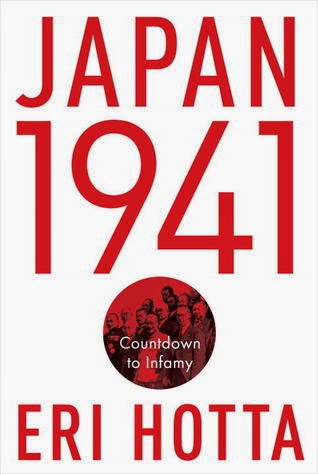
Japan 1941: Countdown to Infamy (Eri Hotta)


Those who are interested in understanding of the events that led to Japan's fateful decision to attack Pearl Harbor will find this book an important one to read. It is one that is packed with information carefully written in an engaging way to provide great insights into how the Japanese eventually went into war with the US. What this book does is to show that such a momentous decision was not arrived in a clinical and logical fashion, rather  readers of this book would not help noticing how illogical, convoluted, and even preposterous the decision process was.

It should be stressed that the book's focus is more on the decision process, rather than the decision itself, which as a bad one was a given. That it was a bad decision was not only clear in hindsight, you will see from the book that there were more people (including the emperor) who believed that it was a bad decision to go to war with the US than those who believed it was right, which only makes it more perplexing. Representing those who were really pushing for war with the US was the Imperial Army and very vocal too. The rest, represented by the Imperial Navy, successive prime ministers, and other members of the cabinet knew it would be disastrous to go down that road, but as the story developed, the reader gets to see how the strange behaviours among the 'doves' eventually made their own positions untenable, and had to be driven along to war with the US.

The author used the concept of Honne to Tatemae to throw some light on these behaviours. This is the concept of saying something or saying something is a certain way but carrying with it an intended meaning. In simple terms, the opposite of "calling a spade a spade". The trouble with doing this was that the listener who did not understand this might misinterpret what the speaker was trying to say, but more seriously, as shown in this book, it could be maneuvered by the listener to mean something else totally. And many a times it was used to good effect by those who advocated war while everyone else looked helplessly at each other, hoping that someone else would find this one small gap to exploit so that they could heap on more doubts and hoped that it snowballed into something big enough for all to decide that war was a bad idea, apparently even the army faction was hoping for that while advocating war (p.g., 210).

Yet they did attempt to find a way out of the situation, initiating many contacts with the US which unfortunately led to nowhere. They attempted to have a summit and when that was not progressing well , Sato Kenryo was quoted in the book saying "What idiots they are in Washington! If they agreed to meet with Konoe without any conditions, everything would go their way." For many it would be hard to imagine staging this summit between two heads of states when everything Japan was saying and doing was pointing towards preparing for war. But for the Japanese leaders, there was no contradictions, they have to keep up the appearance while trying to avert war - Honne to Tatemae.

Dr Hotta wrote an earlier work Pan-Asianism and Japan's War 1931-1945 which I had enjoyed very much. It was written in the academic style and was not so easy to read. This one, Japan 1941, is clearly meant for lay-readers and is therefore much more readable. Unfortunately I think I was spoilt by her earlier book and had hoped that she would repeat that feat. She did in contents, but she had to avoid going into too much analysis in a book thus positioned. Still I must commend her for being very immaculate, for example she used "U.S." and not "US" and implanted her reasoned voice throughout. The inclusion of the timeline of major events in the book was of great value and the Prologue makes a compelling introduction to the whole book. I was however unsure about the purpose of including characters like Richard Sorge, the poet Kafū Nagai, and Soldier U. These are important people in their own rights but while it has added colour to the book, they were not important to the development of the author's narrative and sometimes came out distracting.

The author, being Japanese, has a nuanced understanding of her own culture and therefore was able to explain the behaviours of the Japanese in 1941 exceptionally well. Paradoxically it can be misinterpreted as an attempt to excuse their behaviours and so she would sometimes have to illuminate her own attitudes towards them and the war itself by criticising them severely. I think it is something that she had to do in order for us not to dismiss her too quickly.

We read history in the sometimes vain hope of learning from it, so that we do not repeat it. The lessons in this book were most obviously "what not to do / how not to behave when making an important decision." Many readers would take the series of events as too ridiculous to conceive that we would ever do the same. Yet we have to be careful; as illogical and unimaginable as they have behaved in 1941, would we not have done the same? How many of us would really stand up and confront a seemingly stupid idea? Have we not come across situations in which everyone sitting in a meeting knew that a course of action was disastrous but finding everyone quiet, kept to our own counsel? I certainly have. Somehow the long-term and more severe pain cannot make me suffer the short-term embarrassment. And we will go out of the meeting whispering to each other that the decision taken in the meeting was a wrong one. Everyone suddenly appeared to agree to something opposite of what was agreed upon in the meeting, but no one was really at fault, because "someone" else pushed everyone along.

Pay attention to all the conversations in the meetings in the book, pick a character who disagreed with the war, then ask what you would do if you were him.

(Find this book at Goodreads)

23 February 2014

昭和史第一部(下)(半藤一利/林錚顗)

In this second volume, the author concentrated on the early part of 1940 and all the way to 1945 when Japan surrendered after the dropping of the atomic bombs. The style of the author has been discussed in my earlier entry reviewing the first first volume of the work and has remained largely similar. In this volume, whether he meant to do it or not, the central theme is the behaviours of the policy makers and the military personnel in Japan in those years.

Starting from the late 1930s Japan has rearmed, having withdrawn from the League of Nations. They were then caught in something of a quagmire in China and while events in Europe have been increasingly dangerous, the Sino-Japanese War have been left largely as a side-event in the minds of the West. However, one can't help feeling that events in Asia have taken a life of its own. Japan increasingly felt isolated and was under pressure from the US whom exported most of the oil that Japan needed. Japan wanted to avoid conflict with the US and at the same time wanted to find a way to end the war in China for it was already beginning to take its toil domestically. Finding no support from the US, the UK and their other allies, Japan gravitated towards the Axis and finally entered into the Tripartite Pact with Germany and Italy. Japan's reason for entering the Pact (suggested by Germany) was not clear nor compelling, indeed there were those in Japan that had not supported Japan's entry into the Pact. But it appeared that those who supported it all did it for their own selfish reasons. Take this entry from Kazushige Ugaki's diary (pg 25) whom the author accused of supporting the Tripartite Pact in order to get more resources for the army. But whatever their personal motivations, one does not get the impression that something this important was seriously considered before the final decision was made.

Another example was how they were ready to enter into an alliance with the Soviet Union. One can argue that Japan's involvement in Manchuria was partly due to the need to check the Soviet Union. This got them into a stalemate in China which soured their relationships with much of the rest of the world, and yet later in having to continue the war in China they wanted an alliance with the Soviet Union (after Nomomhan to boot). It is a little hard to square the logic in all these.

Worse was their decision to bomb Pearl Harbor. There was almost a consensus that Japan could not have a prolonged war with the US, including the Admiral Yamamoto who planned the operation. Yet it was almost as if everyone allow one event to lead to another and just went along with it without voicing objections until it was a done deal. The worst of this behaviour would come when Japan wanted to end the war. The way they went about talking about how to go about it and never quite getting down to it was tragically comical. But the author did us a favour by discussing one relatively small event, quoting from two commanders' diaries he showed us why a coming to a decision was hard, even between (or especially between) Japanese.

Referring to the Battle of Kohima when Japan suffered a huge defeat, it appeared that the two commanders Renya Mutaguchi and Masakazu Kawabe knew they stood no chance to winning and their forces were about to be annihilated. Yet both of them would not order a retreat. Post war, this was what they wrote in their respective diaries:
  • Renya Mutaguchi: Although I wanted to say that it's already time to quit the fight in Imphal, when these words reached my mouth, I just couldn't get them out. I could only hope that someone would be able to tell from my expression.
  • Masakazu Kawabe: I got the impression from Mutaguchi's expression that there was something he wanted to say but just could not bring himself to. I didn't probe, and the meeting ended that way.
Personally I found this to be what was so valuable about the book. It is hard sometimes for us to understand how a nation tactically so superior to many of its adversaries could be so strategically blundering. However when it comes from a Japanese, who incidentally was a young lad during the war and could even remember his job in one of the torpedo factories, one gained this special insight and know, especially for an Asian, that it could very well be us.

(Find this book at Goodreads)

27 January 2014

Hiroshima Nagasaki (Paul Ham)

Judging by the two extremes ratings that this book received in Amazon, one can tell that this is a rather controversial book. The author did not think that the atomic bombs made Japan surrender which in turn avoided the loss of lives of many Americans who would otherwise have to invade the main islands of Japan. But his position was not just that the atomic bombs dropped on Hiroshima and Nagasaki were unnecessary, he went further to obliquely imply that the reason for dropping the atomic bombs were for the pure purpose of killing civilians.

The author argued that the atomic bombs were unnecessary by showing that:

Fire bombing was not an effective strategy to make an enemy surrender
In support of this argument the author spent a chapter on the fire bombing of cities in Germany. Meant originally to bring Germany to its knees, the effectiveness was questionable and eventually Germany capitulated not because of the destruction of any of the cities or even all of them, but because of the land forces of the allies that reached Berlin.

The Japanese cabinet was not swayed by the atomic bombs
The author argued strenuously that the Japanese cabinet, especially the three (of six) representing the military, the War Minister Korechika Anami, the admiral in the Imperial Japanese Navy Soemu Toyoda and general in the Imperial Army Yoshijiro Umezu. They did not change their minds after the two bombs were dropped. It was actually the entry of Soviet Union into the war that convinced the Japanese cabinet that all was lost and surrender was inevitable.

The Japanese were going to surrender anyway
Citing the futile and delusional efforts at getting Russia to play the role of the intermediary for an end to the war, the author showed that the Japanese were already seriously contemplating an end of the war (in contrast to unconditional surrender). It would be a matter of time, given Japan’s lack of ability to deploy air or naval power, that they would collapse.

These would have made for a persuasive case but Ham went further and opined that despite all these, the US bombed Japan anyway and it was not really because the decision makers (short of President Truman) wanted to save American lives, but because “total war had debased everyone involved…” (pg 158) and made it easy to contemplate the destruction of properties and lives on a grand scale, not helped by many who were spoiling to demonstrate the new power of the US.

The President wanted it for political reasons; saving American lives was one reason, but more likely to use it as a chip to get concessions from the Russians, if not to get them to be more agreeable. Major General Leslie Groves, the one in charge of the Manhattan Project wanted deliverance of his project. The Foreign Secretary, James Byrnes, just wanted it. The sole conscience of the administration, the War Secretary, Henry Stimson, was brushed aside because he did not say things that the President wanted to hear, and the stance of the scientists involved in the creation of the bombs was ambiguous. Therefore despite the fact that the bombs were going to kill many thousands, not to mention destroying many properties, no one would check the momentum of the project. Worse still, the desire to check Russian territorial ambitions with the bombs was not successful because they would shortly have their own atomic weapons and all that was achieved was a prolonged and sometimes perilously dangerous Cold War.

The author then went further to imply that putting the blame on the Japanese for not surrendering despite the warnings was wrong because the Allies kept insisting on ‘unconditional surrender’, a term which at first confused the Japanese and later became the only stumbling block to their agreement to surrender because they were afraid that the Americans would try the Emperor as a war-criminal. In the end unconditional or not, was this not what the Japanese got? Knowing this the Americans should have just relented earlier, let the Japanese know, let them surrender and the bombs and the resulting carnage would have been spared. And if the Americans had really wanted to drop the bombs, the morally right thing to do was to give warning by demonstrating the power of the bombs given that it was so much more destructive than anything anyone knew then. Finally, even if one argues that Hiroshima was necessary and effective, there was no need for Nagasaki.

And since the bombs were used despite all reasons against their use, the author brought us through the aftermath of the bombs, how many civilian targets were destroyed and how many civilians were killed, maimed or suffered the radioactivity for years while the military targets were somehow missed (pg 410). To add insult to the injury, the victims were denied medical help and were in some cases treated as exhibits for research into the effects of radiation. Finally in the years following the end of the war, the main players could only manage incoherent narratives as to the reasons and effects of the bombs, further attesting to the difficulty in justifying their use.

The author was indeed persuasive. However as I read the book, I could not help wondering if the problem is one of hindsight. Take for example the case of area bombing. Its limits in persuading the enemy to surrender are recognised now because it was used then. Given that prior to the Second World War there was no precedence for one to learn from, it was reasonable that, looking at how much fear it could instil in the enemies, this could be an effective way to get the enemy to surrender. Similarly while it is increasingly recognised that the Soviet Union’s invasion of Manchuria greatly accelerated Japan’s capitulation, how could one know then what we know now? And it fact it was many years after the end of the war that the Russian archives were opened that allowed scholars to piece things together coherently. Also, peace feelers were probably abundant then and by design they were purposely vague and came from unlikely sources. It would be hard to verify the authenticity of each of them to conclude that the Japanese were seriously considering surrender and the only stumbling block was the term “unconditional surrender”. If only we knew then.

How then, given the confluence of factors, should the US respond? Not having the benefit of all these facts the author has now, it was certainly not easy to make the right decision (not that dropping the bombs was a wrong decision), the US probably made the “best” decision and considering everything, this looked like a good option. To accuse the President of not being a character of “unearthly will, vast authority and transcendent moral vision” (pg 475) and therefore not resisting the “fatal momentum of the atomic project” was to expect him to remove one option the outcome of which few if anyone, knew then.

The author also did not give complete consideration to the whole context of the situation, for example it was not that the Japanese military had retreated from island to island and finally were confined to their main islands. They were still in Manchuria and also countries in South East Asia. To blockade them to starvation would mean a more prolonged occupation of these places. If I were my parents and were living under the Japanese then, I would wish for the bomb.

One important question was whether Nagasaki was necessary. There was a sense in the book that people realised the devastation the first bomb did to Hiroshima and were no longer that elated about Nagasaki, seeding some doubts in the readers’ minds about the correctness of its use. How should one decide whether or not to drop the second bomb given that the first one did not seem to get the Japanese to surrender? Did they need more time or did it just didn’t move them enough, in which case perhaps another bomb was in order? Or should all these considerations be superseded by the by then known effects of an atomic bomb?

The “if we knew then” argument that I used here is supported by the results of the Gallup poll did in the immediate aftermath of the bombs and written about by the author in the book (pg 459). It showed that most Americans supported the use of the bombs while much fewer supported the use of other forms of weapons such as poison gas possibly because of “the ghastly memory of mustard gas used in World War I and the emerging horror of the Nazi death camps and gas chambers.” In other words, they were not bent on killing Japanese in the most grotesque manner. Once they knew of the effects they would no longer be so supportive of the weapon, and it did play out in the Cold War.

Questions aside, there were a few chapters in the book that I like very much. The first one being the chapter on the science and scientists behind the atomic bomb which brought back good (and not so good) memories of my school years. The second one was the chapter discussing the Japanese’ deliberations over how to end the war, it was a very nuanced discussion about the Japanese psyche (which I cross-examined with Kazutoshi Handō’s Show Shi). There was this element of (pardon me) “smoking their own dope” where they would know clearly the undesirable outcome if the Russians were to invade Manchuria. And since it was undesirable, it should not happen, and if it should not happen, then it would not happen. Therefore it was conceivable to get the Russians to mediate an end to the war.

The author also gave a very vivid description of the condition of the victims in the two cities immediately after the bombs were dropped. These represented the two times so far that atomic weapons were used on cities. Alas as tragic as they were, it failed to arouse in me the feeling of sympathy and I even felt that the descriptions were slightly over done, especially when he gave some statistics on civilian versus military casualties. I could not help wondering if he was steering readers to the conclusion that the bomb was selective by itself, dropped on a city with both civilian and military targets, the civilian targets would be obliterated while the military ones intact. The indifference I felt towards the victims was curious to me given that I bear no hatred towards the Japanese today. This has made me re-examine my attitude towards Japan today. While I am not going to discuss it here, I have to give the author credit for doing this for me.

The other thing that I was made to re-examine was this: how does one rate a book? A one-star in Goodreads represents “I did not like it”, but what did one not like about it if he/she had given a book a one-star rating? Was it a disagreement with the position of the author or was it because the content was poorly researched and inaccurate, or was it the writing style? The singular metric used to rate a book cannot take into account the different dimensions that one evaluates a book with. In the end one might take an average of the ratings given for the different dimensions. I decided not to give this rather ambiguous rating to this book. I think this book was well researched (although I would really appreciate proper citations, minus one star for that), well argued, and well written. While I could not help feeling a little manipulated, I urge potential readers not to dismiss the book too quickly just because of the possible difference in positions they may have from the author.

A reviewer in Amazon said that this book is only for people who can think for themselves. I would not say that, I would encourage people to read this book but temper it with other books to put things in a better context.

(Find this book at Goodreads)

12 January 2014

Pan-Asianism and Japan's War (Eri Hotta)

In this book the author, Eri Hotta, explored the notion of Pan-Asianism and its relation to Japan’s wars in Asia between 1931 and 1945. First of all, it is important to understand what Pan-Asiansim stands for and the author did a very good job of dissecting the term, not semantically, but really explaining how Japanese of that era looked at Japan in relation to the rest of Asia, particularly China. It turns out that Pan-Asianism in Japan was not just an ideology about the unity of Asians, in fact there were three major strands of Pan-Asianism: the Teaist strand, the Sinic strand and finally the Meishuron strand which eventually became the most dominant strand. The Meishuron strand believed that Asia was weak and should stand together to counter Western imperialism with Japan as the leader of the movement.

There was a reason why this strand displaced the other two as the dominant strand. India, incorporated by the Teaists as a partner in the enterprise was unclear in their position vis-à-vis anti-imperialism. There were surely those who fought for independence from Great Britain (e.g., Subhas Chandra Bose) but many more Indians appeared to be fine with the status quo. China, an obvious partner in the enterprise and even treated as equals by the Teaists and the Sinics, was suffering greatly under the Western powers, especially after the Boxer Rebellion. But she was a torn and fragmented country with no unifying government. One can hardly expect China to play a significant role in the rise of Asia. It is therefore left to the most developed and stable country then, Japan, to take the lead.

An obvious question that one would ask would be whether Pan-Asianism, especially the Meishuron strand, caused Japan’s war. The author made no such claims but demonstrated how the adoption of Meishuron affected how the war and post-battle treatment of the conquered were carried out, both at the macro and the micro levels. At the macro level, in the early stages it led Japan to feel that they could not count on China to act as an effective partner, if not to check the Soviet Union’s likely southern expansion then at least as a buffer for a while. Japan therefore had to do it herself, and coupled with the need for room to house its expanding population and need for resources, found the occupation of Manchuria to be a perfect solution.

At the micro level, it explained the behaviours of the Japanese soldiers and commanders towards the peoples under their occupation. Firstly there must be a pent-up frustration amongst the Japanese soldiers towards the people they conquered because Japan was trying to bring respect to Asia, liberating these countries from the Western Imperialists, paying the price with blood, and yet facing a perplexingly hostile reception from fellow Asians. Secondly in the view of this strand, Japan and Japanese are superior, as seen by their ability to ‘liberate’ the other Asians, and these ‘sub-humans’ can be treated as such.

However in assigning herself this responsibility, the author demonstrated clearly the paradoxical Japanese psyche that was prevalent at that time where on one hand Japan felt a sense of superiority and mission in relation to her other Asian neighbours, but on the other felt inferior and victimised by the West, described by the author as a “curious blend of arrogance and self-consciousness” (pg. 207). The perceived sense of victimisation can be traced to their humiliation by the West in the wake of the Treaty of Portsmouth and the Washington Conference when they realised the ‘Hobbesian nature’ (pg. 53) of world affairs. The sense of superiority on the other hand was a result of their realisation of their advancement in comparison to their neighbours as mentioned above. This psyche became a justification in many Japanese’ minds resulting in a sense of righteousness in their subsequent behaviours in the occupied territories.

While this book is centred around the theme of Pan-Asianism, the author also touched on the other factors that played equally important roles in the war including the role that the Soviet Union played (albeit briefly), the losing of control of the military, the internal fighting within the factions of the military, and most important of all, the dead ends that Japan eventually found herself in after attacking Pearl Harbor. Despite these, the author never let Pan-Asianism out of sight and in the end led one to ask whether it also had a role in Japan’s defeat. To this the author showed that there were perhaps two pitfalls that eventually led to Japan’s failure.

The first was their surprise that China would actually resist. Japan might have expected China not to either because the Chinese were thought to be too impotent to do so or because they might really buy into the ideology of Pan-Asianism. The reality was although China could not mount a successful defence against Japan, the vast expanse of China meant the tying down of a big number of Japanese troops.

The second was while the decision makers in the military might be under no delusions of eventual defeat and were only carrying on because they had promised an East-Asia Co-Prosperity Sphere and were therefore unable to dismount, there were actually others who “saw reforming implications in what they were doing” (pg. 136). The machine therefore grinded on until it was utterly destroyed by the US.

This book must be read carefully because readers from countries that suffered under Japanese occupation might be quick to dismiss it as a revisionist effort to re-present history. The reader may accuse the writer of trying to justify Japanese soldiers’ brutality by pleading that the intention was good, and the brutal ways that were used on the occupied peoples were exactly the same ones used on Japanese themselves. The author did not have the intention of excusing Japan for her treatment of the people in the occupied territories, rather, she wanted to take an open-minded look at the Pan-Asianism ideology and how it influenced Japanese attitudes and decisions during the war. That the outcome of the ideology was bad for Asia in general and Japan in particular serves as a lesson for us in not examining our own reactions to the ideology, it does not imply that any attempt to understand it is an attempt to excuse the perpetrators of a brutal and ultimately tragic war.


This book is not an easy read; the fact that I am the first reviewer since the book was published in 2007 attests to it. It was not written in a “popular history” style where the author tried to inject life into characters by describing for example “he was tossing and turning in his bed”. What this author did instead was to adopt the academic writing style, citing references where they were due, describing events as they were, and making no effort to add colour to the characters. However for those who would make the effort, they can be sure of being richly rewarded with not just knowledge of events and people, but an expanded vocabulary (of which Hotta’s range was huge) and an insight into how an expert does critical analysis. It is well worth the effort.


(Find this book at Goodreads)

23 December 2013

The Battle for Singapore (Peter Thompson)

This book is an attempt to explain why the "impregnable fortress" of Singapore fell to the Japanese even while the Commonwealth forces hugely out-numbered the Japanese.

The book covers a lot of ground; the author, Peter Thompson, started by introducing the main characters, the defence situation in Malaya and Singapore, and the command structure. He then went briefly into the psyche of the different parties charged with the defence, particularly how they viewed the Japanese, carefully laying the groundwork for the later part of the story. When the fighting proper began he described the progress of each battle in sufficient details for one to get a good picture of the terrain and environment, the arms that were used on each side, and the mistakes that were made along the way.

The author wrote in a engaging manner, moving the book along very well thereby making the book an easy one to read. There were also many interviews with both military and civilian survivors adding richness to the account, and highlighting well the very human side to the tragedy. For someone like me who is just starting to explore the history of this event, this book provides a very good overall description helping to define the different dimensions when exploring this history.

To his credit, the author did not claim this to be a scholarly work despite citing references throughout. However there were a few things that disturbed me in regard to citations. There were times when information was presented which would benefit from citations but were not referenced. One example was when he said that "Japanese sources" claimed a certain number of troops had landed in Singapore without clarifying what these sources were (pg. 424). A related problem I have is with the many instances when the author quoted other sources verbatim. To be sure, sometimes this adds to the narrative, but too much of it gives the reader the impression that he is reading a collection of works already published. The author was occasionally not careful about being precise with facts. The Zero fighter was so named because it entered service in 2600 according to Japan's Imperial Year, not because of the big zeros painted on the fuselage as written in the main text. Although it was clarified in the notes at the end of the book, for readers who do not refer to the notes, this would be what they thought was the reason the plane was so named. The author's credibility is also eroded by the occasional dramatisation of the events such as the description "Sir Robert Brooke-Popham's proclamation flapped in the wind..." (pg. 236).

The title of the book is true to its contents, where the first portion was devoted to setting the scene followed by the bulk of which on the battles, if not solely in Singapore. Unfortunately the last hundred pages or so (out of 600) were wasted on an overly brief treatment of life in Singapore under the Japanese occupation. I would prefer that it be taken up in a separate volume in more detail. I also wished that there was more coverage on what was happening on the Japanese side, from the Japanese perspective. I counted but one instance of this (pg 418).

So in the end did the author fulfilled his aim as spelled out in the last question in his first chapter - "The unanswered question was: how had it happened?" One can read this in different ways. One of which is to interpret from the book that there is a complicity of reasons, including poor leadership, inferior weapons, raw recruits, Britain's engagement in multiple theatres, or under-estimation of the enemies. The other is to say that the author was vague and so it became hard to tell what he was attributing "how had it happened" to. Either way I did not get the impression that the author wanted to state clearly his position, perhaps preferring to let his readers make their own judgement.

Overall this is a very readable book which gives a good introduction to this part of history, including the main characters, the armies, and the location of the battle. The description of the pain and sufferings that soldiers and civilians underwent is also vivid. For a person making my first foray into this area, I have certainly benefitted from reading the book.

-----------

It is hard for me to understand how the West can under-estimate Japan when they beat the Russians on a few decades before and was quickly developing technologically since then.

(Find this book at Goodreads)

25 November 2013

昭和史第一部(上)(半藤一利/林錚顗)

Showa Shi (昭和史), roughly translated to The History of the Showa Period was written by Kazutoshi Handō (半藤一利). This work comes in two parts in a total of four volumes, covering the period between 1926 and 1989. This review is only on the first volume in the first part, spanning 1926 to Japan’s attack on Pearl Harbor in 1941. The edition I read was Chinese translation by 林錚顗, a history graduate from the Department of History in the National Taiwan University and the Tokyo University.

The trouble with reading a translated book, besides having things lost (or gained) in translation, is that it is unclear how authentic the book is in its translated form. When one finds an impressively written sentence or phrase, he cannot tell if this was written by the original writer or was just well translated because the language that it has been translated into happened to have more appropriate words or idioms that can be used conveniently. In this review I shall assume that everything was translated as the original author intended.

This volume focusing on the period between 1926 and 1941 tries to address this question – what led to Japan’s involvement in the Second World War? The author started his narrative with the incident in 1928 where the Japanese Kwantung Army murdered Zhang Zuolin (張作霖) by placing a bomb on the train track on which Zhang’s carriage was travelling. Starting his narrative with this event is not just chronologically sensible, it is also the harbinger of a central theme in the book: the Japanese military is rouge and the civilian government is not able to control it. This, together with other factors, eventually led Japan into the tragedy of the Second World War ending in its defeat and destruction.

The circumstances that landed Japan in its final state in 1945 can be understood through the interplay between the external environment and the emerging political philosophies that was eventually embraced by the country. The author carefully described the external environment and situations of that time, the most important of which included the Russo-Japanese War, the Great Depression, and Japan’s desire to be elevated to the status of a major international power. Against this backdrop, the author developed his arguments amid the complexities and intrigues that existed among the various power players, the army, the navy, the civilian parliament, and the advisors to the Emperor. Not only were the relationships among these players complex, within each there were also different factions subscribing to different philosophies, doctrines, and perspectives. Slowly however one of the factions within the army gained the upper hand sometimes through assassinations, other times through coercion. Eventually no one appeared to be able to control the army's field commanders, a situation epitomised by the graphic description of the Marco Polo Incident (pg 188). In the end a certain momentum was gathered and things gained a life of their own.

The style of the author is not one that I’m familiar with. Not having read enough, I don’t know if this is generally how Japanese historical accounts are written or it is just this author. But the prose is a mix of academic, personal, and poetic. For example, his account and analysis of the Nanjing incident is fair and well considered, admitting to the occurrence of the atrocities committed by Japanese soldiers, even apologising over it, but arguing with facts why the number 300,000 estimated at the International Military Tribunal for the Far East is a gross over-estimation (I do not intend to get into an argument over the accuracy of these numbers here.) Yet he would pepper his book with “Isn’t it so?” as if speaking directly to the readers. In addition, he could get into trivialities like why a certain politician has a particular nickname (pg 77). At other times he would include conversations between the actors as if he was quoting them verbatim. And then there would be flashes of brilliance, the most impressive of which is the way he described the end of the Young Officers’ Revolt (226 Incident).
可是,计划就在大高少尉与中侨中尉拔枪相向、四目相对之时结束了。。。(pg 164 - 二二六事件)
But the plan ended the moment Second Lieutenant Otaka and Infantry Lieutenant Nakahashi pointed their guns at each other, staring into each other’s eyes…
There is one issue that I have so far avoided, the author’s attitude towards the role of Emperor Hirohito. In this there is no doubt, the author went out of his way to absolve the Emperor of any responsibilities. The Emperor is either not informed of what had happened, misled by the military, or had his hands tied. This was clear from the start of the book when the author explained how the early events determined the limits of the Emperor’s power. The author made extensive reference to the Emperor's own biographical account 《昭和天王独白录》to gain insights into the Emperor’s thoughts. I wonder why I cannot find a translation of such an important record whether in Chinese or English.

If nothing, this book is important for its contribution to our understanding of what went on on the Japanese side throughout the years leading to the Second World War. It is more than just a chronicle of events which is available in many English accounts; it provided many details about how individuals thought, the dynamics between different individuals and groups, and the general psyche of the populace caught in those turbulent times. The author even had access to some of the important players for example Renya Mutaguchi, an important commander in the Marco Polo Bridge Incident (pg 189). Not having read enough on this subject, I cannot recommend an alternative to this book, but I feel that most of us will benefit from this book if we are not trying to do scholarly research in this area.

(Find this book at Goodreads)

06 November 2013

China's War with Japan (Forgotten Ally) (Rana Mitter)

This book is published in two different titles: 1) China's War with Japan 1937-1945: The Struggle for Survival, and 2) Forgotten Ally: China's World War II 1937-1945. This review is made with reference to the latter.

The use of the first title conjures an impression of a chronicle, recording the events that took place in China between 1937 and 1945. In this, the author has more than fulfilled the promise of the title. In fact, to his credit, Dr Mitter even went way back to the Sino-Japanese War (1894-5) albeit briefly, an era commonly ignored by scholars. This reminder is important for two reasons. First of all, it was then that the Japanese began to station troops on the mainland (in Korea). Second, it became a base from which Japan fought the Russo-Japanese War (1904-5) which really represented when the Japanese infringed upon China's territory.

The focus of the book however starts from 1937, after the Marco Polo Bridge Incident, which started off as 'just another skirmish' but took an unexpected turn when Chiang Kai-shek decided that he would make a stand and opened another front in Shanghai. From there the author took us through all the major events ending eventually with Japan's surrender. In between he culled documents and sources including diaries, official party documents, and reports from journalists to provide vivid details of the Nationalists' feeble attempts to govern 'Free China', their efforts to undermine the Communists, to draw any country into the war to help them, and to manage the aftermath of the defection of important party members, while fighting and initially retreating from city to city. Equally vivid are the descriptions of how the civilians caught in the war suffered from poverty, starvation, rape, and official corruption.

But if the first title reads rather blandly, the second title 'Forgotten Ally' proposes a thesis which the author made very clear - China was the forgotten ally of the allied forces in the Second World War. This powerful position can only come into consideration after Pearl Harbor, when Japan in a span of two days made itself the enemy of at least four other countries, the US, Britain, Australia and the Netherlands. The word Ally therefore was only relevant in the later part of the book. The main argument of the author is the Western powers are now at war with Japan, and China being also at war with Japan has become an ally to them and had even fought alongside them on at least one occasion (Burma). But even if that had not been the case, China has tied about half a million Japanese soldiers which might have been deployed against the Western powers, that would have qualified China as an ally. I do not feel qualified to dispute the thesis, rather I would like to offer my reflection on the significance of the worth Forgotten.

Dr Mitter was clear about who the forgotten party was and seen from the Nationalists' perspective, it would probably aptly describe their sense of indignation. They had been fighting the allies' enemy for six years before the allies themselves entered the war. If China was by then "a battered nation on its knees, waiting for the Americans and British to save it from certain destruction at the hands of the Japanese", it could be partly attributed to, as the book made clear, the fact that they had been fighting the Japanese alone. Yet one can hardly blame the West for seeing it this way, for Japan, while surely on their radar even prior to December 1941, was secondary in relation to Germany then. Had Japan not made the blunder of attacking Pearl Harbor, their invasion of South East Asia would have at most threatened the European colonies, and not the European homeland, it would still have been of secondary importance.

Other reasons also made 'forgotten' inevitable. Firstly, the question of whether China really did contribute to the fighting (when they seem to lose on all fronts, not helped by the opinion of Stilwell)  or whether it was just a corrupt regime always seeking more from the allies (Chiang's request for a US$1 billion loan certainly did not help) also left many questions of China's position and value as an ally in the minds of the US and Britain. Secondly, the cold war narrative also quickly distorted the history of that time, focusing people's attention on China's political ideology rather than their history in the Second World War. Finally, the outcome of the civil war in China meant that certain events must be emphasised, others diminished, and some invented.

Which brings me to this question I had as I read the book - who was forgotten really? If the answer is China, then who in China? The situation in China then reminded me of China during the warring states (between 481 BC and 403 BC) when at one stage China was divided into three kingdoms (三分天下), only this time among the Nationalists, the Communists, and the Japanese (through Wang Jinwei's Reorganized National Government of China). And if the West can be accused of forgetting their Nationalists allies as the author implies, then whatever the Nationalists did right (among the many wrongs) was comprehensively eradicated by the Communists when they came to power (see pg 333-334). And to be fair, post-Second World War and even current Chinese discourse on that part of history hardly give enough credits to the West (used loosely here) too.

I cannot accuse the author of falling short in his effort to support his thesis, he might have felt that the two-thirds of the book before China became an 'ally' was necessary to provide the context but that leaves only the last third of the book to try and develop his argument. I also feel that too little was given on the Communists side of the story, perhaps because in the context of actually fighting the Japanese they haven't done much. One last question was whether Russia was as inconsequential to the events in China as it seemed, for very little was said about them throughout. Still, for anyone who wants a source of information on that period of history in China this book is indispensable. Dr Mitter, with his great scholarship, vivid descriptions, and dynamic style will take you on a throught-provoking ride through his riveting narrative.

(Find this book at Goodreads)

29 October 2013

The Wars for Asia, 1911-1949 (S. C. M. Paine)

The author has an important thesis, as this reader commented in Goodreads. To quote the author:

In other words, the long Chinese civil war precipitated a regional war between China and Japan so that by the time the conflict became global in 1941, the Chinese were fighting a civil war within a regional war within an overarching global war.

By that, she was trying to show the complexity of the war in China which she felt was treated in an overly simplistic fashion by the powers of that time, and the historians of our time.

---------------

This book is remarkable for a few reasons. First of all not only are English books on this part of World War 2 relatively scarce, the author has a proposition: the war fought in China actually had a significant impact on the Second World War and can only be properly understood by examining the intricate relationships between a civil war between the Nationalists and the Communists, a regional war that includes Japan (and more inconspicuously Russia), and the Global War, also known as World War 2. This is an interesting proposition, but to convince the reader through her narrative is an ambitious task, and I shall share my take on it later.

The second reason why this book is amazing is the author knows Chinese and Japanese and was therefore able to make references to many original documents. But beyond knowing the language, Prof Paine was able to show a more intimate knowledge of the Chinese and how they look at things. Finally, the scholarship is quite impeccable, one can tell not just from the amount of literature consulted (the references of which occupied a third of the book) but also from how she critique the literature in the first chapter of the book, and adding more throughout the book as the need arises. With good scholarship, one is left after reading the book to ponder upon many questions, some of which the author briefly alluded to. In order not to spoil it, I shall list, rather than quote from any part of the book.
  1. A chapter was dedicated to Russia, indicating its importance. But Russia was to come back near the end, and indeed was always active in the background throughout the book. Exactly how instrumental was Russia in the whole scheme of things?
  2. Did Chiang Kai-Shek, educated in Japan, make the same mistakes the Japanese made by focusing too much on operational success against the Communists, thereby trading away strategic initiatives?
  3. Exactly how did both the Communists and the Nationalists view the Japanese? The populace, especially the students of that era were galvanised by a sense of nationalism to become strongly anti-Japanese. But were the Japanese just a convenient boogey-man in the eyes or both Communists and the Nationalists?
There are a few specific things that I would like to point out in praise of the author. Firstly, as mentioned earlier, the author knows the Chinese language well and was therefore able to know some of the quirks of the language, for example being able to explain that Huai-Hai from the Huai-Hai Campaign is actually the amalgamation of the words Hua-he (淮河) and Hai-zhou (海州) which define the theatre. Another example is her use of  Chinese idioms at the start of each chapter which aptly describes the essence of the chapters.

In terms of her style and prose, the author is engaging and captivating. Some may feel that she has given too much details but these are necessary to flesh out her narrative to support her proposition. She was occasionally capable of humor (see pages 164 and 186). But most important of all she was able to portray the tragedy of the whole war vividly not by describing the sufferings of the soldiers and civilians on all sides, but the ironies of the outcomes of the war. She did this on three occasions (in ascending order of impact on me):
  1. When she hinted that Chiang Kai-Shek might be right in the early stages of the regional war about fact that the bigger threat to him was the Communists and not the Japanese whom he thought would eventually leave.
  2. When she recapitulated the reasons for Japan to embark on this misadventure (which could have been hugely successful) and how Japan eventually ended up (pg 219).
  3. When she alluded to how Japan might have been right about the menace of the Russia and the spread of its ideology given how the West spent the next 45 years trying to contain it (see pg 284 for example).
Lastly, Prof Paine was rather accurate in her assessment of how the Nationalists were looked at from the eyes of many Chinese, in my view. Whether our opinions of the Nationalists were informed, they surely lost the PR war to the Communists.

As for the supporting materials provided, I particularly like the Chronology section included in the book which listed out the sequence of events clearly. As for the maps, as I am not one with high expectations, I find those included sufficient for my needs.

If I have any disagreements with the author, it is in regard to how she explained the rapid capitulation of the Nationalists after losing in Manchuria. While her use of the Chinese' idea of viewing time as a series of  'cycles' rather than in a linear fashion is novel, I feel it is a little simplistic. It is true that Chinese believe that dynasties (and even right down to individuals) expires at some point and another dynasty would take over, starting the cycle again, this does not always make people jump off the 'sinking ship' and change sides. And comparing how the Nationalists defected to how the the Germans "fought grimly back to Berlin" may not be appropriate because I think the Germans' determination may have something to do with the fact that they view their fight back to Berlin as defending their homeland against another country (in this case Russia). The Chinese were engaged in a civil war, changing sides does not mean selling out their country. That may make it easier to change sides, and may not necessarily be due to their belief that the Nationalists' 气数已尽 (my words, meaning 'time is up'). To know what it is for the individual soldiers caught in that civil war, one can refer to 大江大海:一九四九 by 龍應台 (https://www.goodreads.com/book/show/6902548?ac=1).

Finally, how do I feel about Prof Paine's effort to support her proposition? We should remember that this is no mean feat, for if one does too good a job at isolating the three layers of war (civil, regional, and global) for clarity, they start to look like unrelated events and the proposition is not supported. On the other hand, if one tries to mix the three layers too intimately, a reader would find it hard to untangle the layers and may accuse the author of doing a sloppy job. Finding the right balance is critical and yet terribly hard. In this, I would say that Prof Paine has been very successful in helping me to see the interplay of these three layers, thereby educating me that at every step between 1911 and 1949, the decisions made by all the parties involved in the war in one way or another are affected by their views of the world, their assumptions about their adversaries and allies, and the tactical moves and miscalculations made by their enemies, some of whom can be their own party members.

In the Conclusion, the author tried to demonstrate the confluence of events that led to an outcome, whereby the absence of any one of more may conceivably change the results significantly. This thought-provoking section leads the reader to many 'what-if' questions and I shall close with one of my own. What if the earliest events in this book were to occur a few years later, right when the Cold War was getting hot? Would Japan's occupation's of Manchuria not be warmly welcomed by the West as a contribution towards checking the spread of Communism in Asia? Then what?

This is not just a book to be read, but to be owned. Just Chapter 7 alone would have made it worth the while.

(Find this book at Goodreads)

21 September 2013

Foreword

I originally started this blog to write about the books I've read. I write about the content of the books, the style of the writer, or the lessons I've learnt, depending on which is more prominent to me. I started writing when my reading interest shifted into the Second World War in Asia. Although Singapore (where I am) was also involved in that war, I found that I really have very little knowledge of the war in the Asia Pacific. What I know about the Second World War is mainly of that in Europe. It was not until I started listening to The History of World War 2 podcasts that I started to get interested in the Japanese's entry into the war. I also notice that while the action here is no less brutal, it has received much less interest compared to that in Europe. I decided therefore to read and learn about it.

But while this blog was started with this in mind, and while my interest has not shifted, it has evolved over the three years I've kept it. In the past year I have even started reading Chinese novels, a genre which I have not paid a lot of attention to. So now I allow myself to be more diverse in what I write here, although my aim remains primarily to write about the WW2-related history of Asia Pacific.

Hope we can all learn something through this blog and I hope you would like it.