09 August 2015

Kranji War Memorial

The Kranji War Memorial bears the names of more than 24,000 casualties of the Commonwealth forces who died during WW2 in the South-East Asian Theatre. Of these, 4,500 were buried and Kranji.

The road leading to the memorial


Gardeners maintaining the cemetery, a bunch of students in the background

The buildings faintly visible in the background are in Johor, where Japanese came to Singapore from


It is one thing to read from books about the different regiments that fought here. 8th Division of the 22nd Brigade sounds very real when one sees it inscribed on a headstone. It is hard to put my head around the many British Regiments that fought in the defence of Singapore. Here are examples, starting with the Australian forces.

Australia


Royal Australian Air Force
2/18 Infantry Battalion (Australian Imperial Force)

Royal Australian Naval Reserve

Great Britain
Air Vice Marshal Pulford - Royal Air Force


HMS Prince of Wales
HMS Repulse
HMS Sultan
HMS Indomitable
Royal Army Chaplain
Army Catering Corps
Royal Army Medical Corps
Royal Army Ordnance Corps


Royal Army Service Corps
Royal Artillery
The Border Regiment
Craftsman
The Pioneer Corps

18th Reconnaissance Corps
The Cambridgeshire Regiment
The East Surrey Regiment
The Gordon Highlanders

135th Hertfordshire Yeomanry

The Leicestershire Regiment
The Loyal Regiment
The Manchester Regiment

The Royal Norfolk Regiment

The Royal Northumberland Fusiliers

The Queen's Royal Regiment

The Sherwood Foresters

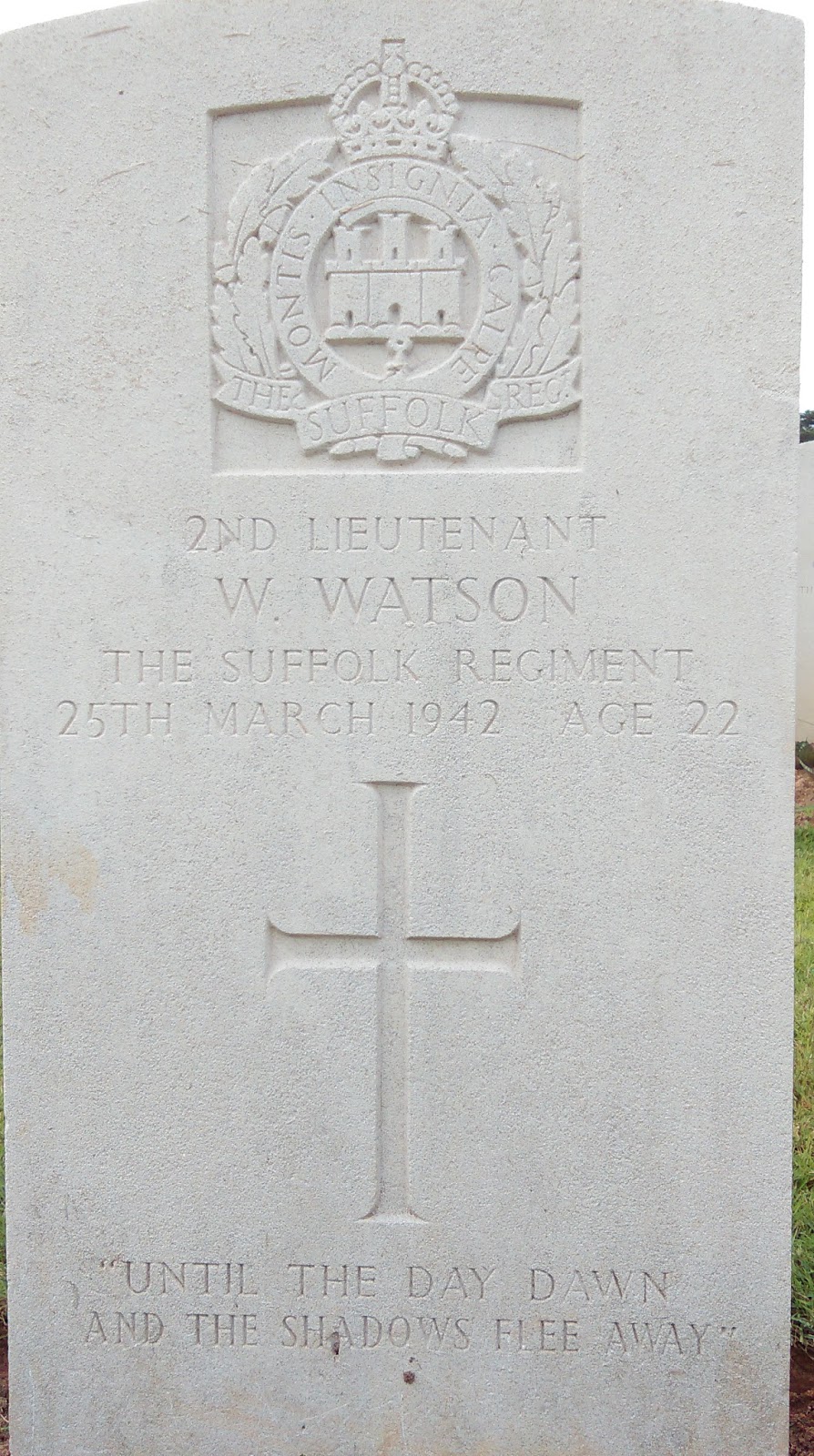
The Suffolk Regiment

The Sutherland Highlanders
The West Yorkshire Regiment

Canada

Royal Canadian Air Force

New Zealand

Royal New Zealand Navy
Malaya

Federated Malay States Volunteer Force

Singapore Volunteer Corps

Changi Museum

The Changi Museum is built to commemorate all the prisoners-of-war (military and civilian) in Singapore during the Japanese Occupation. It is located very near both the Changi Prison and Selarang Camp that were used to intern the POWs. I live about 2 km away from the museum, and sadly, this is the first time I paid it a visit. (9 Aug 2015, as Singapore celebrates its 50th birthday).

From the outside
The entrance

Changi Chapel - A replica of what the POWs built in the camp. The original is now in Duntroon, Australia.
The original door to a typical cell
 Many did not survive the ordeal in captivity. Many more were taken to Thailand to built the Death Railway. But all found ways to get by. The exhibits show the huge amount of talent among the soldiers. There were many examples of prisoners using rudimentary materials to make tools that are in turn used to make other things. There were many who risked torture and death to make battery operated radio sets that were hidden in the most unlikely places. And then there were those who had such artistic talents that gave others a reason to go on.


Read the note


The ingenuity of the POWs
Little things to maintain sanity


Grit
Defiance (with some humour)
Humanity
This mural helps to explain how many went on - Two prisoners struck by Malaria tried to help another with Cholera.
A sketch by an Australian POW

Very moving notes by families of those who suffered as POWs in Singapore, many of whom did not return.


Tsuru by Japanese students (hopefully they did not pray for peace because they felt that they were the victims)

17 July 2015

张学良与中国 (松本一男/林敏生)

Coming on the heels of another book on Zhang Xueliang (张学良), 张学良与日本, is this book. This is a rather short book of about 250 pages. The first quarter of the book was on Zhang's early life, and therefore has much to do with his father, the warlord Zhang Zuolin (张作霖). Zhang Xueliang came to prominence after his father was murdered by the Japanese and partly motivated by that, he decided to 'change flag' (易帜), that is, to change to the Nationalists' flag in a show of subjugation to them. After he lost his empire to the Japanese in the Manchurian Incident, he became increasingly opposed to Jiang's policy of 'Resisting Foreign Aggression after Stabilizing the Country' (先安内,后攘外), which culminated in the Xi'an Incident (西安事变) resulting in Zhang's five-decade house arrest.

This book was written by 松本一男, a Japanese born in Taiwan. However, when I first started, I wondered who translated the book, was it done faithfully to the original script or was it done by a Taiwanese or a Chinese who skewed the slant of the book towards their national stance on Zhang; the Chinese treat him as a national hero, the Taiwanese, a traitor. Some of the early parts suggested that the Chinese Communist Party might have a hand in it. There were instances when the author was highly critical of the Japanese (e.g., pg 41), in ways that only Chinese would do. Others, like the claim that growing up, Zhang did not even have the slightest affinity to the Japanese (pg. 43) also sounded a little too much like Chinese writing, there was also much criticism of Chiang Kai-shek throughout the book, written in a way contemporary Chinese would. Yet at the end of the book, the author's stance was a lot more unbiased, for example, his opinion that the Xi'an Incident saved the Communist Party from annihilation was not something many in China would admit to readily. Most of all however, is his description of the June Fourth Incident in China in 1989. This would never have made it into print had it been translated by a Chinese.

On the Xi'an Incident, there wasn't a lot written. How Zhang came to be in cahoots with Yang Hucheng (杨虎城) was totally ignored. But the author showed that the general political condition then made it hard for Zhang to hold the line on 先安内,后攘外. This book might be a little dated and so some facts were not firmly established when it was written. It could be for this reason that I found the author careful about being overly certain concerting events that are hard to authenticate. For example what was Zhang doing on the night of when the Manchurian Incident took place? Current accounts prefer to suggest that he was having a good time in the theatre. The author took the more tentative approach of suggesting that it was not conclusive and so two accounts were available. He was also less dramatic in describing Jiang's capture during the Xi'an Incident compared to this other account. On the other hand, what was glaringly inconsistent with common knowledge was his missing out on the fact that Chiang fell and hurt his back while trying to escape during the Xi'an Incident (pg. 176).

Overall though, I feel that the author has done a very commendable job in synthesising and presenting his facts. This can be seen from his triangulation of information with various sources when presenting the account of 'who did what' during the Xi'an Incident. More telling was his handling of the literature surrounding the execution of 杨宇霆 and 常蔭槐. The author commented about the conflicting accounts in the Chinese literature and their tendencies to sensationalise and he therefore decided only consulted overseas literature (pg 85). Another strength of the book was the detailed information on the different sects and warlords (pg. 91) and also the order of battle of Zhang's army.

What was surprising to me was what I thought would be the most boring part of the book turned out to be the most moving. This concerns Zhang's life in house-arrest over the five decades, how he turned from being hopeful of early release to join the fight against the Japanese to his gradual acceptance that it would not happened, yet sprinkled sporadically with unfulfilled hopes when old friends visited him promising to put in a good word for him in front of Chiang; the condition of his living quarters in the different places, where he sometimes could only spend a few months or even weeks because of the Nationalist Army's constant retreat from the Japanese; his general state of his physical and mental health and in the end, how his 'freedom statement' was dictated by the politics of Taiwan, right up to the third president.

This book speculates about Zhang Xueliang's nature and attributed his eventual sympathy with the students' cause in 1936 to the May Fourth Movement which he witnessed as a young man . It is easy for people to feel this way about Zhang for he clearly was more naive than he should be, one need only see his belief that Chiang would not treat him as he did. And from this, one can make a judgement on Chiang.

(Find this book at Goodreads)

27 June 2015

西安兵变情恨 (王月曦、薛家柱)

The Xi'an Incident (西安事变) is an important and controversial one in Chinese history. Briefly, on 12 Dec 1936, Zhang Xueliang (张学良), the Young Marshal, incarcerated Chiang Kai-shek (蒋介石) in Xi'an in order to force Chiang to agree to stop his war against the Communists and to instead work with them to fight the Japanese. Chiang was eventually freed, but Zhang would spend the rest of his life under house-arrest, even after Chiang died in 1975.

This book was written in collaboration with 汪日章 (Wang Rizhang), who was the secretary of Chiang. It is however important to remember that Wang remained in China and together with the fact that the book was originally published in China, it is no surprise that the slant is hugely anti-Chiang, or pro-Zhang. But that aside, this book covers a lot of ground, including the run-up to the incident and the aftermath, much of the facts are also fairly accurate. The style of the authors is engaging and so the reader is treated to a thriller-like narrative of an event that still has some reverberation today.

What I thought was missing was 杨虎城's (Yang Hucheng) role in the whole affair. It is well-known that he is the other party to the abduction of Chiang, and in fact, he and some of his family members were executed by Chiang because of that. But while the book gave much attention to how Zhang was slowly moved towards taking this drastic step, there was no mention of Yang's motivation. I am convinced that for one to take part in such a risky business, he must have gone through a process, which involves some soul-searching and doubts. Zhang would not be the only one to go through it, Yang would have as well. Instead the writers gave the impression that Yang suddenly appeared non-committal after Chiang was detained. This was not an accurate depiction of Yang. First of all, Yang never trusted Chiang, he had insisted on a signed undertaking by Chiang before he should be released, but Zhang did not push it in his negotiations with Soong Meiling. What was worse was the negotiation was done in English, which Yang did not speak (see 往事:杨虎城之子回忆 ). I would be angry in I were Yang.

The Xi'an Incident continues to be debated today, partly because of its significance, partly because Zhang himself appeared to give contradicting views and information on different occasions. All the parties involved are no longer around, but this is only the start of my exploration of this incident and this book has certainly helped in my quest.

(Find this book at Goodreads)

24 June 2015

The Imperial Japanese Army (Bill Yenne)

I had originally thought that this book was a study of the Imperial Japanese Army (IJA) but it tunred out to be a book on the different campaigns that the IJA fought from 8 Dec 1941. The subtitle: The Invincible Years 1941-1942 is an accurate one, for the IJA seemed unstoppable throughout 1942 as they beat the allied forces in every South-East Asian territory including Malaya, the Philippines, the Dutch East Indies, and even Burma. But in trying to show the invincibility of the IJA, the author covered too much and was thus only able to say very little about every campaign. It is good if the reader is just trying to get an overall sense of the IJA's exploits in South-East Asia, but it comes across rather unsatisfying.

Adding to the problem is the author's apparent indecision about what he should give attention to in this spread. Take for example Bali, which was but a bit player in the Japanese's drive towards South-East Asia, but the author dedicated a chapter talking about the history of Bali and how the IJA landed on it, without really having to fight, because it was almost undefended. That doesn't really accentuate the invincibility of the IJA.

I also found the author quoting too much from other books giving one the impression that his sources are mainly other books and there was nothing original in this work, except that it is a summary of what others have said. On a matter that has more to do with personal taste, I find the author's style annoying sometimes. A few examples may help to illustrate:
"...you might say that it was almost a rival army to the IJA itself, or you might even omit the use of the word "almost"." (pg 42)
"His transfer from China felt to Tsuji like an exile, and it was." (pg 20)
"The troops discovered that malaria was almost routine and maladies such as dysentery were actually routine." (pg 304)
Not knowing anything about what happened beyond the Malayan Campaign, I learned much about the campaigns in Borneo, Java and Sumatra fromt his book. But the parts where I have already known about, this book has added nothing. To be fair to the author he did not set out to write a detailed account about all the campaigns, he just wanted to show that the IJA was invincible in those years (at least that is my interpretation of his intentions from the title of the book). To that end, his results were mixed.

A more useful reflection for the reader would be to ask - why did the Japanese embark on the Southern expansion? The obvious answer would be for the resources, especially the oil in the Dutch Indies. But why? Did they do all these to sustain their war in China? If we keep probing along this path, we might trace the roots of their military adventures. And it might just turn out to be an enlightening exercise.

(Find this book at Goodreads)

01 June 2015

往事:杨虎城之子回忆 (杨拯民 )

I bought this book in the belief that it was a book on 杨虎城 (the collaborator of 张学良 in the Xi'an Incident - 西安事变), more specifically, a recollection of what happened during the Incident. But I was disappointed, it turned out to have only a small chapter on the Incident, and perhaps only about half the book was on 杨虎城 himself. Much of the rest of the book was on the author himself, the son of 杨虎城 and too much of it was on his adulation of the personalities in the Chinese Communist Party and his relationship with different people whom played bit roles in the greater scheme of history but must be mentioned given the Chinese's culture of 'giving face' (给面子). It was until the end of the book that I realised that while the book was written by 杨拯民, it was arranged by his wife after his death and only at the goading of his friends.

However, one does get some rewards making it through the book. For one thing, writing from the perspective of a common man, the reader gets a sense of general attitudes of the people in China in that tumultuous period. For example, if they were indignant towards the Japanese's invasion of China, they continued to want to live their lives as usual. Even the Marco Polo Bridge Incident did not rouse them to want to fight (pg 155), hoping on one hand that this might be the point when the Japanese could be chased out of China, but wishing on the other hand that the Incident would not precipitate a bigger war. This dilemma puts paid to the notion that Chinese were all patriotic.

Brief mentions were given to the Cultural Revolution that happened much later. It is obvious that the author and his wife both suffered greatly during that time. While they were spared of their lives, many of their friends were not. But the author was unwilling to talk more about it, giving only brief mentions of what happened in drips throughout the book and even absolving Mao for what happened - 人非圣贤,孰能无过。 Indeed.

What is more interesting to me was the almost complete lack of mention throughout the book about his or the Communist Party's fight with the Japanese. Yes, this is the autobiography of a single person, he might have been lucky to have escaped having to fight the Japanese. But he spent many years in Yan An (延安), the Communist base and then was posted to various places, yet in none of this was he required to face the Japanese, nor did he talked about anyone who he met who had. It makes one wonder about the scale of the Communists' involvement in fighting the Japanese.

Overall a rather disappointing book, and if you are trying to understand more about the Xi'an Incident, this is not a book that you need to read. But if you are interested in the somewhat ethnographic take on Chinese life, then this provides one view.

(Find this book at Goodreads)

22 May 2015

Singapore 1941-1942 (Louis Allen)

Louis Allen was an intelligence office in South-East Asia during the Second World War. After the war, he worked as a lecturer in the University of Durham. This book combines his experience in the war, his understanding of the Japanese language, and the academic rigour into a highly readable and insightful volume for anyone wanting to learn a bit more about the Malayan Campaign.

Books on this subject always seek to understand why Singapore fell and who to blame for it. This one is no different, but it adopts a more macro perspective. Some of the grounds he covered were not new and were also in other books that I've read. Examples of these are the deployment of war materiel (vis-a-vis what was going on in Europe and North Africa), the failure to activate Operation Matador, and the leadership of Percival and Brooke-Popham. What is of value in the book is the author's discussion of things that are novel (to me). First of these is the role of the Thais in this fiasco.

That Operation Matador was to be on Thai soil is well-knowned. What is seldom discussed is the role of Thailand. Caught between an obviously aggressive and ambitious power and an old imperial power which, while slowly declining, was still a huge force to be reckoned with, the Thais tried to navigate by duplicity; on the one hand declaring that they will resist any intrusion into their territory, while on the other, hedging their bets by seeking protection both the powers (pg 90). In the end the British's concern that they would be seen as aggressors scuttled Matador, the Japanese, however, would have no such worries. The Thais gave a token resistance and soon the way was open to the Japanese to go down to Malaya.

Secondly, the author also brought into view a few somewhat obscure figures who appeared to have played important parts. Brigadier Ivan Simson, the Chief Engineer, though not unfamiliar, did not appear prominently in the other books I have read so far. In this book his role in planning for the defence of Singapore was given good coverage. He was frustrated in his attempts to build a more durable defence, but his introduction into the book gives the readers an idea of this added dimension in the defence of Singapore and why she ultimately fell to the Japanese.

More interestingly is the introduction of C. A. Vlieland, the Secretary of Defence. This is one civilian who was never mentioned in any book, but who was quite prescient in his assessment of what would happen to Singapore if the Japanese struck. His views of how the defence of Singapore should be coordinated among the various factions of the civlian population and the military would have served the defence purpose well had it not been undermined later by the then GOC Malaya Command, Lieutenant-General L. V. Bond. Those interested in the Malayan Campaign should find out more about Vlieland.

Talking about the 'various factions of the civilian population' would lead us naturally to the third novelty the author brought to this discussion, the issue of race in Malaya. This is one issue that is largely ignored in the literature and perhaps one that is too sensitive to include. But this author tackled it with commendable academic honesty.

Simplistically, there were five races of people in Malaya and Singapore then, the Europeans, Malays, Chinese, Indians and Eurasians. The big question that the book discussed was whether the locals (latter four of the five) should be enlisted in military defence of Malaya. Loaded in this question are the issues of the British's belief of 1) the attitude of the locals towards the Japanese and therefore their attitude towards being ruled by another imperial power, 2) the capacity of the locals to be trained into a credible defence force, and 3) whether there is a difference between the different races towards the first two questions.

Of the four groups of locals, the last two were perhaps too small in numbers to make a discussion meaningful. The Malays received some rather disparaging remarks about their abilities (pg 255) but would go on to give a good account of themselves in several battles (Bukit Chandu being a well-known example). The Chinese, would interestingly be viewed as potential Communist and were not really trusted (pg 185, 250, 255). Events in the decade after the war would prove this view to be of some merit, but at that time the failure to deploy these people was a waste. It probably would not have changed the course of the campaign, but might have bought more time which might just have made a difference. We were reminded in the book that by the time the Japanese reached Johore, they were so low in ammunition that there was event talk that they might have to surrender (pg 174).

Perhaps the most important thing the author did for me was to clarify that Singapore was not really important to the Japanese in the whole scheme of things. Peninsula Malaysia was a lucrative territory to gain for its rubber and tin. The main target however, was the oil in the East Indies. Singapore might at most have been a public-relations victory, strategically, Singapore was of no value. Indeed, the loss of Singapore did not create much of a consternation in London (pg 15), there were more important things nearer home to worry about.

The author ended the book with a very interesting paragraph, referring initially to the contents in the diary of a dead Japanese soldier:
No purely military or strategic advantage can be compared to what those illustrations represented not only for the Japanese soldier who carried the diary, but also for the peoples of Asia. Clumsily, cruelly, hesitantly, he liberated them from the domination of Great Britain and her European allies. Even when Japan was defeated, she had made it impossible for the Allies to return to Asia on their own terms. (pg 263)
This paragraph carried two important ideas. The first one was similarly expressed by Eri Hotta in her book Pan-Asianism and Japan's War 1931-1945: the Japanese actually believed in their justness cause, they just failed to execute it properly. Those who knows the language and were more familiar with the culture appear to believe this to be true - the intention was good, the execution was poor. Personally, I think there were grounds for the Japanese to believe that their culture was superior in comparison to the the peoples of Asia (China and South-East Asia), but at least in the case of the Malayan Campaign, I do not believe that the motivation was liberation and then infusion of a superior culture.

The second one was the upshort (a word the author use frequently) of the war, whoever won or lost militarily, the people's desire for self-determination was awaken. This might not be the original intention of the Japanees, but it happened, and worked in some cases and failed in many others. The legacy of the campaign would be long and impactful.

Overall an important book that contributes to the body of knowledge on the Malayan Campaign. I am somewhat surprised that it is not more read by those who are interested in this history. Granted, its description of the actual battle was not detailed or graphical, but that was not the intention of the author in the first place. The knowledge gained from reading this book is in no way inferior to many other books and the rich appendices in this book makes it invaluable to a researcher into this part of history.

(For this book at Goodreads)

06 May 2015

The Elements of Eloquence (Mark Forsyth)

I had not intended to review this book, it being out of the genre of this blog, but towards the end of the book the author included something that struck a cord with me and so I thought I wanted to say my piece.

First of all, I must confess that I do not know that there are so many elements in the English language, especially their funny names (e.g., Hendiadys, Chiasmus, Adynaton, etc.) I had enough trouble with nouns, verbs, adjectives already. Nevertheless, not knowing that they exist (or their names) does not mean that I do not use them; I used them thinking that they were as common as 'standard grammar'.

While these elements are tools of writers, it is really the readers (or listeners) who keep them alive. As such, I could relate to most of what was written in this book except for one - Versification. This practice of designing a sentence in verse form (te-TUM te-TUM te-TUM) was beyond me because Singaporeans emphasise the wrong syllables in our use of English, for example SylLABle would be SYllaBLE to us. There is much to learn.

The author obviously knows much and has read much. He was humourous, educational, and elegant throughout, but it was when he was talking about Anaphora that I was rather moved by his use of Sir Winston Churchill's use of anaphora to send two messages while skillfully only allowing his audience to remember one (pg 197). You can say that Churchill was honest, yet achieved his goal of exalting his countrymen to fight. No wonder he was considered a great orator.

But it was really at the conclusion of the book that the writer wrote something that I agreed very much. In explaining his motivation for writing the book he wrote:
Above all, I hope I have dispelled the bleak and imbecilic idea that the aim of writing is to express yourself clearly in plain, simple English using as few words as possible.
I have, for a long time, wondered about the English language in comparison to Chinese. While today's use of Chinese has been greatly simplified compared to the past (as has English), the Chinese  language has retained many elements such as 成语 and 谚语 which enrich and add colour to the language. English, especially the brand that I learned in Singapore, has constantly emphasised the use of as few words as possible and the eradication of anything that felt cumbersome. I am not talking about redundant words here (like 'free gift', although according to this book, 'gift' which is understood to be free, sounds different from 'free gift' to the listener, read this book), but even in structure, we have been taught to be as 'standard' as possible. Perhaps being non-native speakers, our teachers felt that it would be beyond us to appreciate the beauty in the language. Or perhaps we had an utilitarian motive for learning the language: to connect to those who could do good for our economy. In the end, English became a 'business' language, stripped of all its live, learnt for the sole purpose of landing a job.

English is a beautiful language. Not being an English major, I surely have not the ability to appreciate it fully. But as a language that I've learnt for the better part of 40 years, I cannot accept that it is only as I know it. There would not be so much to celebrate about English literature otherwise and to start to understand why people read Shakespeare, read this book.

(Find this book at Goodreads)

03 May 2015

最后的帝国 (恩斯特·柯德士 / 王迎宪)

Ernst Cordes was a German journalist who covered China in the tumultuous period in the 1930's. This book is a travelogue detailing the important trip he made to Manchukuo after its formation in 1931 as a result of Japan's annexation of the three eastern provinces in China, namely Heilongjiang (黑龙江), Liaoning (辽宁) [Used to be named Fengtian, 奉天], and Jilin (吉林). This book was originally published in German in 1936 and the version reviewed here is a translation by Wang Ying Bin (王迎宪).

Although the object of the author's trip was to interview the re-installed emperor, Pu Yi, the section that described that interview was very short, and likely because that was how the interview was. But the interview, while potentially able to provide a good historical record, would not provide readers with the rich account of China (not just Manchukuo) at that time. Fortunately for us, Cordes was conversant in Chinese and was therefore able to communicate with the many common man (老百姓) he met along the way. Add to that his keen sense of observation, and we have a book that is able to paint a most lively picture of what life was like in Manchukuo.

Manchukuo at that time was just going through a spate of construction and this one could easily get from the description provided by the author. The palace where he interviewed Pu Yi was none too grand compared to the Forbidden City the deposed emperor was more used to. More vivid was the 'chicken coop' where the immigration officer worked on the author's arrival. It was a temporary structure hastily constructed while the actual building was being built.

More interesting surely was his description and depiction of the people in Manchukuo. As it happened, Manchukuo was a rather cosmopolitan place. There were the Chinese aplenty, the Japanese predictably, and Russians, surprisingly. The Russians were mainly people who escaped the Russian Revolution and could no longer go back. Each of these races appeared to live separate lives and occupied different strata of the society.

The Japanese were an occupying power, despite all the political theatre of Manchukuo being an independent country, there was no question who was boss. The Japanese were by then a confident and powerful race. Unlike the Chinese, they did not treat Westerners with reverence, and perceiving themselves to be highly superior to the Chinese, they treated the Chinese like dirt. Throughout the book, there were examples of the Japanese's efficiency mixed with brutality. But they also had their quirks (like taking their pants down when they felt hot), but more importantly, their militarism, which even extended to the toys and military-themed candies meant for children.

The author's was at his best however, when he was talking about the Chinese. And if there was one word to describe Chinese live, it was cheap. First of all, then, as with half a century later, Chinese labour could be bought at rock-bottom prices. Already then, the author recognised that at those prices, no European country would be able to match the prices of products coming out of Manchukuo. Secondly, Chinese themselves would gladly give up their lives for a small price. The incredible example of how a general managed to stage a battle with live bullets and real people dying by just offering the winner $500 said it all, this was all done in the name of producing a documentary about the warlords fighting amongst themselves.

If that sounded unbelievable, the description of the everyday life of an average Chinese would substantiate that story. From his own accounts of how the Chinese labourers were treated, to the poverty he witnessed from how the Chinese had to sell their children, to how people were dying in the streets. His description of the filthy restaurant where he had a delicious dinner with the poorest of the Chinese would give one an idea of the general hygiene condition the Chinese put up with everyday.

The best account however, was his own encounter with the bandits who were trying to rob the train he was riding in. Soon after the bandits were repelled by the Japanese soldiers tasked to secure the train, the Chinese passengers seemed to be able to put the whole episode behind them so quickly that it appeared to never have happen (他们谈笑风生). The journalists would later report their disappointment when referring to the incident, saying that "only one baby was killed, everyone else was safe."

Interestingly, throughout the book there wasn't a mention of the Manchus, who were supposed to be of a different race from the Han Chinese. It could be that he could not tell the difference, or more likely, the Manchus had by then been assimilated into the Han race. The author himself made this comment about how Chinese culture is one that easy absorbs another and it appears that the Japanese are the only ones who knew it all along and had deliberately maintain a chasm between themselves and the Chinese. There were few inter-marriages and the few attempts from the more idealistic Japanese to see Chinese as the same (the tea-ist view) ended up in frustration more for the Japanese than the Chinese. If the author failed to discern between the Manchus and the Chinese, he was more than able to aptly describe the difference between the Chinese and the Japanese - 此黄非彼黄。(This yellow is not [the same as] that yellow.) He put it down to the races being 'fundamentally different' (本性差异). Indeed, the Japanese appeared to be a race that was determine to show the world that they were to be reckoned with. The Chinese, on the other hand, appeared to only base their existence on their 5000 years of history and was more than laid back about their lives. The Manchuria Incident (which precipitated the formation of Manchukuo and Japan's eventually withdrawal from the League of Nations) went unchallenged militarily for years. The Chinese themselves, while unhappy about the annexation, nevertheless appeared ambivalent about it (pg 123).

When this account was being written, there was still no agreement on who killed Zhang Zhuolin. Much would eventually happen in China. This book is by no means a scholastic account of China in the early 1930s, it is however a vivid account of what China was through the eyes of a very observant and interested journalist. Capturing a moment in China's history, he served Chinese history enthusiasts greatly by painting a picture of the life of an ordinary Chinese and was able to help one understand the events that would follow later.

(Find this book at Goodreads)

09 March 2015

The Defence of Singapore

This is a series of maps used by the Malaya Command during the Malayan Campaign. One needs to know how big (small) Singapore is in order to appreciate how desperate the last days were.


9 December 1941
15 December 1941
22 December 1941
28 December 1941
20 January 1942
4 February 1942
5 February 1942
8 February 1942
9 February 1942
10 February 1942
12 February 1942
13 February 1942
15 February 1942
Those red question marks.

08 March 2015

Japan's Longest Day (The Pacific War Research Society)

This book is about the events that took place in Tokyo twenty four hours before the then Emperor Hirohito's voice came over the Japanese airwaves proclaiming Japan's acceptance of the Potsdam Declaration and to admonish the Japanese people to 'suffer what is unsufferable'. Little did we know that the whole effort almost did not come to fruition because there were elements within the Japanese Imperial Army that were absolutely opposed to the idea of surrender and would rather see Japan totally destroyed. This book, written by a group of Japanese historians went into the details of what various parties were doing in that twenty four hours, hour by hour.

The book itself is short, and written more like a suspense thriller than a record of history. This makes it easy to read and for me, a hard one to put down. Originally published in Japanese, the translation was admirably done, given that I could still detect the sentimental way of writing in parts of the book. What makes this book successful is how, in the short length and easy style, it makes the reader reflect on the complex nature of the Japanese society, language, and psyche.

Japan, by then, was already reduced to a country with its major cities destroyed, even if not by the atomic bomb, then by the fire bombs. Her people have little, if anything to eat; many do not have shelter and everyone is hoping for the whole war to end. Yet throughout the book, one does not get the sense that anyone has given any thoughts to their plight, those who wanted to hold out cared only about indulging in their spirit to never surrender. Those who counseled accepting the Potsdam Declaration might have wanted to end the suffering, but it was not explicit that this was the main motivation. Rather, it appeared that they wanted to do it because that was the Emperor's wish.

If there was uncertainty among the Allies about what Japan would do, the same could be said about the Japanese themselves. The only institution capable of putting in place the conditions to accept the Potsdam Declaration or to derail it was the army. While it can be argued that the Emperor was the one who made the ultimate call, few had access to him, the common Japanese certainly did not. And so among the ranks of the army, everyone was unsure if a surrender had indeed been ordered. This uncertainty was surely aggravated by the multi-layered Japanese language. Take for example the description of the conversation between the then War Minister and his brother-in-law, one of those who thought Japan should not surrender (pg 113)
Anami paused. His brother-in-law, Lieutenant Colonel Takeshita, raised his downcast eyes. Anami ought to have said, “We officers - ” and the fact that he did not convince Takeshita that Anami had also not reached a final decision.
And so everyone tried to second-guess each other, and it gave the conspirators the opportunity to swing people's opinion in their favour.

But the wildcard was Anami. Japan had a Supreme War Council made up of the Prime Minister Admiral Kantarō Suzuki, the Minister of Foreign Affairs Shigenori Tōgō, the Minister of War General Korechika Anami, the Minister of the Navy Admiral Mitsumasa Yonai, the Chief of the Army General Staff, General Yoshijirō Umezu, and the Chief of the Navy General Staff Admiral Soemu Toyoda. If the War Minister was to lean towards one direction, it is not hard to imagine where the other three associated with the war machinery would lean too. Although in this instance the Minister of the Navy thought it better to accept the Potsdam Declaration, all Anami had to do was to resign and the others would have to fall in line. The decision would then have to be put off again, whatever the Emperor wished.

It was fortunate that Anami held it together despite his initial reluctance, but there were a few who were important enough in the hierarchy of the army to dissent, and were ready to stage a coup d'état to that end. While it was not one which would succeed, at some point it did come close. Part of their plan called for the internment of the Emperor himself in the palace, which only emphasized the irony that they were the Imperial Guards. At that stage when Anami was already prepared to take his own life and could no longer care about what was going on, it was left to General Shizuichi Tanaka, commander of the Eastern District Army to put the rebellion down.

Perhaps the most vivid way to represent this story is to quote this small section from page 238 of the book:
The War Minister’s official residence was one corner of a triangle in the center of which stood the Imperial Palace. The other two corners were headquarters of the First Imperial Guards Division and headquarters of the Eastern District Army.
The interplay between the three most important parties in the last twenty four hours before Japan officially surrendered was captured thus, all going after the prize, right in the centroid of this triangle. That is why I said that there is something poetic about how Japanese writing. More however, is their description of what became of the attempted rebellion, epitomised by what happened to the two most fanatical leaders (pg 324):
The two offices (Major Hatanaka and Lieutenant Colonel Shiizaki) thrust their declaration into the hands of the passers-by – but the latter did not pause; they passed by.
I am surprise that this book has not gotten more attention than it did among World War II enthusiasts. The surrender of the Japanese was more complex than the dropping of the two atomic bombs, more than the pouring of the Russian forces across the Manchurian border, it almost did not happen the way it did. Was there another atomic bomb to drop to convince the Japanese that more would come if they did not immediately surrender unconditionally? What then? The Japanese almost tripped themselves up with their brand of nuance (language and culture) and their code of honour (which easily led to fanaticism). It was to the credit of the Allies that while the Japanese Imperial War Council was squabbling amongst themselves, bombing was withheld, which though not explained in the book, showed patience on the part of the Allies. Continued bombing might just allow the rebels to convince others that they should go on fighting in order not to fall into the hands of the 'ruthless enemies'.

Reading a book like this would give those making the decisions a reason to pause and to reconsider their next steps. And perhaps more of us should.

(Find this book at Goodreads)

22 February 2015

Singapore Burning (Colin Smith)

Many books on the Malayan Campaign tend to use 'Singapore' in part of the title rather than 'Malayan' (compare the number of books listed under the search string 'fall of Singapore' to that under 'Malayan campaign' in Goodreads). The fact is the fighting in the Malayan Peninsula lasted 55 days and that in Singapore no more than a week. But it could be that Singapore was given the rather undeserving title of a fortress that made its fall all the more dramatic. Still, reading books on this campaign, one gets the distinct feeling that the word 'Singapore' is something of a misnomer. It is no different in this book of 560 pages, of which perhaps only the last 100 were on the fighting in Singapore itself.

Hair-splitting aside, this book is an invaluable one for anyone who wants to learn about the Malayan Campaign. That it is well-researched cannot be disputed, one only needs to look at the amount of references at the end of the book to know. What is more challenging is to organise this amount of information and facts and to write it in such a way that would keep the reader going. This, the author did admirably. While the beginning of the book is a little slow because it was more a description of the expatriates' life in Singapore, this part of the book is important for it sets the context and contrast that would come later. Once the reader gets through it, the action starts, and it would not stop until the end of the book.

Some events were given more detailed treatment than others and rightly so. The part on the sinking of the Prince of Wales and the Repulse was most heart-wrenching; the description of the aftermath of Parit Sulong made one seethe with hate. The all-too-few successes against the Japanese gave some reprieve and consolation to the fighting Commonwealth soldiers and also to this reader (pg 243); the inaction and lost opportunities left the reader holding his head in despair <I really want to include this one on pg 311: The fate that anticipated for these sitting ducks (Japanese soldiers) is not hard to imagine. Nothing happened.> The footnotes, thrown sparingly about the book played an equally important role, take for example the one on how 'missing' in North Africa often meant taken prisoner but in Malaya really meant 'missing' (pg 403). Not only does it paint the picture of the terrain for the reader, it even reminded me of how we got lost in our own small jungle during national service.

Like other books on this campaign, the author asked the important question - whose fault was it? Had one started reading this book keeping this question in view, he would be brought along the whole campaign changing his mind several times. The author did not state his views explicitly but gave a good summary of the possible factors on page 484. However, whether by accident or by design, these were all just before General Gordon Bennett put the 8th Australian Division into action defending Singapore. The calamity that followed and the description of the almost zombie-like deserters following that gave a hint as to what he thought. But then there was also this oblique reference that could easily escape one's notice: this Indian lady by the name of Lakshmi Swaminadhan was featured in Chapter 2, early in the book, and then the book ended with a mention of the INA. Could that be what the author attributes to the defeat of the British/Australian forces?

All in all, a very informative and entertaining book which I highly recommend. While some may complain about the amount of details, I think the casual reader does not have to remember all the regiments and battalions that were engaged in the theatre. Those who are want to know more will find their interest well-served.

(P.S. Lee Kwan Yew was Singapore's Prime Minister, not President as said on page 550.)

---------------------------------------------------
These are some additional thoughts that I have as a Singaporean reading this book.

The Second World War is 70 years past, but it is not that long ago that only through one's imagination could we go back to see what it was like. For one thing, photography and even videography have preserved much real-life images for us. Then there are the many artifacts that are still around. Most of all, Singapore is but a small place, and the names of places have not changed all that much. Changi Camp is no more than 3 kilometres away from where I stay, Bukit Timah is still very much there, even Muar and Batu Pahat in Malaysia are familiar places where I visited as a child. I just didn't know that these were important landmarks in the campaign and it's aftermath. I think I cannot see these places in the same light again.

General Tomoyuki Yamashita, the commander of the forces in the campaign eventually surrendered to the Americans in the Philippines. That the Japanese army committed great atrocities to the Commonwealth soldiers and the civilians is beyond doubt. What is more tricky is determining to what extent the commanding officers are responsible for these atrocities. I do not intent to discuss this here, but perhaps this book which I intend to read may provide some answers. There is another officer in the Japanese army whom many Chinese consider to be more guilty - Masanobu Tsuji. He even wrote a book on this campaign which might be worth reading. According to a documentary I watched, wherever he went, a massacre would follow; he was never brought to justice in any tribunal.

Finally there is still the issue of who lost Singapore. Scholars will no doubt continue to try and assign blame for years to come. But the Commonwealth soldiers, as individuals, suffered in one way or another, many others died, all have no reason for themselves to be here. Would it be of value even if we eventually were able to pin the blame precisely on any one group of them? I have no such interest, I just wonder what would be more appropriate for me to say to the many who did not manage to go home, when I visit the Kranji Memorial - 'Thank you' or 'Sorry'?

(Find this book at Goodreads)

01 February 2015

永遠の0 (山崎貴 Director, 百田尚樹 Author)

This is a review of the movie, not the original novel on which the movie was based.

The Zero Fighter was a very successful fighter used by the Japanese in the Second World War. In this moive a pair of siblings went in search of their maternal grandfather's story after their grandmother passed away. They knew that their grandfather was a pilot in the war and was killed in 1945, they didn't know that he was one of the finest and was eventually killed in a Kamikaze mission.

The movie did not portray the difficult task of tracking down surviving and living comrades, instead it focused on the inconsistent story that was given by the ones whom they were able to interview. Not a few referred to him as a coward, avoiding action if he could, trying all ways to live while they were supposed to be ever-prepared to die for their country and their emperor. Later, as a trainer in flight school, he would fail his students so that they never got a chance to get into action. But then there were those who said that they were alive because of him, who thought he was brave, and even refused to talk to the siblings because they dared to ask if their grandfather was a coward.

In their search for their truth about their grandfather, the audience is treated to reasonably good CGI portraying Zeros in action and recreated Japanese and American carriers, a quick introduction to the battles in the Pacific, and most of all, war as seen from the eyes from the Japanese soldiers. But for a movie that spans more than two generations, the audience is invited to reflect on the difference between the socio-political situation in Japan in these two periods.

First of all, was Kentaro's grandfather a coward as described by some of those who have served with him? For a naval pilot serving the Emperor, death should be 'as light as feather', and yet we have one who tried all ways to live, not because he feared death, but because he knew that his family would need him at the end of the war; after all, the war was lost. Yet it is precisely this determination to live in that climate that led others concede that he was brave later.

The newer generation of Japanese by contrast, appeared to be rather indifferent to the war, their own national education not withstanding. They found discussion about the war either too 'deep' or irrelevant, comparing the Kamikaze pilots to terrorists who flew their planes into the World Trade Center in New York. They prefer to spend their good life and money on chasing girls.

But perhaps the most captivating of the movie was the self-destruction of the protagonist (the grandfather), Myuzo Miyabe, who while determined to live could eventually not bring himself to do it anymore. As an escort for the Kamikaze planes, he witnessed over and again the futility of their mission by the end of the war. The planes were not even able to get close to their targets before they were roundly destroyed. It is one thing for the planes to go to waste, it is quite another for the young lives to be lost so pointlessly. But the paradox is that the more you witness the destruction, therefore learning of the futility of the whole idea, the more you can't live with yourself for being the one to escape death time and again. The pilots you were supposed to protect were not protected, in fact, they didn't stand a chance.

With the current rise of Nationalistic feelings in Japan, many would look at a movie with such a title another attempt at propaganda. I urge audience to suspend judgement until they have watched the movie. It surely hasn't glorified Japan's experience in the war or make themselves out to be the victim of the atomic bombs. It gave fairly equal treatment to Japan's attack on Pearl Harbor and defeat at the Battle of Midway. But most of all, it gave us a chance to know the few who did not buy into death being as light as feather, and how those who have lived viewed that time after 70 years.

01 January 2015

Winston's War: Churchill, 1940-1945 (Sir Max Hastings)

This is the first book I have read about Sir Winston Churchill and I'm glad to have picked one written by Sir Max Hastings, another first. Sir Hastings is British, and many would expect him to therefore have a great command of the language, but not all British can write like him. His arsenal of vocabulary and elements of the language is impeccable. He was able to summon the right words and phrase them in ways that express precisely what he was trying to convey. It was not only on the one or two occasions when you would see the gems, it was peppered throughout the book. But I could have been too easily impressed, not being a native speaker.


Most readers probably knew Winston Churchill as the Prime Minister of Great Britain in the Second World War despite his service to the nation prior to and after that. For that reason, this book that focuses only on his years as Prime Minister is a good first book to read about him before moving on to other more comprehensive biographies. Instead of just the events, the author showed how the fortunes of the man rose as he led Britain as the sole nation to stand up against Hitler and fell as he found himself losing influence over the conduct of the war once the Americans entered the war and the Russians' fortune took a turn for the better.

The Americans' involvement in the war was featured throughout the second half of the book and it was important because the depth of America's involvement in the Second World War was in direct proportion to the decline in Churchill's influence over its conduct. One cannot help feeling a little indignant over the American's handling of their allies; it is easy to feel that when the British were suffering alone (and at one point was on the brink), the US was dragging its feet and seemed almost ready to let Britain meet its 'fate' in the hands of Hitler, and yet once they themselves were attacked, they were almost reckless in wanting to bring retribution to their enemies. But this narrative would be simplistic. The US is a huge country, and huge countries have huge buffers to shield them from what is happening around the world, even the eastern side of the country is rather different from its west, it is therefore hard to feel the urgency of things happening across the Atlantic. On top of that, the democratic system in the US probably mean that as much as the President himself wanted to enter the war, he would be up against many opponents.

I always put the US' involvement in Europe against the backdrop of the 'Europe first' policy. Japan was the one that violated the US, not the Germans, even though Hitler perplexingly declared war against the US after Pearl Harbor, a sneak attack by an ally for which he received no prior notification. Selling the 'Europe first' policy to Americans in general would have been hard when it was Japan that they wanted to go after, and yet the Americans were persuaded. For that, Americans deserve credit.

The portrayal of Stalin was more straightforward, although there was nothing straightforward about him. Desperate at first, he emerged the master of realpolitik as his own army prevailed over the Germans. His treatment of Churchill was harsh, not in the sense of being rude, but he knew exactly how to 'play' with Churchill. He probably had respect for Churchill in recognising that if anyone, Churchill could see through his own designs on Eastern Europe after the war. But he knew that Churchill had no chips with which to bargain and so would not be able to do anything about it. So he just led Churchill along, giving some hope whenever it suits him, and needling Churchill when he felt like it. I doubt Stalin had more respect for Roosevelt, he probably respected the US' industrial and therefore military might, but at the same time he was cordial with Roosevelt because he thought Roosevelt was not able to see through his ploy and was too idealistic in believing that post-war, countries would behave civilly.

The British lost a part of their empire to the Japanese in South East Asia, together with that a huge number of men (British and soldiers of the Commonwealth), materiel, and even the Prince of Wales. Yet Asia got just but a cursory treatment in the book. I do not think this is a deliberate omission on the part of Sir Hastings, rather I think it reflected the actual sentiments prevailing in Britain then. The enemies were at the gates of the home islands, and even though they did not manage to break through, the British suffered years of uncertainty, deprivation, humiliation, and endured many nights of German bombing. The war almost bankrupt the country and the people were weary, how would some faraway land matter? Sadly, if they prevailed over the Germans, they surrendered their initiatives in the colonies. It would be hard, if not impossible, to hold on to them when most British no longer wish to anyway.

It is hard not to like Sir Winston Churchill. People who worked for him had sometimes been harshly treated, but even they grew to like him. Although we can point to his rather unenlightened attitude towards imperialism, his magnanimity towards the vanquished (and even the French), his unselfish fight for the Poles, alone against Stalin, was really moving. Unfortunately, recognition of his tremendous qualities as a war leader does not automatically confer him another term as prime minister in a parliamentarian system. In his case it was not even because his party could not field enough good MPs to win over their constituencies, the electorate had comprehensively rejected him sensing his lack of interest in running the country as a peace-time prime minister.

At the end of the book Churchill was in the wild, very much alone, like how he was shown on the cover of the Vintage edition. Sir Alan Brooke wrote: ' It was a relief to get Winston home safely...I honestly believe that he would really have liked to be killed on the front at this moment of success." I do not know how to feel about this, there was a part of me that felt that this might just be the most fitting way and time to go. But then, how could I?

(Find this Book at Goodreads)